
I don’t mind failure. You learn from failure. You actually learn faster from failure.
Anthony Lynn has spent more than three decades inside NFL buildings: six seasons as a running back with the Denver Broncos and San Francisco 49ers, two Super Bowl rings in Denver, and a coaching career now in its 27th season, including four years as head coach of the Los Angeles Chargers.
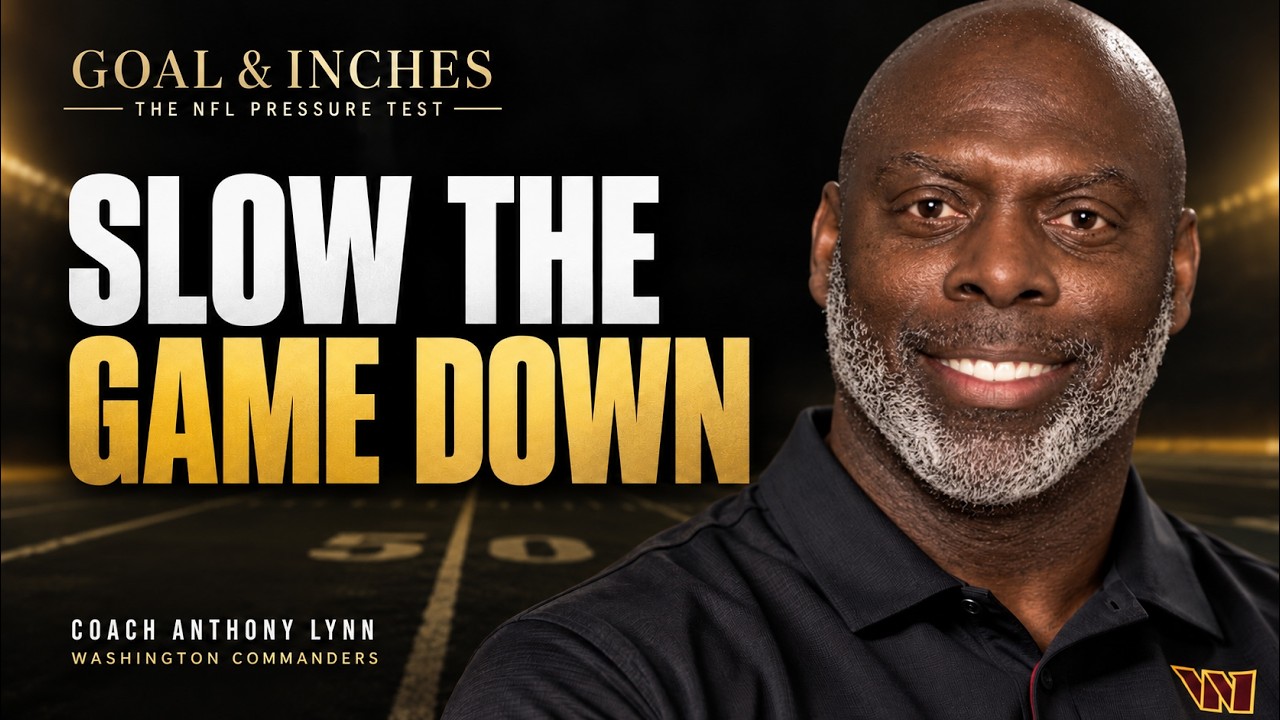
He joined Goal & Inches the day before Washington’s season opener against the Philadelphia Eagles, his voice worn from a week of coaching over simulated crowd noise. The conversation goes inside the craft: why a coach’s job is to slow the game down, why ball security comes before everything for a running back, how his view of practice moved from chasing perfect reps to deliberately letting players fail, and the Denver janitor who changed the standard he set for himself.
For anyone who leads a team, it’s a lesson in preparation, honest feedback and developing the person as well as the player.
Key Moments
3:44 – What Denver’s championship culture taught the coach
6:55 – Inside an 18-hour NFL coaching day, Monday to Saturday
10:11 – “The ball is life”: what earns a running back his coaches’ trust
13:02 – Why a run game that looks good on the whiteboard can fail on Sunday
14:01 – Staying out of one-dimensional football, and what the Eagles did to Kansas City
18:04 – From perfect practice to deliberate failure: how his coaching evolved
21:42 – The Denver janitor who changed his standard
24:12 – “How do I slow the game down?”: his coaching philosophy
25:27 – Measuring everything that can be measured
29:10 – “What’s your problem?”: honest feedback once trust is built
What This Conversation Teaches About Pressure
Slow the game down. Lynn sees his core job as helping players see clearly when everything speeds up. Harder, faster practice makes game day feel slower, and that is when players make the plays you can’t coach.
Make practice harder than the game. He moved away from chasing perfect practice. Putting players in situations where they can fail teaches faster, and the mistakes happen on Wednesday rather than Sunday.
Earn the right to be blunt. “What’s your problem?” only works once a relationship exists. Honest feedback lands when people know it comes from a good place.
Standards belong to the whole building. In Denver, Mike Shanahan shared the team’s philosophy with everyone, from players to cooks and cleaners. One janitor’s care on a hard day lifted Lynn’s own practice.
Develop the person, not just the player. In Lynn’s experience, every player he has helped on a personal level became a better player on the field.
Read the full transcript
As a coach, I've always felt like my job is to how do I slow the game down for my players. That is basically my philosophy. In the NFL, you can't slow down the opposition. Everyone is an elite athlete. But you can prepare your players to see more clearly, make better decisions, and use their abilities when everything speeds up. That's the challenge at the heart of Anthony Lynn's coaching. Lynn brings the experience to more than 500 NFL games across his playing and coaching career, including two Super Bowl championships as a player. Having been head coach of the Los Angeles Chargers, he now serves as the Washington Commanders run game coordinator and running backs coach. He joined me the day before Washington's season opener against the Eagles with a voice worn down by a week of coaching over simulated crowd noise.
In this conversation, we explore how he prepares players to perform under pressure, why his approach to practice has evolved, and why developing the person is central to developing the player. For anyone responsible for leading a team, these lessons reach well beyond football. I'm Andrew Johnson. Welcome to Goal & Inches, the NFL pressure test with Coach Anthony Lynn. Anthony Lynn, thank you for joining Goal & Inches. Well, thanks for having me, man. So, you're in Sydney, huh? I am, but I've only just come back. I spent the whole week in Melbourne to see the first game on Australian soil. A big week that you know that well that might have been the first regular season game. Yeah, because I played over there and 97 98 we played in Sydney. Really?
Yeah, we Denver Broncos played the Miami Dolphins. And so do you recall was that an exhibition game or was it part of the regular season? It was No, it wasn't regular season. It was pre what we call preseason. You know, we'll play four games before we play regular season just for practice and so we was over there for a whole week and that was my first time going to Sydney. That's why I fell in love with the place, man. I liked it a lot. Have you been back since on holiday at all? No, I haven't. You know, it's a long that's a long flight, but I do plan on coming back. And how did you cope with the travel back then? You know, we was there for a whole week, so we came over for a whole week and, you know, by the time we played, there was no problem with the altitude or anything like that. You know, we actually made it just fine. Are you happy to jump straight in?
Yeah, absolutely. Absolutely. Now, my I don't have much of a voice because I've been talking loud all week in practice, you know, and we have all this crowd noise because we're playing on the road and it's going to be loud as hell tomorrow. And so, we have to talk all week over loud music. And so, I'm just now getting my voice back. I can't imagine. It must be such an exciting time of the year. Divisional week one doesn't get any better than this. No, it's this it's yeah, it's going to be exciting. Coach, before we get into the I guess the craft of coaching, I want to go back and acknowledge the full journey. You came into the league undrafted, built a six-year playing career as a running back with the Broncos and 49ers, two Super Bowl rings with the Broncos, and after the playing career, your coaching career is now entering its 27th season.
When you look back, what did the player version of Anthony Lynn learn about the NFL that still shapes the coach today? You know, when you've been in these players shoes, in that locker room, a part of a special culture like what we had in Denver, you know, in a six-year period, we won more games than any team in NFL history, including two world championships. You know, you do have a little bit of an insight on what it takes to win and what you have to do to be successful in this league because it's extremely competitive. You know, 1,600 draft eligible young men are available every year and only 1.6% of that make it to the NFL. And so, it's a very elite group, you know, because of that. But also, you know, the guys that have gone on that journey, you know, I think it's very important for us to give back and to help these young men in their journey.
As a player, you had to build your career without anything being guaranteed. How did that shape the way you later coached players who were fighting for roles and a future in the league? You know, just in encouraging them, giving them advice on you know, on what to do, how to train, you know, a lot of kids come to this league and they're coming out of college and they don't know how to study. You know, they're not quite a professional yet. And so, you know, you have to first of all lead by example, but then you can teach them, you know, some things that's going to help them be more professional and stick around in this league for a while because it is so competitive. When you moved from playing into coaching, what was the first thing you realized about the job that most players do not fully see while they're still playing?
The hours that coaches work. You know, when I was playing, especially actually it was seven years, but when right around my fourth year, you know, I knew the end was coming because I had a bad knee injury and I did something that I've always wanted to do. I started my construction company. I grew up as a kid working in construction and so I've always had that creative mindset of certain type of homes I like to build and so I was doing that while I was playing but just knowing that every year here comes the newcomer the newcomer you know you have to figure out a way to stay and stick around and a lot of that is you know what you bring to the team outside of just your skill you know, it's your character, it's your leadership and those type those are the things that kept me in the league at least two more years. You know, just I was like I became like a coach on the field and that is why when I retired, Mike Shanahan, my coach, offered me a coaching job. And so I retired and two weeks later I was coaching, you know, and so you know it was really unique having that perspective of being in the locker room and then going to the coaching side and just telling these young men you know you know just sharing my experience with them. That's all.
Outside the league, it's not uncommon for people to think that coaching is mostly play design and some game day decisions. Inside an NFL building though, what's the job really about from Monday to Saturday? You know, I tell you this, okay? Monday, you come in there and you and it's a long day. It's 18 hour day. You know, you evaluating the tape, your players are in the building, and then you get into game planning that afternoon. Tuesday is all day. Wednesday is the same. I'm say all day, I'm talking like 6:00 a.m. to 10:00 p.m. sometimes later. Okay. Thursday, you know, if you're lucky, you get out of there by 7:00, 7:30 and that's early. Fridays, most coaches try to get guys home to spend time with their family and their kids. You get a chance to pick your child up from school. You may be out of the office by 2:00, 3:00 on a Friday. And then, you know, Saturday, you're either traveling on the road or you're in meetings all day. You know, you get a little break in the middle of the day, but you don't want to give the players too much time off the day before a game. So, you have meetings, occupy that time. Morning, mid midday, and then at night and then you play the game on Sunday and then you do it all over again on Monday, you know. And this goes on for like seven months, you know, and if you make it to the, you know, to the championship game, maybe a little longer, but this goes this every day, you know, and so you don't really don't get a day off, you know.
So, what does sleep patterns look like during those times? Well, you know, I've learned to function off of four hours of sleep, which is not the healthiest thing in the world to do. You know, we have so many resources and we bring in all these people to talk to us about our health and this and that. And they always and every time the sleep doctor comes in and gives her spiel or his spiel, I just laugh because we sit there and we take it all in and then we go right back to work in 20 hours a day. And you mentioned you don't want to give the players too much free time before game day. What does that mean and what does that look like and how do you ensure they don't play the game before it arrives?
Well, you know, we'll have them in that morning and we do give them like a three-hour midday break to go home and be with the families and everything and then we have to come back and we all stay in a hotel. We all stay in a hotel together whether it's home or whether it's away. We stay in a hotel. We have meetings and then we just have time together. You know, it's I spend more time with my players than I do my kids. And so you start building those relationships as you should and guys become like family and so you enjoy spending that time together with them and they look forward to it. When a young player enters your room, what are the first signs that they are starting to understand what it means to become a professional?
You know, about the questions that they ask. You know, you ask good questions, you usually get good answers. And so when players start asking the right questions, then I then I start thinking, okay, he's starting to get it. So that's the mindset aspect. So I guess when a running back comes out of college, they're often talked about in terms of their production, their physical traits, but what tells you that a player is ready to be trusted with the complete demands of that position, you know, is how he handles and take care of the football at this position. The ball is life. And we always say the ball is life. And if you lose it, I mean, you're dealing with a lot of people jobs and careers, you know, and we're trusting you to put the ball in your hands. And we're probably going to touch it more than anybody on the team other than the quarterback.
Quarterback touches it every single play, but running back is probably second. And so, you have to be able to secure the ball first. And some guys can excellent runners, but they just can't secure it. And so, it doesn't work out. You may bring them in because they're so talented and you try to develop them and get them to do it, but at the end of the day, if they don't get it done, they're out. And so that's the first thing. And then once you get that skill down, then it's just your movement skills. You know, you guys are so big, strong, and fast that it's not like college or high school. You're going to get hit, but you got to make sure that you don't get hit a lot because if you get hit a lot, you're going to have a short career. So now I'm teaching you six to seven movement skills, you know, and well, I say I should say fundamentals, six to seven movement fundamentals and so that you can use them at the right time. For me, I want to teach you the fundamentals, but then you using the fundamentals at the right time. That's the skill part. You know, if I ever say that's a skillful runner, then that guy knows how to make miss. You know, when to stiff-arm, when to spin, when to side step, when to highman, you know, all those fundamentals that we train on, train and work. When I start seeing that, then I start seeing skillful runner that can take care of the football. Now, I know I have myself in the NFL running back.
So, that's the ones that come through and succeed. When you mentioned that some aren't able to secure the football, why is that? Is that technique? Is it mindset, combination of both? You know, how do you come? Some players can't make because we teach we teach the techniques from the time they're small. And if you if you don't have it down by the time you're 18, it's probably going to be it's probably going to be hard. It's just, you know, at that at that if you can catch it that early, you change positions. You see a lot of running backs that go over and play in the secondary, you know, in high school, in college. Rarely does that happen in the NFL. It ha it has, but not very often, but you see it a lot in college and high school. You try to change that position as quick as you can.
At the NFL level, what separates a run game that looks good on the whiteboard from one that can actually hold up on a Sunday? That execution, man. You know, it's just you got to drill it, drill it, drill it, and then you got to go do it on Sunday. You got to execute on Sunday. And sometimes Sundays are just too fast for some people. I mean, it is a fast game. And when I'm watching college tape, you know, I can see the speed of certain players in college because it's that big of a gap. But in NFL, everybody's fast. The linemen are fast, the defensive ends, the secondary. So, you know, it's this it's just the speed of the game is is what guys got to get used to. And when guys get used to that, then the everything slows down for them. And that's another thing. Usually, I'm gonna say about the third month, things start to slow down for the rookies or the younger players.
And then you start seeing their real potential. Up until then, you know, it's, you know, it's hard, it's hard to tell who's going to be what. So, you've been a part of so many strong rushing environments in different buildings and different systems. What travels from team to team in a good run game regardless of scheme, you know, and staying on schedule, being efficient, you know, if you can do that, there's nothing you can't do in football. And I really believe that if because if a team can make you one-dimensional, you're probably done. You know, just look at the Super Bowl two years ago with Kansas City and the Philadelphia Eagles, the team we're about to play tomorrow. You know, Philadelphia made them one-dimensional and Kansas City couldn't run the football. And so, if we can stay on schedule, stay efficient, when I say stay on schedule, I mean be efficient, you know, that efficiency that travels.
Run game travels in all weather, you know, on all types of surfaces. So there are some things where the pass game doesn't travel. It gets cold in some cities, you know, and it gets windy in some cities, you know, but you can run, if you can run the football, it doesn't matter what the climate is, what the surface is, when or where, you know, you got a chance. So naturally, the running back's not in isolation and then I guess significant coordination required between the backs, the O line and tight ends, receivers, the QB and play caller. What does alignment look like when all of those parts are working together properly? It's a beautiful thing. You know, you know, the linemen are coming off the ball when the backs are getting to the heels of the lineman. You know, he's able to find his holes. You know, we run this wide zone scheme, which I've run a lot of over my career. But it's just, you know, creating lateral movement and getting people out of the gaps and letting instinctive runners find holes.
You know, I like that you can build a lot of offense off of that, you know, but we also run a downhill power schemes as well, just to change it up. And so, you know, when you have a back that can do all those things in and different type of backs, you know, I have some backs that are that are make miss smaller speed guys or some guys that are power. I like to mix lightning and thunder together and attack a defense that way. And so, when you have when you have those combinations, it you really have to pick and choose how you complement them so that they can wear down a defense. So, what does a running back have to master without the ball before you can fully rely on him? You know, number one, ball security. And then number two, you have to be able to get what's blocked. And that's easier said than done. You know, that starts with your alignment.
That starts with your with your track. That starts with your run reads because things speed up on game day. You know, you can sit in the classroom and your heart rate is just beating real nice and slow and you're looking at film and you can you can make all the right reads, you know, and you can even go out to practice, you can make all the right reads. Then you get in the game and everything is going like this, going really fast and you know, you're going to miss a couple. Quarterbacks miss reads. We all miss reads, but you can't miss too many. You know, you have to be I'm looking for guys that are more consistent in that area as far as getting what's blocked and just starting out with your alignment, you know, your track and then your assignment, then your adjustments.
But, when you can teach your back to do that, then he can learn to win his one-on-ones. Get what's blocked first and then now let's go win the one-on-ones. And that's when I teach you different movement skills to do that. So, just help us understand that jump from college into the NFL. And when you're coaching the hard technical detail, how do you do that without making a player hesitant or slowing down their instincts? Repetition, you know, you just it requires so many reps over and over and over. And for me, you know, I like this deep learning philosophy where when I was a younger coach, I was always I was caught up in perfect practice. You know, I wanted my guys to be perfect in practice, and I never put them probably in situations to fail in practice. Well, I'm completely different now with that.
As I've evolved as a coach, I don't mind failure. You learn from failure. You actually learn faster from failure. And so, I will put my guys in difficult situations where they may make a mistake. And to me, that's how they're going to learn the fastest and get to where I want them to be. So that way, we make all those mistakes in practice. I make it for you harder in practice than in game day. Hopefully, it's easier for you. Because the week is so short, how can you tell then when the coaching has translated into a genuine change in a player's preparation or technique or decision-making? No, you're not going to tell that in a game week. You're going to know that over a five-week training training camp. You know, we'll come in and we'll have we'll have OTAs, offseason training. We train year round. NFL players get paid to practice, you know.
We practice more than any other sport, you know, and then we then we go out and we play 17 games, you know, but we practice constantly. You learn this over the offseason and then you go through a five-week training camp that we just came out of. You get more information going through that and so I pretty much know exactly what I have now going into this game tomorrow. So how do you know when the standards that the coaching staff expect become I guess a part of the player and how they operate day-to-day? When I when I start seeing number one again asking the right questions but when I start seeing the execution on the field you know my job is to is just is to develop you and to get you to execute on the field and I like to say off the field as well and sometimes I think off the field developing you off the field is just as important if not more important than developing you on the field because we do have an obligation as a coach to help these young people reach their full potential on personal level and professional level and every kid that I've helped on a personal level became a better player on the field. So, I think they're both equally important.
Having held a range of NFL coaching positions, what has to happen day-to-day to keep the coaches and players aligned? You know, just communication. You know, we have to make sure that, you know, we're all communicating and connecting and there is a culture that you want to have, you know, and that culture starts with relationships. I just believe that you have to intentionally do that first, you know, get to know your these young men when they come into the building. We spend so much time with them and we have to trust one another. And once we can get to that level, then you know we can start talking about the standard and expectations and just constantly demonstrating that and showing them you know whether it's through film or whether it's bringing in speakers just so many different ways you can keep reminding them of that and you know and then slowly we all you know understand exactly what the standard and expectation is and then we all start coming together and collaborating and those teams usually are the ones in the playoffs at the end of the season.
So, does standards apply equally to everyone? Like obviously you're coaching stars, you're coaching rookies, there's veterans and role players, everyone, you know, I remember when when I played in Denver, my coach Mike Shanahan, he would have a meeting with the whole building, secretaries, cooks, janitors, football players, everyone. And we talked about our football philosophy and what it takes to win and our standard and our expectations and everyone is pulling in the same direction. And so after experiencing that, you know, it's it takes more than a locker room to win a championship. It takes the organ the organization and everybody being on the same page, pulling in the same direction. I can tell you one time I came to work and you know, football's it's a it's a grind and it was late it was late in the year and I was tired and I just said to myself, I'm going out to practice today and I just got to get through practice. It was going to be one of them days where I just made it through practice. And I go into the restroom before I go out to practice and there's a janitor on his knees with a toothbrush cleaning the cracks, you know, in the tile. And the bathrooms always smelled great. They were always clean. And, you know, we're messy as hell, you know, as young men, but they were always kept clean by janitors. And I looked at that man and I said, "Man, this he is being the best version of himself right now, you know, and on his knees and cleaning those cracks."
And so if he can be the best version of himself doing that, how in the hell could I go out on that practice field and not be the best version of myself? A janitor inspired me to go out and I had probably had the best practice I had all year. And so that's just because everyone was on the same page. So you can be inspired, you can be motivated by anybody in the building at any given time. So I'm interested in how you diagnose when things break down. So communication's so critically important against all roles. So when you see the tape and it's clearly a breakdown, how do you diagnose whether it's technique, assignment, communication, effort, timing or scheme? How do you go about allocating where things went wrong? You know, I ask questions, too.
I ask my players, "What were you thinking here?" Because I'm trying to help them, you know, execute and think better. And so, a lot of times, you know, what they're what they're seeing with their eyes, may be different than what I'm seeing, but also have to take into account they're on that field and what's going on that field is happening very fast. And so, as a coach, I always felt like my job is to how do I slow the game down for my players? That is basically my philosophy. What do I do to slow the game down? So, I would put them through exercises that are difficult and very fast so that the game is slower for them because when the game slows down for a player, they make decisions that you just can't coach. You know, they'll make a move, they'll make a catch or throw that you did not practice. You know, that is just them being authentic them. And so, I like, you know, that's just figure out ways and that's a challenge for me too for every single player. It's something different. How do I slow this game down for him? And when I can do that, then I can get better communication. I get better execution and these guys make plays.
So, pressure has a way of revealing habits. What do you look for during the week that tells your player is more likely to hold up when the game gets tight? I don't know if there's any one thing that I look for, you know. I just I just at the end of the week, you know, we we evaluate and we track everything. You know, I look at my list and I look at reps, how many reps you had, you know, how many mistakes you may have had, how many balls you may have caught, how many balls you may have dropped. I mean we measure everything that can be measured we measure because we believe if we can anything that can be measured can be improved and so I look at all that and if I see a pattern in this information then I try to address it with the young men by the end of the week you know if there's a pattern.
So when you think about helping men become professionals, what are you trying to give them beyond football technique? Be what was that question again? What are you trying to give them beyond football technique? So what are some of the other areas that you're trying to help them move from that college game into the professional league? Well, you know, just the hours, you know, I talk to them about the hours that the coaches put in, and I really expect my players to know the playbook as well as I do because it's your business. You know, I tell them all the time, I'm a servant. I'm here to serve you, okay? And I'm here I'm here to be give you honest feedback. Sometimes that feedback you like. Sometimes that feedback you may not like. But I want you to put the time in. And so if I don't see a player putting in enough time, you know, I will have a problem with that. We have to have a sit down. We have to talk. I need to see him studying film. I need to know that he knows how to use all the technology that we have in the building so that he can go in and make his own projects, look at his own film, his cutups, and do things like that to improve himself as a professional.
Are there any other signals that may tell your players got talent but they don't have the full operating rhythm required to last in the league? Is there any trends there that you've seen over the 27 year coaching career that No, there have been a lot of players that have talent that there's probably more players that have talent that are not playing in this league than is to be honest with you. You know, it takes more than talent is what I've learned to play in this league. It takes a certain character, integrity, a certain mindset, a focus, you know, for a young man to come in this league and stick, it is hard. It is really hard. And for a guy to come in and play for a long time and become even like a Hall of Fame player, I mean, they are that's why the Hall of Fame, I mean, they are great, you know, but there are a lot of good players though in this league. You don't have to be all of them are not great, but they're elite in their own way. But it's hard to stick around. And I know I'm babbling here.
I kind of got off got away from your question. What was your question again? No, I was just sometimes they've got talent. Is there any signals that you see that are sort of a pattern to say they haven't reached that operating rhythm where they could likely last in the league? You know, it's the first thing I see is how they're executing. I mean, this there's so many guys that have so much talent and I will go up to a young man after a while, not, you know, wait until we get to know each other because you can't talk to people any kind of way until you have a relationship. Once you have that relationship, then they know that it's coming from a good place, not a bad place, you know. But I've asked players straight up because I'm really straightforward and blunt.
What's your problem? And they'll look at me like, "What do you mean what's my problem?" I'm like, "What is your problem?" You know, you have all these measurables. You're this athletic. You're this talented, you know, and you should be doing this, you should be doing that, but you're not. So, help me help you. What's your problem? And some people will actually sit down and we will have a interesting conversation about it. And then some have no clue. And it's just a total lack of awareness. And if they don't understand what their problem is, then they can't fix it. And so that's when I may have to, you know, step in and tell you what I think it is. But sometimes they still don't get it because if they don't believe you, you know, you know, we're professional athletes. A lot of them have egos and they don't believe they have problems. But, you know, that is one of I've asked that two or three times a year. I go up to a young man and ask him, "What's your problem?" And it's awareness.
You know, the ones that have the awareness of what their problems are, they can fix them. And if they don't know, then they will listen. But then some just won't. And you really can't do anything about that. And that's when you move on. Coach, can we finish with this one? Years after a player has left your room, what would make you feel that your coaching had stayed with him? You know, well, he's probably asked good questions. Before he left that room. And if he's, you know, if he's consistent and what I see on tape, you know, if there's some consistency there, you know, I know he's getting it. And so I have a good feeling about it. I have a good feeling about it. Fantastic. Coach, I really appreciate you taking the time to join us. Week one is not too far away. Very exciting time. Commanders against the Eagles tomorrow. Thanks for joining Goal & Inches. Thanks for having me. Appreciate it.
The moment that stays with me is Coach Lynn's story about the cleaner in Denver. Late in the season, a tired NFL player was ready just to get through practice. Then he saw someone else taking extraordinary care in their work. And it changed the standard he expected of himself. That's a powerful reminder for any leader. Everyone in the organization can influence how others perform. Coach also gives us a clear responsibility as leaders. Know your people. Give them honest feedback. Prepare them for difficult situations and keep developing your own approach as you help develop theirs. Thank you to Coach Lynn for sharing his experience so openly and for making time on the eve of the season opener. If this conversation gave you something to apply with your own team, share it with another leader and subscribe to Goal & Inches. I'm Andrew Johnson.
Thanks for joining us. This has been Goal & Inches.
More Pressure Tests
Episodes