
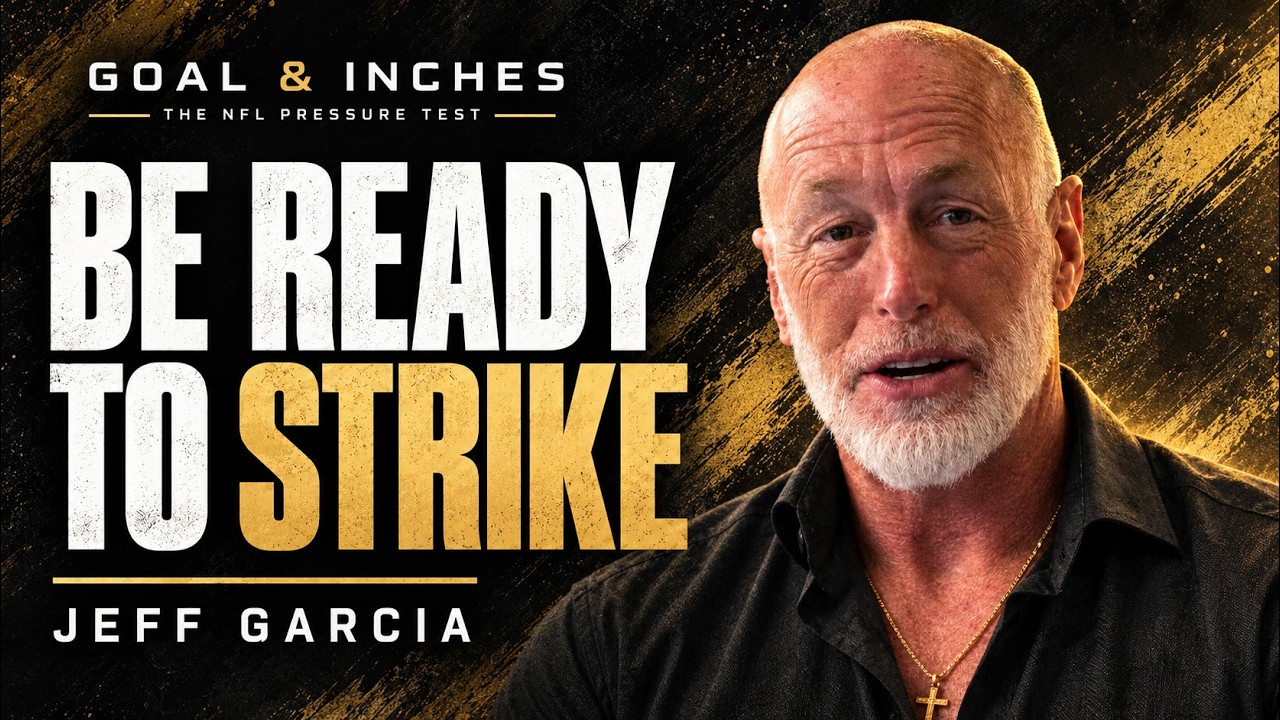
When an opening presents itself, you better be ready to strike prior to that opening even happening.
Jeff Garcia’s professional career began with one quarter of a preseason game in Calgary. He made the most of it, and five CFL seasons later the Grey Cup champion and MVP joined the San Francisco 49ers, the team he grew up watching, with Bill Walsh in his corner and Joe Montana and Steve Young as the standard he was measured against.
Across 11 NFL seasons Jeff played 125 regular-season games and six playoff games with the 49ers, Browns, Lions, Eagles and Buccaneers, earning four Pro Bowl selections. He talks about being benched early in San Francisco and coming back to set the franchise’s single-season passing yardage record, why he stopped listening to outside criticism, how a quarterback anticipates an opening before it appears, and why the position needs the authority to change a play at the line.
He also reflects on sharing one football between Jerry Rice and Terrell Owens, backing up Donovan McNabb in Philadelphia, leading Tampa Bay to the NFC South title, and what a career spent proving himself gave him, and cost him, on the way to contentment.
Key Moments
1:33 – One quarter of a Calgary preseason game to earn his place
7:40 – A home, a restaurant, and the NFL door Bill Walsh helped open
15:44 – Handing the Calgary starting job back to Doug Flutie
17:59 – Starting for the 49ers, the team he grew up watching
20:00 – Benched, then nine touchdowns and two interceptions in his last five starts
24:24 – “Don’t drink the poison”: handling outside criticism
30:09 – Anticipation: throwing before a receiver is open
49:54 – One football: managing Jerry Rice and Terrell Owens
53:26 – Backing up Donovan McNabb and staying ready in Philadelphia
1:01:40 – The cost of always proving yourself, and knowing when to stop
What This Conversation Teaches About Pressure
Be ready before the opening appears. Jeff earned his CFL place in a single preseason quarter because years of preparation meant the moment was not too big for him.
Don’t drink the poison. When the 49ers struggled, he stopped reading and watching the commentary and listened only to his teammates and coaches. Removing that noise helped turn a difficult first stint into a Pro Bowl season.
Be yourself, not your predecessor. Following Joe Montana and Steve Young, his turnaround came when he stopped trying to be them and went back to the way he played the position.
Don’t predetermine the decision. With Jerry Rice and Terrell Owens on the field there was pressure to feed the stars, but he let the coverage and the matchup decide where the ball went.
Choose environments that set you up to win. After Cleveland and Detroit, he looked for consistency in coaching, management and ownership, and found it in Philadelphia and Tampa Bay.
Read the full transcript
When an opening presents itself, you better be ready to strike prior to that opening even happening. Otherwise, you're going to miss that opportunity. Jeff Garcia's professional career began with one quarter of a preseason game in Calgary. A chance to prove he belonged. Five CFL seasons and 78 games later, the Grey Cup champion and MVP joined the San Francisco 49ers, the team he had grown up watching. Across 11 NFL seasons, Jeff played 125 regular season games and six playoff games with the 49ers, Browns, Lions, Eagles, and Buccaneers. He earned four Pro Bowl selections, three with the 49ers and one with Tampa Bay. But reaching the NFL brought a different test, following in the footsteps of Joe Montana and Steve Young, responding when early success gave way to setbacks and learning when to back his own decisions. Jeff shares what it took to earn those opportunities, what separates an elite quarterback, and what years of having to prove himself taught him. I'm Andrew Johnson. This is Goal & Inches, the NFL Pressure Test with Jeff Garcia.
Jeff Garcia, thank you for joining Goal & Inches. You got it. Hey, thank you for having me on. It's definitely a pleasure to be talking to the other side of the world. So Jeff, today I'd like to cover the full arc of your career and that started out with earning opportunity in the Canadian Football League. You had one quarter of a Calgary preseason game to show you belonged. Take us back to how you navigated that opportunity and what the pressure was like in your own mind entering the game. That's right. I was a rookie. Green. Green. I was like green as all can be at that point in my professional life. But, being able to be with the Calgary Stampeders, being able to watch a guy like Doug Flutie play the quarterback position, a guy who was highly acclaimed in the Canadian Football League, highly accomplished, had already won Grey Cups, was really the top performer in that league. And me getting to watch him and learn from him in practice every day, I just tried to absorb as much as I could.
And I knew that it was going to be a tight competition for not the backup spot, but really the third string quarterback on that team. We had another veteran backup in the name of Steve Taylor, a guy who had been in the league for six years, I believe, at that point, who had plenty of opportunities on the field to prove that he was capable. And so, he was already set in stone at the backup position to Doug. And so I was competing with another rookie for the third string spot. And it really was going to come down to the one quarter, one preseason game where I was going to have a chance to play. And in that fourth quarter when I stepped onto the field, the game being tied 14-14 at the time, not really knowing the offense like I would down the road when I had more reps and more time to mentally grasp it, but knowing enough of it to get on the field and make the right decisions, make the right plays, and just play in the moment and know that this was an opportunity that I really needed to take advantage of.
I needed to prove that I belonged. I needed to prove that I was worthy of playing at this level. And it was in that quarter that really set myself apart from the other quarterback. I think we were pretty much neck and neck. No really no one guy had really pulled away from the other in practice opportunities and what we showed in practice. But there was a little bit of favoritism toward the other quarterback by our American scout who had scouted all of the collegiate players who brought in the collegiate players to the CFL team to Calgary for that year. He liked the way the other quarterback was playing throughout practice. And it was in that game, in that moment when our offense coordinator, John Hufnagel, really said, "Hey, that Garcia kid did things that I didn't know he had within him." Obviously, they knew what I had coming out of college. They had scouted me and they knew what I was capable of. But to see it in the heat of the battle in that moment where I rose to the occasion really was the difference-maker and it solidified my opportunity to make that team that year which really was a practice squad type situation.
I really didn't get opportunities to play in games that year. I had to watch. I was the number three guy. Sometimes I would suit up. Other times I wouldn't suit up for the game. So, it really was a lot of mental growth and just waiting my time. But fortunately, I made the team. I mean, we could have looked at 1994 as a change in direction for me as a professional quarterback. If I don't make that team, where do I go to from there? Where do I continue to maybe hone my skills and build on who I could potentially be as a quarterback? It may not have been it may not have opened another door may not have been presented. And so for me, making the most of that moment really was a difference-maker in what would be my career for the next my career path for the next 16 17 years. And so how did you handle that pressure knowing all of that was going on in the background of your mind?
You know, at the end of the day, it's football, right? And you go out and you just do what you've been training your body and mind to do for so many years up that up to that point. I mean, I was 24 years old. I had played collegiately for four years. I had played high school ball for four years. I had played Pop Warner at the little league levels for five years. I mean, I had 13 years of football experience going into that game and yeah, not quite to that level of competition, but everything that I had trained for, everything that I had watched and learned and watching my dad as a football coach and how I grew up, just with the knowledge that had been thrown at me and that I was able to retain and then taking that onto the field and being a competitor and wanting to be a leader for my team and wanting to go out there and be a difference maker and then just utilize the talent that I had around me, the receivers, the running backs, hey, the time that I was going to get to make a decision by our offensive line, being able to read a defense, being able to break down a defense and attack it.
All those things that just come into fruition, come together at one time to where I'm able to make the right decisions. I'm able to be accurate with my throws. I'm able to throw on time. I'm able to make the most of my skill set in that moment. And that's what really differentiated me from maybe the other guy that was competing with me is that I rose to the occasion in that moment. And I didn't think that the moment was too big for me. I just felt like I'm preparing myself every single day for this time and for this opportunity. And now it's a matter of just going out and letting it fly, doing what I know how to do. So, just to explore your I guess career mindset a little bit more. By your fifth year in Calgary, you'd bought a home and opened a restaurant. Was that you making peace with the possibility that the NFL might never happen? And how did the door finally open?
It really was. I really believe that if the CFL was my life, my career path, and it is what it is. And you know, I was really at that point in my life, 28 years old, I had bought a home there in Calgary, like you said. I opened up a Mexican food restaurant, bringing a little bit of that flavor north of the border, so to speak. And you know, for me, I was having such a great time in my life. I was surrounded by great teammates. I was in a great community. Calgary is a beautiful city in Canada. Just so much fun to be a part of that whole growth of that organization and of that community and really entrench myself there as one of them and somewhat become Canadian in a sense. And so I just felt like maybe the NFL just wasn't meant to be. But I'm not going to sit here and lower my head or mope about it. I'm going to just optimize that.
The fact that I'm still able to do what I love to do, still somewhat bring the kid out in me and play a game and get paid a little bit of money, enough money to go out and afford to buy a home, to start a restaurant, start a business, to do those things in life. I just felt like that's where I was meant to be. Obviously winning the Grey Cup and the path of Doug Flutie. The year before, Doug had obviously had a tremendous career in the Canadian Football League, but he had doors open for him and he joined the Buffalo Bills the year before and had helped lead them to the playoffs in that 1998 season, my last season in Canada. I think that helped open some eyes up to what I was doing up north. And potentially bring about that opportunity. I had five workouts. I had workouts with the Rams, with Jacksonville, with Miami, with the Oakland Raiders at the time. And my final workout was with the 49ers and Bill Walsh.
And you know, Bill and I had built up a relationship over the years. Bill being a San Jose State graduate like me being a Spartan, but also being the head coach at Stanford University, which I played against, I competed against while I was in college. That was the rivalry game for San Jose State. We'd go up to Stanford and try to do our best against the Pac-10 school at the time. And you know and there was one game in my senior year where I was a difference-maker on the field and Bill Walsh recognized that and he mentioned to the media after that game that Garcia kid he did some Joe Montana-like things on the field today. And you know, from that point forward, I just reached out to Bill and I asked Bill, "Hey, you're a well-respected coach and football leader in the NFL community in the world of football. And if there's anything that you can do to help get my foot in the door to help open up that opportunity for me, I would appreciate it." and he was very gracious in reaching out to some of the coaches that had coached under him at and with the 49ers like coach Holmgren who at the time was the coach head coach of the Green Bay Packers.
You know, there were multiple coaches in the league that had been under Bill Walsh and were and very respectful of what Bill Walsh had done as a coach. And so for me to have him in my corner and trying to help me get into that level at the NFL level was very meaningful. Now it didn't happen right away. It didn't happen after college. I had to go earn my stripes in Canada. But that was something where every year I would just keep in touch with Coach Bill and said just let him know how my season went. And when it did come time for him to be back involved with the NFL, get back involved with the 49ers on a management side, management position. That's when that door really opened. I did have a contract offer by the Dolphins, but that last workout with the 49ers solidified their interest in me. And the fact that Bill Walsh was there and the fact that Steve Young was the quarterback there also to me was just a better fit.
I obviously I grew up in the Bay Area. I grew up a fan of the San Francisco 49ers, fan of Bill Walsh, fan of Joe Montana, Steve Young, all the greats that played there in the 80s and 90s. Being able to watch them firsthand as a child growing up in the Bay Area and really dreaming and emulating guys that played on that field for that team and now Bill Walsh being there and opening that door for me and him believing in me just felt like that was the right place for me to sign. As much as, you know, I appreciated the offer from the Dolphins, they had Dan Marino. And I was not really a Dan Marino style of quarterback. I was more of a Steve Young style of quarterback, which was more fitting in San Francisco. So, it just it seemed like the perfect opportunity for me to be back home, to be in the Bay Area, to be playing for the team that I grew up watching.
Really a dream come true for me. But also to be able to learn from a quarterback like I did in the CFL from Doug Flutie who's one of the greatest to play up there to now learn from one of the greatest to play in the NFL, Steve Young. And I thought that this would be a situation where I'd be able to learn and grow for the next couple years and then he'd retire and then I would take over. Well, I got onto the field a lot sooner than that, but you know, it was just meant to be. So, Bill Walsh, obviously legendary name. From your conversations over the years, was there anything you learned from those that changed the way you understood the quarterback position? I think I would have loved to have had Bill in our quarterback room a little bit more often. That was something that I think he just wanted to allow the coaches to do the coaching. But, you know, there were things that I took from just how he coached Joe Montana.
I think just being able to watch a guy like Joe Montana play the game to see how he observed the game, how he made decisions, how he his footwork corresponded with his decision-making with the ball coming out, his ability to throw receivers open or to anticipate. Those type of things as far as how I learned to play in the West Coast offense, which was Bill Walsh's you know, major contribution to NFL football was the style of offense that he brought to the 49ers and to learn how to play in that type of offense, to learn how the quarterback position can optimize their decisions and their skill set as far as how they see the game, how they operate the game. I think those were the things that I was able to really take from Bill and just the players that he coached while he when he was the coach of the 49ers. You also mentioned Doug Flutie and his stature in the game. He became injured at one point and you succeeded while he was out but then he returned to start the playoffs.
How did you handle being asked to give the job back? It was difficult because I felt like I had earned the right to be the starter and we had gone on such a great run with me as a starter of that team going eight and one in our final nine games with me as a starter and then coming off the bench in our first playoff game because of the struggles that Doug had on the field, still dealing with an elbow that he had surgery on and just the fact that the rust was there from not playing in nine weeks. He just wasn't as sharp and I stepped onto the field and helped win us the game in the second half on that day. But as much as the coaching staff said it was an open competition, I also knew that Doug was the guy that had been the star of that team and of that league for many years. And that would be a tough seat to overcome, so to speak.
And I knew that they had trust and really valued him as a player and what he meant to the team on the field. I think the biggest disappointment was that when we went into the Grey Cup that year and we did make the Grey Cup game and he had a heck of a game in our second playoff game which he started again and actually played like Doug Flutie normally plays. It was in our championship game, Grey Cup, that there were struggles within our team. He had some struggles and I never saw the field and we ended up losing that game. And you know, that I think for me was the biggest disappointment that I didn't get a chance in that game to help lead our team or to see what I could do to see if there was possibly a difference that I could bring to the field. That being said, Doug went on to Toronto the next year. I became the full-time starter in Calgary and eventually I did get my Grey Cup opportunity, my Grey Cup win.
Very nice. So, you find the opportunity with the 49ers if we look back to your first game as a starter. What highlights stick out to you? First of all, just driving up to Candlestick, you know, the old stadium that the 49ers used to play in, Candlestick Park. It was just known for its history and the greatness that had come through that stadium. And for me to be driving up to the stick that day and just seeing it off in the distance and knowing that on that day, here's this kid that grew up in a country town on a farm that was going to recognize his dream come true and play in front of the hometown crowd, play in front of my family, my friends, everybody that grew up watching me in my hometown of Gilroy and who probably never imagined that I would be stepping on the field with that team on that day leading them and leading them to victory. That was a game that I remember playing against the Tennessee Titans.
My first start was a home game. Tennessee would end up going to the Super Bowl that year. So, they had a heck of a football team. But, I went out there and I played like I was capable of playing. Played like I had been playing throughout my CFL career. Went out and threw for I know I threw for over 200 yards. Threw for two touchdown passes, ran in a touchdown, so I, you know, had three TDs total. I was like, man, this is easy. I can just continue to go out there and star like this every weekend. Well, I quickly found out that's a difficult thing to do and that once teams game plan for you and figure out a little bit that you're going to have to overcome a lot more than what I did on that day. But that first game, that first start at home was an epic start for me. Kind of my welcoming into the NFL and it was a great way to start.
So, moving from the CFL to the NFL and having some early success, you find yourself back on the bench. Was anything that sort of stuck that stood out from that first win that you I guess led you were led to believe, but the following games forced you to reconsider? Yeah, you know, I started to just feel the pressure. You know, one loss led to two losses to three, then four. And I started to feel that outside pressure. I was allowing that outside pressure to really have an impact on me because anybody on the outside looking at the 49ers at that time really saw a major difference at one position and it was the quarterback position. They went from Joe Montana to Steve Young, two Hall of Famers, two Super Bowl winners, to now Jeff Garcia playing quarterback. And the team struggling. The team hadn't struggled like that in 20 years. And so, where's the major difference? Well, it must be the quarterback. And granted, that team had hit an age or a process in their maturity where certain positions had gotten too old and we just weren't as competitive as a team as they had been in years prior and it had caught up with them.
But that being said, I looked at it like everybody's looking at me. I'm the major difference. I'm the reason why we're not successful. And so for me, it took getting benched. It took watching from the sideline to see and realize that there are more problems with this team than the just the quarterback position. The other quarterback that stepped in for me didn't have any more success. As a matter of fact, he probably struggled more than I struggled. And that's probably why they gave me the job back. And also during that time, the quarterback coach who took me aside and told me that, "Hey, we're going to give you the ball again, Jeff. You're going to be our starter going in next week, but I want you to do something. I've created this package of clips that I want you to watch." And it shows your success on the field. It shows you making the right decision, making the right throw, being accurate, being on time, showing you that you're capable of being successful in this league.
Now, it's just a matter of your consistency. Now, it's just a matter of stringing it together. And I think being able to watch that, also being able to understand that we have more issues within our team than just the quarterback position helped alleviate some of that burden, some of that pressure I was putting on myself to go out there and play perfect football, which is just not going to happen. You can always strive to be your best, but you're not going to be perfect out there. Mistakes are going to happen. Other guys are paid to make plays. They're going to make plays against you. That being said, those last five starts, I was a completely different player on the field. It didn't mean that we won more games, but our offense was more consistent. We were more productive. We were putting points on the board. My play statistically was completely different. You look at my first five starts, I threw two touchdowns and nine interceptions.
The two touchdowns came in my first start. My last five starts, I threw nine touchdowns, two interceptions. A completely different way of how I approached the game, how I played the game. I played with without that pressure that was like that I was putting on myself and I just went back to my own basics of how I play the position. Hey, read and react. Do the things that you're capable of. Don't try to be Joe Montana. Don't try to be Steve Young. You're not those guys. Be yourself. You're capable of doing great things within yourself. And really that's what led to the next year where I set a record for passing yardage for the 49ers. I had a 30 plus touchdown season. I went to the Pro Bowl. You know, all these things from a season where you may have thought, well, the 49ers better find themselves a new quarterback to all of a sudden showing that I was their quarterback and I would be their quarterback for the next four years.
I'm interested to understand if you consciously had to do something to block out that external noise. You mentioned two Super Bowl winners previously and I guess when you look at Steve Young still holds a Super Bowl record to this day with six touchdown passes in a Super Bowl. From the mental side is there how did you identify what you genuinely needed to own and what just needed to be blocked out? Well, I think there's always a sense in professional sports the words that are thrown out there, don't drink the poison. And by saying that meaning you're going to have critics from all angles, from all different perspectives. Doesn't mean that they can do what you do. Doesn't mean that they have the ability, but they're going to give their responses. They're going to give their remarks. They're going to they're going to look at your position. They're going to evaluate it. You don't have to listen to it. You don't have to sit there and drink in what that poison is, so to speak.
And so for me, it was just more about, hey, I'm going to turn my back on. I'm not going to read the newspaper. I'm not going to watch ESPN. I'm not going to listen to anybody outside of this building, this facility. My teammates, my coaches, those are the only people that matter to me and that's who I'm going to listen to. I'm not going to pay attention to all the outside noise and I'm just going to allow myself to alleviate that sort of pressure. And that's what I did. And I just felt like that's where my focus was. That's what I needed to do in order to not be distracted or not feel burdened like I was the problem. And really, you know, try more to be the answer to the problem and change the direction of where I was headed. And I think that I was able to do that in that season just in the two separate starting stints for me. I was able to prove that I did have the ability to play this game at this level.
Believe me, there were moments in those first five starts where I started to doubt myself, started to think that maybe I just didn't belong in the NFL. Obviously, when you come from the CFL to the NFL, if anybody understands the Canadian Football League game, the field is wider, the field is longer, there's more space, so your windows are a little bit bigger. Things happen a little bit faster in the NFL. You got to be that much faster on your response. Be that much more deliberate in your reaction. And so learning that on the fly basically in the heat of the fire because Steve Young had gone down in the third or fourth game of that season and I was the guy thrust into the position. I had to learn through the pain and grow from it and I did. Across your career, is there one moment that I guess carried the greatest amount of pressure for you personally? And if so, can you take us inside that moment and how it played out?
Yeah, I don't know if there was one moment that felt like I had any more pressure than others outside of when you get into the playoffs. I mean, the playoffs, you know, it's a one game at a time, one and done potentially. So there's obviously a lot more. There's a ton of importance that's put on your performance in that type of situation. You can't afford to have an off day or a bad day. So, I think when you talk about pressure, that's when things become that much more pressurized, so to speak. And being able to perform in that sort of moment in a playoff game that's going to be a difference maker for your team that's going to help lead your team to a victory. You know, I had some wins, I had some losses, and you know, that's what this game's all about. Unfortunately, I never made it to a Super Bowl, but you know, there were times when I was close and times when I was just a play or two away, and you think about, could I have made that play or could I have done something a little bit different that would have created a different outcome?
And I think that's what competitors do. You're always gonna you're always going to self-evaluate. I'm gonna always look at myself as what could I have done differently? And not so much, oh well, we weren't just we weren't very good in special teams or we weren't very good on defense that day or we didn't run the football well. No, I'm going to look at a handful of plays that where I could have been the difference-maker or where I could have been better. Could that have been the difference in the game? And that's just the self improvement that I was always looking to attain as far as moving forward and trying to be the best that I could be for my team and really just not really taking a look at my life or my responsibility as being pressure-filled but more so being in the moment of greatness and in the moment of fulfilling a dream and in the moment of just going out there and just giving my best and whatever that would bring out in the rest of the team, hopefully it would be enough to win a football game.
And you know, that was really my approach to my daily life and to every game that I played in. So, take us into the I guess the huddle and as the quarterback, you've talked about releasing the ball before a receiver is visibly open as the play develops. What tells you that you're anticipating an opportunity rather than simply hoping everyone executes on their assignments? Well, I think, you know, you have to trust first and foremost in everybody that's around you that they're going to handle their job, that they're going to do what they're coached up to do what they're capable of doing. I can't do their job for them. That's that's their responsibility. My responsibility is to give them an opportunity to make a play and to make a good decision. And so for me, it starts from before the snap, the recognition of where the defense is lining up, where their potential threats are of pressure, what the potential coverage could be based upon a pre-snap look, where the safeties are located.
There's a lot that goes into just processing information quickly and at that moment before the ball is even snapped. Now when the ball is snapped, you have movement taking place. You have the area of where you intend to attack on the field and whether that is going to be the area you stick to within those first probably three steps of your drop. And if it's not, now it's moving on to number two and who number two could be in that situation and then number three. And so those sort of things are what we call process of information and how I'm processing that information through those 3 seconds is going to be valuable as to my final decision. And being able to anticipate, being able to throw to a spot or in a direction that's going to give my player a chance to make a play, not the other team's player. And so, you know, there's there's so much, especially the quarterback position. I talk about this all the time.
I talk about how this position at the highest of levels is often coached by guys who have never played the position. And I don't see how you can have someone coach up that position who hasn't done it themselves because there's so much that goes into the quarterback position before the ball is ever snapped into his hands. There's a process of elimination that is taking place. There's a process of formulation as to where the defense is lining up and how my play is going to attack that type of defense and whether I have weaknesses that I better protect by changing the play or eliminate prior to the ball even being snapped. And so to be able to do that and to see guys do that at the highest of levels, take for instance Brock Purdy, who I feel is a prime example of playing the position the way the position should be played and being coached in a way that shows how he sees the game, how his footwork corresponds with his delivery with his eyes, how he anticipates openings based upon what he sees and movement of defensive position.
Conditions, defensive personnel, and how he creates when things break down around him and how he's able to be successful still, whether it's within the pocket or outside of the pocket. So I'm interested in your decision making framework whether it's conscious or instinctive but when you're talking about a game of inches and so many things can go wrong by just that margin of inches when a decision produces a bad result how do you determine whether to change your judgment or back yourself to make the same decision again? Well I think it's first of all short-term memory. You can't dwell on the mistake that you just made but you have to learn from it. You have to grow from it and hopefully put yourself in a position to where you're not going to repeat that same mistake. I think playing the game is very instinctive in so many ways. I think you put so many hours of preparation into practice, into film work, into all the things that are preparing you for that moment to just then go out, read and react.
You cannot afford to think while you're in that moment because if you think, you're going to be behind the eightball. You're going to be late on the decision. You're going to be turning what could have been a positive into a negative. And so by saying that all of that preparation work from your practice time to your film study time to your time at home of studying your game plan, all the things that go into what you have to do on Sunday is preparing you to where you get into that moment and it's just a feel. It's a vibe. You don't even think about it. You're just in that zone because you've been so prepared mentally and physically to operate in that situation that now you're just reacting and you're you're playing the game at a level where you just can't be denied. And you know, I've felt that at times on the field and you know, I've felt that many of times. I think in order to have the experience and to have the statistics and to have the career that I had, it shows that my preparation going into game day was at the highest of levels and preparing me for moments to be successful and to take advantage of.
And that's what you need to be able to do at the quarterback position. When an opening presents itself, you better be ready to strike prior to that opening even happening. Otherwise, you're going to miss that opportunity. So, you've shared before that in Cleveland, you couldn't change the line of scrimmage. So, in finding those opportunities, what responsibility does a quarterback have when he can see the play that's been called is unlikely to work? I that was a rare situation and honestly very much a struggle to be successful in a system that operates that way. And I feel like as a quarterback, you are an extension of your coaching staff on the field. You're an extension of the play caller. And whether he's given you the reins and the ability to make changes at the line of scrimmage or to make adjustments at the line of scrimmage or not, I think obviously depends on the confidence that coach has, not just in the quarterback, but in his system first and foremost.
Are there outlets? Do we have options built in if we see certain things that a defense presents to us that just are not going to be good for us initially? Can we either change the protection? Can we get out of the play or do we have adjustments once the ball is snapped? And the best coaches in football present opportunities like that. And the best quarterbacks playing the game understand what their keys are to the success. And it's not just always sticking with the play that's called because defenses prepare to stop teams and study offenses and know the basics of what a team what an offense is trying to present. And so they're doing their best to stop you from doing that. And so there's got to be a counter action to that. It is much like a chess match as far as how the pieces unfold on the table. And that's what a quarterback is capable of doing at the line of scrimmage, of taking a play, preventing the potential disaster of that play based upon whether you're limited in protection to a side and they're attacking that side or you have options based upon reactions, say a hot route that happens or a side adjustment by a receiver so to speak.
So, you know, those sort of things and not being able to have those sort of things in Cleveland just really limited us as a team and as an offense that given that careers in the NFL can be really short and times with multiple franchises. If the QB is an extension of the coaches, what did you have to demonstrate before a coach was willing to give you greater authority and what do you owe him in return? And how do you build that dynamic? Yeah, I think I mean so much of it is trust. First of all, being able to speak the language like he speaks it. Understanding the terminology, the offensive scheme to a point of where you can get up on a board and diagram and talk a progression versus multiple different defenses just as a coach would be able to do. So, I think earning that trust and then demonstrating it, obviously with the physical ability to go out on the field and make it happen.
If you can't physically go out there and do it, then you're not going to be given the opportunity in a game-like situation to be able to do that. And I think so you're constantly trying to earn that trust and that growth in the relationship, being able to be on the same page, understand what a coach is thinking in certain situations and be either there with him or having a reason as to why you think something else would be better in that type of situation. And I think that's where the great quarterbacks like a guy like Peyton Manning or Tom Brady or the greats in the NFL got to those levels where as much as they had trust from their coach in them and they trusted in their coach, they also had the ability and the support from their staff, from their coaching staff to make certain decisions on the field in the heat of the moment that they thought would benefit the team and would put themselves in a better situation to be successful.
I think just through constant hours of preparation, through showing that ability on the practice field when you're just going up against your own defense, with your own players, those type of things are so important in order to gain that trust and belief that you can go out there and lead this team to not just have a chance to win, but to win. To have a chance to win every single weekend to be able to be that leader that team other teams fear. I'll tell you this right now, there were quarterbacks on the other side of the field that I knew when I was going up against them that there's no reason why this team should beat us just because of what I felt they lacked at the quarterback position. Can we delve into that a little bit more? You mentioned Manning and Brady. From your long vantage point inside the game, what separates an elite quarterback from a very good one that fans might struggle to see?
We talk about reps, we talk about the process, but what's that innate areas that fans might not be so aware of? Yeah, I think so many quarterbacks obviously at this level have the physical characteristics and ability, but it's the guys who mentally understand and grasp the game that are able to be ahead of the game. They used to talk about Joe Montana when he stepped up to the line of scrimmage. He already knew what defense he was going to see before the ball was even snapped. And there are keys that help you in understanding that. And I think over the years, defenses have obviously gotten better at disguising their looks and showing certain looks and going to other looks. So, it's become more difficult. But that being said, you still study the film. You still study the game plan. You still understand what you're about to face on that weekend. And the guys that separate themselves are the ones that are able to be pristine in their decision making as well as their accuracy in the heat of the moment with pressure on them with all sorts of things going on around them, but yet they're unfazed by it.
They see through that. The guys that see the pressure, the guys that are focused on those sort of things are more often than not going to be unsuccessful. And so the guys that separate themselves from the rest are the guys that just are able to go out there, able to lead their team to more positives than negatives, to make the right decisions at critical times, to make the big play when the play presents itself. You don't just go out there and throw 70 yard touchdown passes, but when those opportunities present themselves, you have to be ready to strike and you have to be ready to be accurate and on target. And that's what separates the guys who are from who are successful and those who are not. And it's a fine line when you get to this NFL level. It's a very fine line. But let me say this about the development of the quarterback position. I don't believe even though the passing game has developed at the high school levels and the collegiate level, quarterbacks are not being prepared mentally the way they were 20, 30, 40, 50 years ago.
I think quarterbacks in those days prepared to play the game differently than quarterbacks today. And because of the spread offense, because of the mentality to spread a defense out, coaches are trying to manipulate the decision-making process of the quarterback and trying to simplify the game for them. In doing so, I believe they've taken a lot of the understanding of what the quarterback needs to be doing and seeing and watching and preparing for to go into a game in order to be the best that he can be. There are still some quarterbacks out there that are being prepared in that way, but I think there are a lot that aren't. And do you put that down to anything in particular? I just think that it's become more of a science and more of a mentality of a coach to create this system that is leak-proof so to speak and how he wants to control that position on the field. And I think at the end of the day that's just impossible to do for an entire game.
I think there are times and moments where you can do that, but there are going to be times where you have to rely on your quarterback to be instinctive, to be decisive, to be able to read and react, to understand what's happening against him, and to be able to protect the team with his decisions. I just also believe that there are certain things that have developed in the game like the short passing game, the screen passes, the quick throws to the sideline, the use of the entire width of the field along with the length of the field, I think is something that coaches and teams utilize a lot more today than they did 20, 30 years and beyond. The screen game has become a much bigger part of the game, which simplifies a quarterback's decision-making process. From the outside, it feels like the film work is really intense for the opposition that's coming up. And you don't really get the chance to look too much more broadly.
You mentioned the benefit of, playing on teams with Steve Young and Flutie. Were there any quarterbacks you played against that you either borrowed from or you had the chance to look at and helped you reconsider your own game? I think if there's one guy that I played against that I had a lot of fun playing against and we battled. I mean he won some I won some obviously I didn't face him. I faced his team's defense but Drew Brees I mean here was a guy that had similar build to me. Wasn't a big guy, wasn't a huge strong arm, but just mentally just understood the game so well and just was such a great leader for his team on the field. And obviously it shows in what he accomplished. I mean, obviously getting into the Hall of Fame this past year, but just all of the things that he has represented as a player, as a person, as a pro. How he studied the game, how he played the game, how he manipulated defenses to do things that worked in his favor, how he was just a beast on the field to stop.
And you know, he was a lot of fun to watch on the other side of the field when I was playing against him. It wasn't always fun in the sense of the outcome, but you know, like I said, hey, I had my moments, too. And you know I think we had some great battles against each other, but he was definitely a guy during my time who I saw had similar characteristics and just really maximized his abilities to be great on the field. So when you look across your entire career, how would you describe your own superpowers? What were they? I think just my scrappiness, my ability to bounce back, my ability to create and make something out of what may have been nothing. The ability to break down and read coverages, to be decisive, to throw players open. I think I don't get enough credit for my long ball. I felt like I was very accurate throwing the ball down the field. You know, and I just took what people said I lacked and put that as fuel to my fire.
And I think I played the game that way with a lot of grit, with a lot of just tenacity. I was stubborn. I was battle tested and battle ready. And you know, I played bigger than my size was measured. And I think that really came from heart and the mentality to grasp the game. And I played with a lot of that with a whole ton of that. You know, and it came down to just being courageous and durable and just wanting to do whatever it took to help my team win. What about the unique relationship between the QB and your receivers? I certainly empathize in that receivers run a lot of routes and you only get so many opportunities to make a play. You've described the pressure a receiver feels when opportunities depend on someone else getting them the ball. How do you or how did you distinguish between a team making a legitimate demand from one asking to compromise what was in the team's best interest?
Yeah. Well, I think first of all, you understand the abilities that certain guys bring to the field. I mean, being able to play with Jerry Rice, one of the all-time best to ever play the position leader in all the statistical categories and him being a teammate, you knew there was a responsibility to get him the football. And then obviously having another guy like Terrell Owens who presented a different factor of physicality on the field and what he meant once the ball was in his hands. Well, there's only one football and I have to be the last one to decide where that ball is going to go. And yeah, there was pressure to get the ball to certain individuals, but I think for me it really came down to being observant of what I'm facing and where the best opportunity lied for our team to be successful. I wasn't going to allow a name or an energy to dictate forcing a situation. I think that was the major thing for me as a quarterback was to not get caught up into forcing throws to guys in order for them to have an opportunity to make a play if that opportunity really wasn't there.
And so that being said, you knew that Terrell Owens was going to create space in certain ways and he deserves to get more looks than maybe certain other guys on your team. And I think that's how you decipher. You know, you have to use a combination of things. First of all, where is my decision leading me? Secondly, do I have a matchup opportunity with that one player that is in our favor? Is it a one-on-one situation? Is he in a position where there's not help that can get over there to take away from what I'm looking at? And so, you know, that's those are the things that you calculate in a matter of seconds to really try to come to the final answer that hopefully is the best answer. And you know, hey, I got stuck at times where I'm trying to give a certain player an opportunity to make a play and it backfires. And those are the situations that remind you as to why you cannot predetermine.
I think any quarterback who goes into a play predetermining where he's going to go with the football is setting himself up for failure in a lot of ways because that's just at the end of the day you have multiple great athletes on both sides of the field. Athletes that are capable of making plays whenever the opportunity presents itself. And that's where you have to be the difference-maker as to ruling out what is a good choice and what is not a good choice. In Philadelphia, you mentioned that you'd wanted to push Donovan McNabb while helping him succeed. How did you navigate the tension between you personally wanting to play and wanting the best for him? You know, I thought going to Philadelphia was the best decision at the time because I had been in Cleveland and then I was in Detroit. And you went to went I went through two similar situations with struggling organizations where I really believed as a starting quarterback I could be a difference-maker.
I went to Cleveland thinking we have talent here. I can be a difference-maker on the field. And you realize and you find out through different circumstances that you're fighting an uphill battle. I go to Detroit with a very familiar coaching staff. Steve Mariucci was the head coach. A lot of the offensive staff were coaches that were with me in San Francisco. It's the same offense that I've run for many years, but I break my fibula in the final preseason game. So, I missed the first eight weeks of that season. So that sets us back and doesn't maybe give us the opportunity to be as successful as I hoped we could be. I came out of those two situations very scarred at the game of football, at being in situations where you think you could take them or help take them to another level, but sometimes that's just beyond your reach personally. And so I decided to go to Philadelphia thinking I'm going to a team that was just in the Super Bowl recently that is used to winning that has a great coaching staff that has been together for a number of years.
Yes, they have a Pro Bowl quarterback, but I just want to be part of a winner. I don't want to be I don't want to be in a situation like I was the last two years where we're struggling just to compete, let alone win football games. And so going to Philadelphia and relinquishing the fact that I was not going to have an opportunity to compete to be a starter was difficult because I'm competitive and I want to be out there contributing. And with the quarterback position, it's not like I can go play special teams and run down on a kickoff and make a tackle. They're not going to let me do that. So you almost feel helpless as the backup. But the way that I could be helpful on that team was just through my energy, through how I studied the game plan, how I stepped in the huddle when I did get my reps and just spit out the information with confidence and knowledge and then went about operating the system with confidence and knowledge and being effective in that way.
I used to say when I stepped in the huddle with the what we call the backups or the number twos, I'd say we're not the number twos, we're the 1A's. We're the guys that are a play away from being the starters and we need to approach it like that. And we would be the ones as the twos, we'd be going against the ones defense in practice. And I took tremendous pride in trying to whoop their tail and trying to be successful against them and showing that, hey, we can do this, too. And you're only a play away from being that guy that we're going to depend on being that starter. And when that opportunity presented itself to me with the unfortunate injury of Donovan and being supportive of Donovan, in no way did I ever create a negative energy in that quarterback room or on that field. He and I had a great relationship. I tried to push him in a positive way. I tried to just demonstrate through my own approach as to how I play the game and how I try to master it for myself.
But when he got injured, that was my opportunity to step on a field with a really good football team and prove that I was worthy and prove that I still had it. I was 36 years old. I was what most would call at the end of their career at that point and I felt like I was still finding myself still capable of being a great leader on the field and I think that was something that I showed in Philadelphia and which is why it opened the door for me to become a starter in Tampa the next two years. Jeff, you've linked longevity to having an organization that continues to back you across the teams you joined. What helped you judge whether an organization would bring out the best in you? Yeah, I think I learned some of those lessons when I went to Cleveland. I went to where the money was the best. I went to where the opportunity was the best to be a starter as compared to some of the other opportunities that were being presented to me that year in 2004.
And I saw where I went to an organization that we have to remember that Cleveland just had come back into being an NFL team in 1999. So that was their fifth or sixth year of being back in the league. They were still growing, still developing in ways and hadn't had the consistency at the head coach position, which they continue to fail at and why they struggle year in and year out. But that being said, being in a situation like that in Cleveland, you know, I really hoped when I went on to Detroit and making that decision of going to familiarity and a coaching staff that had been successful with me in San Francisco that we would have that same success. Obviously that year we found out that we would go through struggles and uncertainty and so you know the things that I experienced in those years really helped identify a team that I wanted to be with in Philadelphia because of their coaching staff, because of their GM, their management side of the game, their ownership.
They had so much consistency with their organization and that's why they were able to field a team on a yearly basis that was going to be competitive and potentially be a team that could make it to the end. And you know, and I felt the same way with Tampa, a team that had come off of a Super Bowl win after the 2002 season under Jon Gruden. Gruden had obviously been a great coach in the NFL for a number of years. They had a great nucleus there in Tampa on the defensive side of the ball with their defensive coordinator, Monte Kiffin, having been there for a number of years, playing great defensive football, understanding that the mentality of the offense was really to go out there and just don't screw it up, don't put your team in a bad position. And I felt like I could manage the game in a positive way for that team and be that veteran leader that they needed on the offensive side of the ball.
And we had success. I mean, we had an NFC South division winning team in 2007 and then 2008, we should have been repeating as division champs. We just had an unfortunate finish to that season that nobody expected. And unfortunately, it went the way that it went. But, you know, those two years in Tampa were very competitive. We were competitive every single week, no matter who we played. And, you know, we had the opportunity to be successful and a lot of that to me was looking at the coaching staff and looking at, you know, just the nucleus of players that were in that locker room that gave them a chance to be successful. And that was important. When we consider your superpowers of grit, resilience, tenacity, you've said that contentment was difficult because you were always fighting to prove yourself. What did that drive give you and what did it cost you? Yeah, I think just, you know, saying that I was content or satisfied with certain things in my life was hard for me to accept.
I felt like I was always pushing to prove myself. I was always pushing to overcome the obstacles in life. I was always pushing myself to just fit in so to speak and you know and it accomplished a lot for me in my life especially on my professional career side but it also was costly. I think it was costly in the sense of how I maybe looked at my personal life off the field, how I felt like there was still a need to compete or seek out certain I guess accomplishments or certain I'm just seeking I'm struggling to find the word. But I think the ego stroke was something that I was continuing to try to probably find in my own personal life. And it was something that I think hurt relationships that I was in. It hurt maybe just direction that I was headed with certain things in my life. But I feel like those were all lessons that I also needed to learn in certain ways and I had to grow from and grow up during.
And you know, it's led me to a life now today where I'm able to say I'm content. I'm able to say I'm satisfied. I'm able to look at what I accomplished in my professional career and be thankful and grateful and proud of what I accomplished. I think that, you know, even going into my final years of being 39 and being with the Oakland Raiders and trying to prove my worth there and eventually really throwing in the towel myself and just saying like, I'm tired of trying to prove myself week in and week out. I feel like I've done enough in my life to prove that I'm worthy, but yet I feel like there's those out there that are trying to still put me down in a sense that I'm having to overcome. And at that point in my career at 39, I didn't have the fight in me anymore. I felt like I had gone through so much in my life, accomplished a lot in my life, but I had to have a different mentality throughout that entire time of being able to overcome what others were trying to either take away or not give me.
And so that being said, when I asked to be released from the Oakland Raiders in 2009, it really was the last opportunity for me to have a full season in the NFL. And you know that was hard to accept initially. But I also felt the transition of now starting a family, of having young children at home, of living in a new place, moving to San Diego, of really starting to develop that other aspect of my life. You know, that took precedence over being in a difficult situation or in a situation where I felt like there was going to be a struggle to be happy. And you know, and I think that's with any player who goes through that transition of doing something that they love to do and they've done it for a majority of their life and now all of a sudden they don't have that anymore. And it's kind of like, well, what's next in my life? And not maybe having a certain setup going into that type of situation, you're going to have those struggles.
You're going to have those breakdowns mentally as to what it what is acceptable in my life. And I think that's where I really struggled for those first few years of retirement. As to, you know, looking at my success and my career as being something to be proud of, but more so looking at, well, I still have more to give and how could I contribute that and how could I give that to someone when all I know is playing the game of football. And that was something that I had to really learn from, grow from, mature from, and accept that, hey, there comes a time when certain things come to an end, and it's time to move on and carry on with other aspects of your life. And eventually I got there and really the acceptance of man what a fortunate place I'm in to be healthy to have the career that I had to have young children that I now get to spend time with and be a dad to and you know but I think that as a competitor when we compete in life and we're used to competing on a daily basis for a majority of our life it's hard to just put that fire out.
And I think that was the hardest thing for me is to put that fire out a little bit and maybe engage it in another aspect of my life. So Jeff, one last question. They're the areas that you've needed to unlearn since you stopped playing. What did the game of football teach you that you still rely on today? I mean, I you know, it's hard to not look at the game of football and sports in general, but really the game of football that teaches so many valuable lessons that taught me so many valuable lessons from the standpoint of dedicating myself to something to a bigger element than just myself. You know, really dedicating myself to a team, to my teammates, to that brotherhood, the work ethic, the drive, the commitment that I had in playing the game of football and how that translates just into life and how you can apply it into life, teamwork, adversity, the challenges, losing, you're going to lose, you're going to have to deal with losing.
How do you overcome it? How do you learn from it? How do you grow from it? How do you apply that moving forward to not hopefully have that same outcome as you do take steps down the path of your life, your journey? And you know, and that's why for me like my kids, my children, I thought that it was important for them to have that experience playing sports in general. You know, I have two girls and two boys and certain aspects of football were not available to my daughters. But flag football all of a sudden became that option and my oldest daughter thrived in it. She wanted to play tackle football and I had to really like slow down, pump the brakes for her because I just felt like with her I did worry about injury. With my boys. I didn't have that as much of a concern. And I still wanted them to have that experience though, whether it was through flag or through organized tackle where they have that ability to learn first of all commitment, dedication to something, priority, prioritizing the things that are important in your life and what you've committed to.
Being able to follow through with that commitment and you know and just the competition what that brings out in people and it could bring out something special in individuals and people can thrive off of it and they can utilize that in a way of bettering themselves and being their best self. And so I think that those sort of things that I was able to learn through the game of football taught so many life lessons for me. I think that I'm able to take on situations that may not always look to be promising or positive or headed in the right direction, but I'm allowing I'm I'm able to look at it and not I guess be discouraged by it, so to speak. I still have a way of looking at things where I feel like I can overcome it despite what I'm facing. And I, you know, I think a lot of that just comes from playing the game of football and being around sports and being engaging in that sort of way.
That has really been such a valuable life lesson for me throughout my life. Jeff Garcia, a truly remarkable and inspiring career. Over 120 games, regular season games in the NFL, six in the postseason, championship in the CFL. Really two magnificent careers. Also, just wanted to say thank you for wearing your San Francisco hat that's got the Australian Southern Cross on it for our Australian audience. Thank you so much for joining Goal & Inches. Well, we didn't get to talk about the experience in Melbourne in Australia, but what a amazing experience that was to be out there to be in that stadium watching the game, all of the fans, the Niner fans that all of a sudden became part of Australia and how they supported the team and you know, definitely a place that I look back look forward to going back to for sure. We're certainly keen to see you. Thank you. Thanks so much. Take care. Thank you. Bye. Bye. My thanks to Jeff Garcia.
What struck me was how clearly he connected the decisions made in a few seconds on the field with the choices that shaped his career. Taking an opening, knowing when to change course, and recognizing when he had done enough. If you found something valuable in Jeff's story, share the conversation with someone who would appreciate it. I'm Andrew Johnson. This has been Goal & Inches, the NFL pressure test.