
There’s no secret recipe. It’s just purely based on the repetition and the effort that you put in.
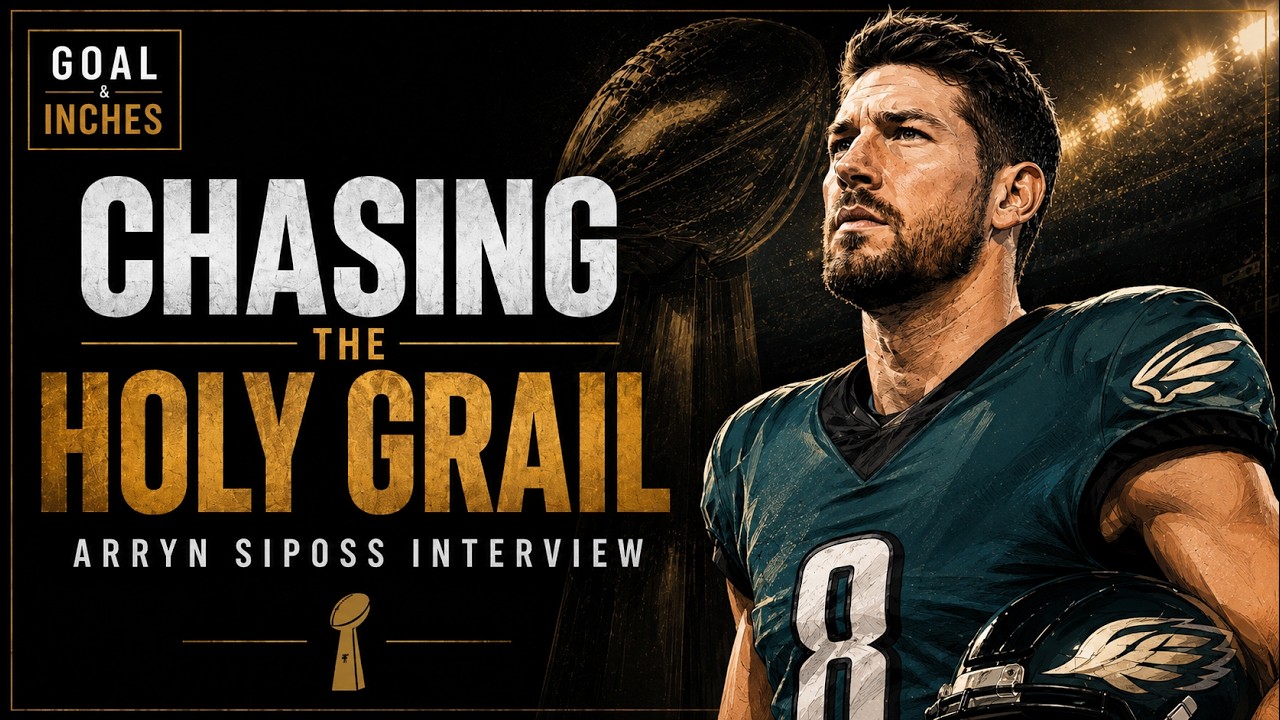
Arryn Siposs’ chase for football’s holy grail started a long way from the Super Bowl. After 28 AFL games with St Kilda, he rebuilt himself as a punter, played two seasons in the SEC at Auburn, went through the uncertainty of being cut and re-signed four times in a season by the Detroit Lions, and earned his place with the Philadelphia Eagles, where he played 32 games and reached Super Bowl LVII.
Arryn goes inside the specialist’s craft: preparing all week for a handful of moments, the coffin-corner punt, the invisible pressure of holding for field goals, and how Australian punters changed the game. He talks candidly about belief at halftime of the Super Bowl, the mental preparation he committed to afterwards, and averaging 50 yards a punt in the rain at New England while knowing the Eagles had already made their decision.
He also shares what he saw in Jordan Mailata’s rise, Howie Roseman’s win-now roster building and the habits of Jalen Hurts and Lane Johnson, and why his real Goal & Inches moment was the decision to back himself and go.
Key Moments
3:06 – The pressure of being an NFL specialist
6:08 – From the AFL to Auburn and the SEC
8:24 – Coffin-corner punting and tiny margins
10:25 – The invisible pressure of holding field goals
13:12 – Cut four times by the Lions, and re-signed each time
19:34 – Super Bowl LVII: belief at halftime
23:00 – Mental preparation after the biggest stage
25:19 – Performing at his best after the Eagles had moved on
What This Conversation Teaches About Pressure
Make every rep count. A punter might get three chances on a Sunday, so Arryn kicked more than 100 balls a week and built mental reps on the sideline to be ready for each one.
Prepare for the job you want. At Auburn he only kicked drop punts in games, but practised spirals and holding in every spare moment because he knew the NFL would demand them.
Stay composed when things break down. When a blocker missed his man, Arryn sidestepped the rusher and turned a likely blocked punt into a five-yard penalty and a re-kick.
Train the mind like the body. After the Super Bowl he committed to mental preparation, and eight months later averaged 50 yards a punt in driving rain at New England.
Control what you can. In a business with “no love in the game”, the only answer is to work on your craft, execute your role and ignore the noise.
Read the full transcript
Every athlete knows the dream, the biggest stage, the biggest pressure. The prize almost no one ever gets to touch. For Arryn Siposs, the chase for football's holy grail started a long way from the Super Bowl. It started in Australian rules football, continued through delisting, private training, two seasons of college football at Auburn University, onto the Detroit Lions, the Philadelphia Eagles, and eventually one of the biggest stages in world sport. But this is not just a story about switching codes. It is about what it costs to chase the highest prize, what small margins teach you, and how elite sport tests you when nothing is guaranteed. Today on Goal & Inches, Arryn Siposs joins me to talk about the highs and the lows of chasing football's holy grail.
Arryn's story is one of the most compelling Australian football journeys of the modern era. He played 28 senior games of AFL with St Kilda kicking 22 goals. He rebuilt himself as an NFL punter. Went through uncertainty with the Detroit Lions. Earned his opportunity with the Philadelphia Eagles where he played 32 games. He had 115 punts totaling over 5,000 yards at an average of 44.5 yards a punt, a longest punt of 68 yards. He registered two solo tackles which you should check out on YouTube. He also reached Super Bowl LVII. But this is not a conversation just about the result. It is about the chase. What does it take to pursue the holy grail of American football when there is no guaranteed pathway, no simple translation from one code to the other, and no margin for error once you arrive. We talk about the specialist pressure of punting, the discipline required to perform in a role where a handful of moments can define how people see you. Also, the influence of Australian athletes on the NFL, the realities of being cut and recalled, life inside the Eagles, Jordan Mailata's rise, Howie Roseman's eye for talent, and what it means to keep holding yourself to a standard even after an organization has made its decision. This is a conversation about reinvention, pressure, recovery, and the highs and lows of chasing the biggest prize in the game.
Arryn Siposs, welcome to Goal & Inches. Thanks for having me. It should be a good one. Excellent. So, let's start with the NFL is known as one of the most ruthlessly accountable performance environments in the world. 17 games, public results, no place to hide. As a specialist who touches the ball maybe just a handful of times during a game, how did you internalize that accountability when your entire contribution can be reduced just to those handful of moments? Yeah, I think you train knowing that's the situation, I guess. It's a very unique situation to be a part of and you know, training every day to make that happen and knowing that's what you need to do and it's a results-based business. That was your sole purpose and your focus. So, you kind of dial in on that a fair bit knowing that you may only get one or two opportunities or you may get six to eight opportunities to be on the field to execute your role. And just zone in on it as best as you possibly can. There's no secret recipe I'd like to say. It's just purely based on the repetition and the effort that you put in knowing that you're going to make those four or five opportunities count per game. And you get that right. Not only from a physical point of view, but from a mental point of view as well. It puts you in good stead going forward. So that's solely what I focused on, just knowing that my role was to get the job done, get the ball down the field, and give the defense every opportunity to be able to play their style and how they want to be and be aggressive. And you zone in on that and focus on that as much as you possibly can.
Excellent. So, just as an example, during game week, how many reps are we talking about? Compare the punting to the gym work for example, like how many reps are you getting? Yeah, look, in terms of team reps, there's not a lot. I would probably get six to eight reps on a Wednesday practice. I would get six to eight reps on a Thursday practice. So, a lot of the stuff that you're doing is on the sideline to build those mental reps. Have your other specialist guys be able to kind of help you just apply a little bit of pressure on you to make sure that you're executing your role and feeling good about things leading into the game. So a lot of the repetition even though you know it sounds like I only get you know 15 16 kicks in a team aspect I'm still kicking 100 balls a week at a bare minimum to make sure I'm right to go and feeling good about myself leading into the game. So, yeah, look, that's the role cuz yeah, I'd have 200 kicks on a Sunday. But I may only have three in a game. So, you know, those things are all they all apply and they all count to something. And, yeah, you'd spend three or four days in the gym as well, working on just more specific things. It's not heavy load base. It's not just trying to put on 150 kilos on the bar and try and squat. It's more of a management load and making sure that your body's feeling really fresh to go out there and again execute it and feel really good about yourself going into Sunday.
Nice. There's this concept if we go back to the beginning when you first enter the NFL. There's this concept of the floor and ceiling is what scouts look forward to assessed on a player's ability. As a punter transitioning from the AFL, which obviously entirely different code, how important was the work you did at Auburn for NFL franchises to evaluate when you had no previous tape? Yeah, look, I was probably extremely fortunate with playing in the SEC. And for those people that don't know what that is, it's the Southeastern Conference in college football, and it's probably the biggest conference in all of college football. You'll find the NFL fans that out there that are college fans as well. It's the Alabama, it's the LSU's, it's Texas A&M. There's some big schools in that conference and a lot of the guys get drafted out of there. So, I was up against some top ranked players leading into my NFL process. Guys like Jaylen Waddle, who's just been traded to the Denver Broncos. I had to punt balls to him and hopefully he wasn't going to be able to return any back. So, that led me, you know, into good stead for my NFL journey.
I only hit drop punts in college football. So, I guess if you look at it, you know, to the ceiling, I had a lot to be able to show that I could kick a regular spiral in the NFL. And so, there was plenty that I was able to show. And when I was able to do that throughout my process, that was a big tick, I think, for most NFL franchises because that was the thing that was going to be hindering me. It's like, oh, can he kick a spiral and can he hold? And for me, I was able to show both of them really, really well and consistently. And that put me in good position to be able to get started in my NFL journey and have the opportunity to sign as an undrafted free agent. So, yeah, I put in the time and effort. So throughout my college situation, as I said, I only did drop punts, but any time that I was on the field by myself or doing extra work, I'd always hit a spiral because I knew that's what I needed to do in the NFL. I had to execute that every time. So team practice, I would hit drop punts. Game day, I would hit drop punts, but pregame I'd hit spiral. Working on the sideline, I'd hit spiral because I knew that's what I needed to do. And that put me in a good position. And I felt really confident going in and showing that I was more than capable because I put in the time and effort to get that done.
So let's just focus for a second on the coffin corner punt. So pinning an opponent inside their own 5 yard line. One of the highest consequences, smallest margin plays in the game. Walk us through the decision-making there and the execution discipline. Yeah, look, obviously you have a shorter field to be able to deal with. So really trying to pin them deep is a very important part of the game. It's something that's evolved obviously I think over the last 10 to 15 years where punters are now starting to pride themselves a little bit more on that and as you could see the Australian influence and being able to pin teams and oppositions has been huge where you've seen the Americans really build upon it well now and being able to execute it at the same time too. So, look, there's a bit that goes into it. Obviously, what the returner is doing, they normally stand at about six or seven yards from the goal line. You want to try and tease them to, you know, put them in two minds like, oh, should I catch it or should I leave it and hopefully it bounces into the end zone where we can restart from the 20. And that's really what I want to be able to do. So, my sole focus is to probably land it at the four or five yard line. Give it enough height as well so my gunners can run down there and make a play. And then if we do that obviously we've given our defense an excellent position to be really aggressive. And the field position is absolutely huge. So there's nothing more nerve-wracking than as a punter going out there and next thing you know you're having to kick from the minus three yard line and you're having to take one step and execute your job. So being able to give them the short field to work with is huge for our defense. And that's a little bit of what goes into it. So, it's always a drop punt for me. I always try and execute with extra bit of height. And I'm always trying to test the returner and giving him two thoughts and like should I catch it or should I leave it and try and play that game. That's what my thought process is.
What about the mostly invisible role, the holder of field goal attempts? What does that dual accountability and it is high pressure teach you about composure and trust that applies well beyond football? Well, it's kind of funny. It's almost more important than the punting role cuz it's three points or a point on the board every single time, isn't it? So, I put a lot of time and effort into my holding. As I mentioned before, I didn't do it in college football. So that was the knock on me again going into my NFL experience. And again, it was something that I worked with and worked on a lot on the sideline because I knew it was another thing that I had to get right and I had to do. Cuz the old school way was the quarterback used to do it or the backup quarterback used to do it where now the punter is doing it because you spend the most time with the kicker. So I knew I had to be all over that and I worked hard on it. It's not an easy role. There's minor details that go into it in terms of placing it on the exact spot that the kicker wants it and expects it to be. The angle of the ball needs to be in the right spot every single time. Catching the ball in the same spot so you don't have the laces so you don't have to turn it around all the time. It's just there perfect for you. All those minor things that go into it play an important role to being able to execute that just to make the kicker's life a lot easier. So, I pride myself on it. If I wasn't having a super day from a punting point of view, I knew I was going to be, you know, elite and really sharp from a holding point of view. So, we could put three points on the board every single time. And I felt like I was able to do that. It's an unrewarded role. But a very important one for us to win games of football.
And if you compare that to punting, what do reps look like during the week for holding? Well, probably the same to be honest. My kickers particularly from an NFL point of view, like to get lots of reps. So pre-training field goals is normally the first thing that gets done before the actual training starts. So we're out there probably 40 minutes, 45 minutes before training actually starts and starting to get our reps. So I'm catching ball after ball. My kicker is hitting 25 30 balls easily at a bare minimum in the leadup to his actual rep work in team and that's the way we go about our business. After that we'll get more reps. So honestly I'm spending as much time holding and executing that role as I am in the punting game.
If we just look at the nature of the NFL machine during one year with the Detroit Lions, you were cut four times and re-signed. Looking back, what did that cycle, the cut, the wait, and the recall do to your internal standards? Look, look, for me, I was very fortunate. Each time that I did get cut, the Detroit Lions were fantastic with their dialogue and communication, you know, saying that we're going to put you back on the roster you know, two or three days later. Every single time that I did get cut, it was more because of what they needed leading into the game. So they would bring in an extra O lineman because they knew there was a really good O lineman in the opposition. They brought in an extra D lineman because they knew there was a really good D-lineman in the opposition. So they had to fill the role in a different way just from a practice point of view. They really liked me. So I guess that's why every time I got cut I was put back on the roster. So they were true to their word. They were excellent in terms of how they went about it. The first time I got cut I was extremely nervous cuz all I heard was that the NFL is a brutal business and you're not sure what you're going to get out of it. So when I first got cut I was like oh are they actually going to do it and things like that. But going forward they were excellent with the process and it was purely just from an opposition point of view that they needed to get somebody in that was a similar size and shape.
For instance, I remember I think we were playing the Texans one week it may have been and you know JJ Watt obviously an absolute superstar. He was a big defensive end guy for the Texans and they needed to bring somebody in with a little bit of similar speed and shape like that. So that's more what it was about. Obviously you know unfortunately that person therefore wouldn't be on the roster when I would get back and then I was put back on the roster on a Friday afternoon and you know traveled with the team during that period. So I still had to make sure that I was doing you know everything that I needed to those four or five days out of the building. I still had to make sure I was doing everything from a weights point of view, still getting a kick by myself cuz I wasn't getting it in practice. I still needed to make sure that I was doing that outside. But just yeah they were excellent about how they handled their business which was you know a lot of guys in the NFL are very unfortunate and probably can't say that.
I'd like to explore the concept of transferable skills. So in business you have one skill in one industry and they can transfer to another. What skills did you take? Look for me it was obviously the drop punt is a huge thing for us. We naturally in the AFL get to do that from the age of four or 5 years old for people that love AFL and being able to transition that over was a huge thing for me. Would the spiral always work for me? No, it definitely didn't. I had days where I just wasn't quite getting the ball to turn over and executing that. So, knowing that I had the drop punt up my sleeve just to execute the role, get the ball down the field, get it into a position where it was easy for our guys to cover was always a good thing to have in, you know, in my kitty, in my kit bag, sorry. So, that was one thing. The next thing was obviously if you got yourself in a little bit of trouble or we had an issue where we weren't quite getting our blocking scheme right. Being able to do a little shimmy or something like that to just get away from a little bit of trouble was also another thing. I remember I had a game against Washington and one of our guys on the edge just forgot to block the guy on the outside and just completely left me all alone and I obviously was going ready to go kick. Balked him a little bit and got ourselves saved from a blocked punt and probably being returned for a touchdown. Ran to the side, got a kick away, which was good, but obviously in the NFL if you have too many guys down the field before you kick, it's a penalty. So I had to redo the kick. We lost five yards. Lucky for me, I was able to get a good spiral away on the next one and we got a fair catch and it was happy days. But, you know, I've avoided a situation that's catastrophic, being blocked and arguably the opposition getting six points, to just losing five yards and we're able to reset. Guys can execute their role and get it done right and we live to fight another day.
So, you made the case earlier that Australian punters changed the landscape over there in the US. But the NFL's often called a copycat league. So, one team copies what's been successful enough for another team. What does the value that the Australian punters are bringing show about how valuable different thinking is coming into an established system? Yeah, the game has changed from just arguably just trying to hit a big ball and get as far down the field to being a little bit more strategic. Just from a special teams point of view, I mean, I think it, you know, NFL offense and defense is always strategic. It's been that way and that's why I think the game is so cool. But from a special teams point of view, I think there's a little bit more into it. And what, as I said, we've been able to bring is different styles of kick. So, not only just the drop punt, but, you know, we've got the banana kick, we've got the checkside kicks, we've got the ball where we can show our hips are going right, and we can kick the ball going left. And those things we've kind of added to the game. I think that it's been a huge thing whereas now you see the Americans really starting to lift their game and over the last four or five years you can tell that they're starting to execute it really well and I think the punting game's become a little bit more interesting. Not to the point obviously where everyone's looking at it, but there's definitely a little bit more to it now and strategic which is excellent to see. I think it's become a bit more of an important role. I think you can see that from a financial point of view that teams are starting to pay their punters because once they've got one and they're able to do their role really well they just want to be able to hold on to them. So from a financial point of view I think you can start to see that as well rather than just like you know nah no it's too much money. We'll just worry about getting the next one. It'll be fine. I think they're starting to value it a little bit more in the NFL, which is exciting.
Excellent. So, you were very fortunate in that you got to chase the holy grail of Super Bowl and you were there in Super Bowl LVII. At halftime, you've shared that you genuinely believed you were going to be the first Australian to win that championship. Take us inside that psychological state and how does that impact composure for the rest of the game? Oh, look, yeah, I mean, we were humming. We were 24-14 up. We kicked a field goal to end the half and there was you know we obviously had great belief in what we had done. Not up until you know that game at halftime, you know throughout the whole year of what we've been able to do. We had a great win against San Francisco two weeks prior. We dominated in the playoffs and there was genuine belief. I think you have to have belief that you're going to be able to go and get the job done and win that. And it was no different going into halftime. Schemes were going well. We're executing on offense really well. Bar one silly play that we're unfortunate with that they returned for a touchdown. We were absolutely flying. So we felt incredible and personally yeah felt incredible. My first punt in the first quarter was a 57-yarder and it felt awesome. Got him in, got him, went left, executed the role outside the numbers. They tried to return it after bouncing a couple of times and my guys were down there and made a play and it was awesome. So I felt incredible into that and you know, I've said it before, I was coming off a big injury and going out there and executing that first one was awesome and it was feeling good. Jake had hit two field goals. We had scored on the extra points on others and we were flying and going into that locker room there was extreme confidence and belief that we were going to get the job done and yeah as I said I felt the exact same way.
And if we go back, you've described the other punt in that game too, so you've described it in terms of height, placement and the returner's read. Goal & Inches is really about the margins where they're tiny, so when the margin is inches and consequence is everything, what actually does break down? Oh, look, I think you know, executions of roles. You know, clearly Kansas City changed a few things in terms of how they were going to play going into the second half. And it was quite evident hence the result of the game in the end. And they changed a few things up. They spread our defense a little bit more. They tightened things up on their defense in a way. And it was probably more about us not executing our roles. And as you said, when it comes down to inches, that's a massive part of the game. If you're on a third and long and you've got their offense in trouble and you're unable to execute by purely just one missed assignment, that can be the game. And we had that on a few times. You know, everyone knows, you know, there's enough people that know about my situation and that as well, which I'm sure we'll build upon. But those things like that can you know is a matter of you know small minor things and minor details where we're not quite able to get it. Whether it's a missed tackle, everything like that, not having the ball in the right area, they can account to being catastrophic in the end and that's the reality of the game.
And I guess what you're alluding to there is the mental side and mental preparation these days has come a long way from just in the last 5 to 10 years. And you obviously participate in that yourself. What shifted in performance when you commit to it? And what does that tell us about how elite environments need to think about the psychological maintenance aspects, not just the physical preparation? Yeah, look, I mean the game's changed, hasn't it, a lot in the way that you prepare yourself mentally, too. And it's well spoken about these days and it's good and I love it. You know, it's a shame that it took me to have something personal happen to me to want to be able to change that and really expose myself to it. You know, if I had my time again, I probably would have done it a little bit earlier just, you know, just to make sure that I'm prepared in all facets of the game. I went into that game in the Super Bowl feeling excellent. I can honestly say that I felt amazing. Was I coming back from injury? Yeah, I was. But I was tuned, ready to go. I was physically ready to go. I'd spoken enough to enough people about how was I going to impact the team and everything like that. From a mental point of view, I was well prepared to go out there and execute my role and felt great about it. So, I, you know, I can't sit here and say, I wish I'd done this better and I wish I did this better leading into the game. I don't have any of those issues. It's just something that happened on the day that I unfortunately can't take back now. But obviously it was very significant in my path going forward and I needed to spend more time on the mental side of things if I wanted to continue in the right direction of being an NFL punter and for those few moments that I had you know in the next year I felt much better about going into it because there was no doubt that I had doubts going into the next season and the next game and I'm glad that I went through that process cuz as I said I can say that I'm proud of myself with the way that I handled that going forward.
So that was 8 months later. You're playing in the rain at New England and you're averaging 50 yards per punt and you've previously described it as one of your proudest moments. Yet the Eagles had already made their decision. So, what does it mean to perform at your best when the organization's privately moved on? And what does that moment teach us about the difference between, I guess, performing for results and performing to standards? Yeah, look, there's no love in the game. It's fair to say there's no love. Second chances are rare and when the team has got their mind made up, I guess there's not much that you can do about it. So, I thought after that first game, with the way I handled myself, I thought maybe I'd be a chance just to kind of continue on and show that I'd made some significant progress. But, obviously with the result that did happen eight months prior, there's things that you can't change. In the end, the Lombardi Trophy is not, you know, in Philadelphia's possession, and I had a part in that, unfortunately. So, that's very, very hard for them to kind of take their mind off. And I guess no matter how well I played, I was going to be in the firing line until somebody else popped up that they really liked. And that happened to be the case. Not much I could do about it. But, as I said, I was proud with the way I handled myself.
I went into that first game. Weather was absolutely shocking. Wind blowing a gale, raining everywhere. I was up against one of the best returners in the game in Marcus Jones. And as you said, I averaged 50 yards on gross and I averaged 46 or 47 on net. And that's probably one of the best games that I've played. And to do that while under some significant pressure of being able to hold my spot, I can say I'm really proud of that. And I went into the next game against Minnesota. I didn't have as long a field to be able to kick the ball. It was more of the pooch punts that we spoke about and the shorter field and naturally my stats are obviously shorter on paper, but I executed my role. I think I had three punts, maybe two of them inside the 20 and yeah, look, obviously the writing was on the wall and they wanted to have a different path and there's not much I can do about it. So, that's a good way to explain it. There's no love in the game. It's all business. Yeah, you know, you really have to execute your role at every single moment, particularly for a specialist. And that's how life goes.
And I guess that sort of environment, you know, it exists week in week out and we talk about accountability inside the NFL, but you previously mentioned that the accountability flows almost entirely to the player, not to the organization. How do players cope with that pressure week in week out through the off season through I guess even with drafts coming up and seeing what new talents being brought into the club might be putting pressure on? Just what's the mindset? How do you navigate that successfully? In a weird way, I think it's just all about what you can control. It may sound silly or really obvious, but it really is just about what you can control. And what I can control is going out every day, practicing hard, working on my craft, and executing my role. And then, you know, that should put you in good stead going forward. And that was my mindset. Like, I'm aware of what the business is. I know what it's like. If you don't do it, you're out the door. But if you succumb to that, then I don't think you can last. It's as simple as that. So, I think when it comes down to it, it's just applying your trade. You know, working as hard as you possibly can on that, keeping it really simple and just executing and worrying about yourself. It's a selfish business in the end. It's a selfish position, a punter spot. And that's solely what I focused on because if I focused on the other thing in the external stuff and oh what if I don't do this, I would have been lucky to play four or five games to be honest. So my contract was designed that way. I was an undrafted free agent. Nothing was guaranteed for me. If I played long enough then I would you know have myself a chance to be able to earn a little bit more money financially and you know maybe have some longevity. But until then, I just had to worry about myself and just execute my role as best as I possibly can. So the outside noise I couldn't, you know, fall for.
And I guess for most of the population, it's really hard to understand that sort of environment. So in business if an exit's handled badly, you know, there's brand damage, cultural trust issues. Not only in your own circumstances, but your observations across the league, are there better ways to handle those exits? And do you see some organizations living different values across the league? Yeah, it's a good question. I'm not really too sure. I just think now it's just the way it is. You know, the sport's obviously brutal. It's for everyone to see and there's not much, there's no other way I think you can go about it. There's no nice way of saying, "Hey mate, you're not part of the team anymore." And I don't think that's just the NFL. I think that's just in general. Anytime you're having to let someone go, it's never a good feeling, but you just kind of have to get it done, don't you? And that's just the way the business works. I can't see any other way to do it. Do some people do it a bit more brutally than others? Maybe they do. But I don't know if there's a nice way of going about it, unfortunately, to say, "Hey, we're moving on from you and there's somebody else here." I just I can't see it.
We've just had the draft, and the undrafted free agent pathway is often one of the most exciting if not underreported mechanisms in the league. But, you know, if you can look at round seven, compared to being able to potentially have a choice of where you go to, that second chance of a starting line for talent that was overlooked or undervalued, you've lived that pathway. What does that teach us about how organizations should think about talent and particularly when it doesn't fit the standard evaluation model? I think the way the undrafted stuff works, I think it's amazing. I'd love if the AFL had something like that to be honest here. I think if you know there's so many kids here from an AFL point of view that miss out on their chance and then they have to go to the VFL to showcase their skills again for another year for just hoping for an opportunity. If they had a system where you could miss out on the draft but then be offered to come and train and do the preseason for 6 months and see if you can get on to a spot, I think that would be amazing. And we're starting to see it a little bit, but I'd love it even more if there was like genuinely three or four spots available for these guys to have an opportunity to make it because the amount of stories in the NFL where a guy has been undrafted and they've gone on to have a great career is incredible. And you know, the punting position is probably the first one that comes to mind because naturally not many of them get drafted. So, you have to make your way through there. So, that's obviously cool to see. But there's plenty of other skill positions where guys haven't been drafted and they've played 10 years and it's amazing to see and I wish that would happen in the AFL because I think it works and no doubt that you can get it wrong. Everybody gets it wrong. There's no doubt. But having the chance to be able to make up for it and giving a kid a shot straight away I think would be really good.
As a development coach at Hawthorn, you've got an experience that almost no AFL coach has. And having seen the NFL's coaching infrastructure and preparation standards, what was the single most transferable thing you brought back from that environment into AFL development? Yeah, look, I spent the last two years at Hawthorn. And then I'm actually back in the NFL system now working at Prokick Australia. But my last two years in the role at Hawthorn and just seeing a different game and purely just from a work rate point of view, not again not saying that nobody works hard in the AFL. There are guys who work really hard and I understand but me and my development role helping young kids achieve a standard and an ability that they're not sure that they can make was huge. And being able to just to kind of make sure that hey there's a standard that you need to get to very quickly and I learned that obviously a little bit in the AFL side of things but it really resonated with me more in the NFL because there's a lot of time that you have by yourself. In the AFL you don't have as much time, you may get seven or eight weeks you know during the October November period but you're at the club a lot of the time otherwise whereas the NFL you'll have training camp four weeks before the season starts, you'll have your season and then you basically don't get seen from January until middle of April. So there's three and a half months right there that you don't see them and then you have a little four-week period and then you got another 8 weeks before training camp again. So you're arguably spending half the year not being in front of coaches. So a lot of your stuff you have to do by yourself and if you're not ready to go by the time you show up, well, you're going to get found out pretty quickly.
And a lot of that alone time and spare time that you had you know you worked hard and so I tried to bring that back and build that with the guys at Hawthorn. As well as just building up their craft and really honing in on craft work cuz as a punter as I mentioned a while ago you only get so many kicks from a team aspect. It's all the stuff that you do on the sideline and when people aren't watching. So trying to build that with the guys, the younger guys that are in their first, second or third year and just getting reps of things and applying themselves to their trade. That's really what I tried to focus on. And I like to think we got a few results out of it which was good. We saw some guys play some excellent football there, which was exciting. And I really enjoyed my two years at Hawthorn and now I'm essentially back just applying the craft in the NFL and things that I've learned from a punting point of view to help the next generation come through.
Fantastic. Jordan Mailata, one of the big stories, one of the best left tackles in the game and you got to see some of that development from the inside of the locker room. Is there anything you can point to where the Eagles were able to help make that transformation possible? He had one of the best coaches on the offensive line in the NFL. He, you know, Jeff Stoutland is an absolute star. He has been at the Eagles for a very long time and has one of the best records in terms of having successful O linemen have great careers in the NFL and Jordan was very fortunate to have him as his coach with no NFL experience as everyone is aware of when he got drafted late in the seventh round and he was this big prodigy and 6'9 140 kilo absolute monster. Why wouldn't you want to give him a shot? But there's a lot of risk with that too. And he had to work very hard at his craft. It was no easy feat. He came in, and even though he looked big, there was muscle there, but he had to learn how to, you know, move properly, get his body right to be in that position. And it took him a good two or three years to be able to get that done. And when I arrived in 2021, that was his first genuine year as the starting left tackle. He played, you know, a few reps there as a backup and things like that, but it was his first year and he was off the charts. He was amazing. It's the most important role I think on the O line cuz if everyone's watched the movie The Blind Side, they'll know that. And he protects the quarterback from the stuff that he doesn't see.
So huge for him. I'm really proud of him. I've become really good friends with him, which is great, too. I was able to celebrate at his wedding a few years back, which was really special. And just watching him develop. I'm still learning the game myself and was learning the game at the time, but just to see kind of him transform and be this absolute monster of a man and working his craft, like you see him after practice and he's just working on his footwork just making sure he has quick feet to get back into the position as quick as he possibly can while pushing guys back. And he's up against stars of the game. Myles Garrett. As I said, JJ Watt, TJ Watt, Micah Parsons, like these are star defensive end guys in the game that he's having to come up against week in week out. And the fact that he's been able to do it so well is a real credit to him.
That was a real front row seat in year one. Apart from that extra training, we looked at the Eagles side of the ball and how they helped him, but was there anything that's sometimes called the intangibles that you observed that had you feeling confident that he was going to continue to make jumps? Yeah, I mean, he applied himself. It's as simple as that. He left nothing in doubt. It wasn't just from a physical point of view. You know, he would always be the guy in the classroom, essentially in the meeting room, just extra detail. That's all it was. And a lot of people forget that there's so many plays in a playbook that you're going to be studying a fair bit and getting that right. And the fact that he was able to do that, learn a completely new sport, there's hundreds of plays that he needs to identify and every time they call it, he has to know the right one. And the fact that he was able to do that by applying his trade in the classroom and in his meeting rooms was awesome. And that's the difference in the end. You know, you can have young guys who can walk out just thinking, I've got it all sorted and they go to practice the next day and they can't remember the play. He left nothing to chance and you know, now the reward is definitely, you know, starting to show.
Most people judge whether an organization's elite by the trophies particularly in sports obviously. And you've been inside the Eagles at one of the strongest periods in their recent history. Before the results came, were there any sort of daily signals that told you this was a different kind of organization and what does elite look like inside of a locker room? Oh, look, for me, I'd be telling a lie if I said I saw the process occur. For me, I got there in 2021 and it was a new head coach. The organization is about, you know, still winning games of football and winning championships. I don't think that's changed for Philadelphia for as long as I can remember. You know, obviously there is transitions and things like that, but I don't think they ever wanted to be in a losing phase. So, new coach came in 2021 when I was there. You know, Jalen Hurts took over as quarterback. I think that was a real steal. And we still had old guys there that were talented. Lane Johnson, Jason Kelce, you know, that won the previous Super Bowl in 2017. Like there was still guys there that were playing great football and could take us back to the promised land. So, I didn't get to see the real kind of transition in the phase of maybe they went through a little bit of struggles to therefore get to where they are. But I would say trades and, you know, drafting really well was pretty darn good.
So, my year that I got there, DeVonta Smith was our first pick who was the Heisman Trophy winner out of Alabama, and we picked him up at pick 10 in the draft, and that was the wide receiver that we needed. We picked up some guys on the O line and the D-line to really help us. And really, we kind of got the ball rolling from there. It was all going to be based on how Jalen played as the proper starter and the number one guy for the organization. And you know my time there we made the wild card. Unfortunately we lost to somebody by the name of Tom Brady. And then the next year I was there we made the Super Bowl. So yeah we recruited really well. We knew the path that he wanted to take and he got us back there pretty quickly.
So, you talked about the importance of the draft and the trades and how Howie's known as one of the sharpest GMs in the league. Is there anything that you can point to that I guess led to the successes and trace that back to the way that he built that roster? Yeah, look, it was about identifying a winning culture and what's going to take us back there and Howie is relentless in that. There's obviously people in higher places than him, you know, that obviously apply the pressure because we want to win, we want to win championships. That's the way it is. Some teams are happy to develop and take three or four years to get right. Other teams are just wanting to win right now and Howie knows that. So we got AJ Brown in a trade. It was a huge trade. I think it was a bit of a shock to everybody because they knew that we needed to win now. We had the culture, we had the coach, we had the experience. We just needed some extra bits on the outside there to really fine-tune it. And that led to obviously AJ Brown signing, which was incredible. As I said, that year we unfortunately did lose, but the winning pieces were there to go all the way. And obviously a couple of years later, they're still in the winning phase, and they go and get Saquon Barkley just to kind of really cap it off. And obviously they win the whole thing and they drafted incredibly well. They got the replacement for Jason Kelce in Cam Jurgens. They got a couple of extra guys on the D-line to help Brandon Graham not have to work as hard and go for as long and they did a really good job from that recruiting point of view and drafting process to get young guys with genuine speed, you know, in Jalen Carter and guys like that. So he did a really good job.
The word elite gets bandied around a lot. What does that word mean to you? And are there a couple of Eagles teammates that you would describe as elite and what separates them and what makes them elite in your eyes? Oh, look, elite obviously for me is not just about executing your role on game day. You can't just rock up there and just expect it to happen. It's what you are doing from the Monday to Friday. And you know the ones that are elite are applying their trade every single day. You know similar as I said about Jordan, it's what you're doing behind the scenes, what are you doing extra in terms of your meeting room to identify small things that need to be done so honestly that the weekend becomes relatively, you know, easier for you knowing that you've put in the work during the week and that's kind of what I see as elite. It took me a little bit of time in my AFL career to identify that, I probably didn't reach that, but knowing the different beast in the NFL, knowing there's only one of 32 guys that can play as a punting role, I really had to hone in on that and I definitely dedicated my time and effort to do that. And not saying that I'm elite by any way, but I had to have that mindset if I wanted to get somewhere.
And guys are able to do that. I mean, I know this is probably easy, but Jalen Hurts is just an absolute beast when it comes to it. He is there at 5:45, six o'clock every morning in the locker room. He's in treatment getting his body right and then he's working with the quarterback coach. He's working with the offensive line and the head coach about what they are installing for the week and then he applies it at training and then he's repeating himself and looking after himself. So obviously that's an obvious one but then another one was Lane Johnson and his longevity. He's the right tackle for the Philadelphia Eagles and he's been in the league for 14 15 years now and his body is in magnificent shape. Like you wouldn't have thought that he's been in the league for 14 years. He probably feels it some days but the way he prepares himself and gets himself right is the reason why he's had that longevity in the league and there are a couple of guys that I can you know say that are elite at what they do but not just on the field but off it as well.
Arryn, congratulations. Achieving securing one of 32 jobs in the world and keeping it is a magnificent achievement. Goal & Inches takes its name from one of football's most defining moments. When the margin is its smallest, the stakes are the highest. What you do next reveals everything about your preparation, your judgment, and your character. Looking across your entire career, what was your real Goal & Inches moment? The one that actually decided everything? Oh, look, I got this question last night reading through and I had to really think about it and I think for me honestly was actually making the decision to go and do this, go over and try and make a career over in the NFL. It is no easy task to want to be able to leave what you're comfortable with in terms of your home country to go and try and pursue something that's bigger over in another country. And I procrastinated on it for a long time. If it's one thing that I wish I probably did, I should have just done it sooner. I should have just given it a crack and just done it a lot sooner. But hindsight's a beautiful thing. I don't take anything back. But yeah, just the fact that I just said, "No, I'm gonna go do it. I'm gonna go apply this trade. I'm gonna go make something of it. I'm going to give it all I've got here to pursue a career in the NFL." And that moment where I just said that I'm going to have a crack at it and do it was obviously the best thing that I've ever done.
So, in all honesty, whether I played in the NFL or not, honestly that doesn't matter to me. It was just the fact that I made the decision that I wanted to go over there and do it and really apply myself. That was the moment that changed everything for me cuz as I said, I took 18 months to two years wondering, you know, should I do it? Should I try and get another crack in the AFL again or should I really try and focus on this stuff? And when I made that decision to do so, then I felt like that was kind of my Goal & Inches moment cuz if I didn't who knows where I would have been, but yeah, I'd say that was the moment for me that just changed everything and it obviously worked out relatively well. Fantastic. That's an incredible story. Arryn Siposs, thank you for joining Goal & Inches. Thanks for having me on. I really appreciate the chat.
My thanks to Arryn Siposs for joining Goal & Inches. What stands out from this conversation is the distance between the dream and the reality of chasing it. From the outside, the Super Bowl can look like a single destination. The ring, the stage, the confetti, the holy grail. But Arryn's story reminds us that the chase is made up of much smaller moments. The decision to start again. The moments of training without certainty. The cut, the call back, the punt, the next hold, the next opportunity to prove you belong. In football, the margin is often inches. In a career, it can be even smaller. What matters is not only whether you reach the prize, but what the pursuit reveals. Your standards, your resilience, your preparation, and your willingness to keep going when the outcome is no longer fully in your control. That is the idea behind Goal & Inches. The biggest outcomes are often decided by the smallest margins. And those margins are shaped long before the world is watching. If you found this conversation valuable, share it with someone interested in pressure, preparation, and elite performance. And subscribe for more conversations at the intersection of football, leadership, and execution. I'm Andrew Johnson. This has been Goal & Inches, the NFL pressure test.
More Pressure Tests
Episodes