
In the NFL, you’ve got to be 10 out of 10 of one thing.
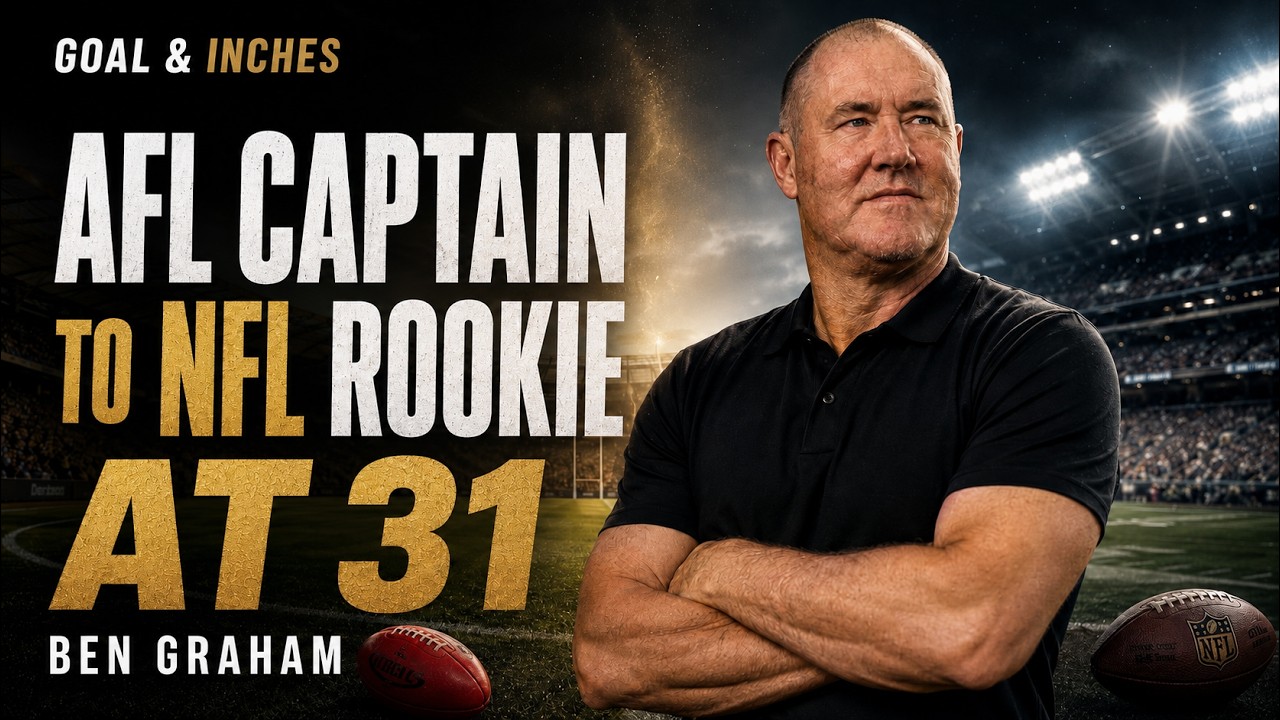
Before he ever entered an NFL locker room, Ben Graham had built an elite AFL career: 12 seasons and 219 games with Geelong, 145 goals, the club captaincy, a best and fairest, a 1995 Grand Final and induction into the Geelong Hall of Fame. Then, at 31, he started again, with no Pop Warner, high school or college football behind him, and became the oldest rookie in the NFL.
In Part 1, Ben traces the journey from an AFL long-kick competition, where Darren Bennett lit the fire, to winning the New York Jets punting job in a training camp battle covered daily by the New York press. He shares the culture shock of day one in an NFL locker room, life in New York from Sesame Street to the Wall Street bell, the “hired gun” mindset he adopted after being cut, being signed by the Saints because he had a passport, and the Arizona Cardinals workout that led all the way to Super Bowl XLIII.
He also reflects on facing Sav Rocca in the NFC Championship Game knowing one Australian would reach the Super Bowl, what elite punting demands when you may only get one chance a game, and his advice for AFL players thinking about chasing the NFL.
Key Moments
2:36 – Becoming the NFL’s oldest rookie at 31
3:08 – The AFL long-kick competition that lit the fire
9:15 – Day one inside a New York Jets locker room
18:15 – Winning the New York Jets punting job
21:58 – New York media, Sesame Street and life with the Jets
34:26 – Signed by the Saints because he had a passport
36:14 – The Cardinals workout that changed everything
39:34 – Ben Graham v Sav Rocca: first Australian to a Super Bowl
44:01 – Performing when you may only get one punt
51:45 – The record punt, forced fumble and game-winning swing
What This Conversation Teaches About Pressure
Don’t live with “what if”. Nobody could guarantee Ben another injury-free season and a premiership, so he backed himself to leave Geelong and chase the NFL rather than spend his life wondering.
Be 10 out of 10 at one thing. An AFL footballer needs to be strong across many disciplines. An NFL punter has to be elite at one, and for Ben that was hang time.
Earn trust beyond your role. Specialists can be treated as outsiders. Ben and kicker Mike Nugent trained, studied and tackled to prove they were part of the team.
Perform when the lights are on. A great practice means nothing if you can’t deliver in your moment, even when it comes after an hour of waiting on the sideline.
Keep your network close. His advice to athletes chasing the NFL: exhaust your current career first, enjoy the adventure, and don’t lose touch with the people and opportunities at home.
Read the full transcript
At 31, when most AFL players are closer to retirement than reinvention, Ben Graham walked into an NFL training camp as a rookie. No Pop Warner, no high school football, no college system, just a left boot, a lifetime in Australian football, and one brutal question. Could he make the switch? This is Goal & Inches. Before we get to the interview, it is worth understanding exactly who Ben Graham is. This is not a novelty story about an Australian who tried the NFL. Ben Graham had already built an elite AFL career before he ever walked into an American football facility. He played 12 seasons and 219 games, all with the Geelong Cats. He kicked 145 goals, was club captain from 2000 to 2002, won Geelong's best and fairest in 1999, played in the 1995 grand final, and was inducted into the Geelong Hall of Fame in 2001. Then at 31 when many footballers are looking at the end of their career, he started again. New sport, new country, new locker room, new language of the game. He did not arrive through Pop Warner, high school football or the college system. He arrived with a left boot, an Australian football background, and a question very few athletes ever have to answer. Can elite performance survive when the entire operating environment changes?
The answer became an NFL career. Eight seasons, 99 games with the New York Jets, New Orleans Saints, Arizona Cardinals, and Detroit Lions. His longest punt traveled 69 yards. His total punting reached 20,661 yards. His inside 20 rate was 34.62%. He became the first Australian to captain a US professional sporting team. He also became the first Australian to play in a Super Bowl with the Cardinals in Super Bowl XLIII. So this conversation is not just about making the switch, it's about what actually transfers under pressure. Talent, routine, trust, craft, and most of all belief. This is Ben Graham on Goal & Inches.
Ben Graham, good to see you. Thanks for joining Goal & Inches. Thanks for having me, Andrew. A wide-ranging conversation today. So, I really want to start at the beginning. You became the oldest rookie in the NFL at 31, an age when many of the AFL players are retiring, and you walk into an NFL training camp with no gridiron background, competing with Americans who have been playing since they were 8 years old. Did anyone tell you you were crazy? Yes, they did. From a number of walks of life. The transition itself was more difficult than it seems. People just think that I went from an AFL career to an NFL career. It was seamless. It was orchestrated. But it was far from that. And the journey started back in the early 90s. So the fire was lit by Darren Bennett. Now, if I could quickly indulge in a story, back in 1992, the AFL used to host a long kick competition and Ross Oakley was the chair, I guess. And in '92, I was playing at Geelong. It was my first year. And because I wasn't part of the finals squad for 92, I was put up as Geelong's representative in the longest kick competition. And I led the competition all day. And with the last kick of the day, Darren Bennett just kicked a bomb and won a trip for two to LA. And he used that with Rosemary to embark on what was a great NFL career. The very next year, Kevin Dyson was winning the competition. And with the last kick of the day, I kicked a bomb and I won a trip for two to LA. But at that stage, I was only 19 and I used the trip with my brother. We went overseas and had a great time. But I always kept an eye on Darren's career.
So that was early 90s. So then late 90s, the New York Jets embarked on an international search for potential athletes. And Eric Mangini's brother worked at Ford in Melbourne and knew the local comp and realized that there are athletes in the AFL that could potentially transition into the NFL. That was in 97. So that created another idea in my head that at the end of my AFL career I might want to go and explore this. But the end of 2004, which was my last year in the AFL, we made the preliminary final and I was coming off the back of a contract. The contract offer from Geelong at the time was one year for about half the amount that I was on. And the negotiations went on, but they also said just if you need to go overseas and explore the NFL and what that might bring, go for your life. We'll be here when you get back. Well, as it turned out before I left, they had to submit the lists and that's when I officially, with my family, it was a big decision to make with a young family. We had two girls at the time. They were four and five, to embark on this potential journey and maybe follow in the footsteps of Darren Bennett. So, it was a decision that I didn't take lightly. I felt like I had a lot of support from the AFL community. There were a few at Geelong that were a bit annoyed that I'd sort of left at that point in time. But I remember two things. One, that someone would have had to guarantee me a successful year injury-free and to win the grand final for me to stay. And of course, no one can guarantee those three things. And the other one was I didn't want to grow old sitting on my rocking chair on my verandah wondering for my entire life what if I had have gone, what might it have been like, and that was some motivating factors.
But I then went overseas to work out with four teams and in the end it was the New York Jets that had the best opportunity and at least I think back to Eric Mangini's visit seven years prior, but I still had to win my job and I knew of the NFL. I watched the Super Bowl. I wasn't a massive fan of the NFL. Didn't really know the rules. Understood the punting position from following Darren's career. But it was essentially the way I looked at it was I took a skill from one industry in sport to another industry in sport in another country. But that first three months of learning the craft, wearing a helmet, pads, kicking a different ball, a ball that's designed to throw, learning the technique, which was really important because yeah, we grew up kicking the football, but when you have to kick it in a phone box, hold it a certain way, you've only got the ball in your hand for 1.2 seconds, there are a lot of changes I had to make. And one of the biggest changes I had to make was holding for the field goal kicker. I didn't want that to be the responsibility that held me back from winning a punting job.
So training camp in 2005 was so interesting, unique, eye-opening, especially in New York. The Jets had come off a successful season and it was largely reported the only position they needed to upgrade was the punter. So training camp in New York in the summer of 2005, every day in the New York Times and the New York Post was reports on the punting battle. But I really enjoyed that and I think my AFL career held me in good stead to be able to cope with the rigors of a training camp, the pressure of punting daily for my job, the media attention, but also the support from my family which enabled me to make it happen.
That's fascinating. What do you consider day one? You trialled with four teams, you have gone to the New York Jets for training camp. What was going through your head when you walked through? Is it the weight room? Is it the training paddock? Is there 90 other guys there on the field? What was going through your head on day one? Day one was a little culture shock. A locker room of an AFL team is pretty, I mean we say it's diverse. People come from different backgrounds, but we're all essentially cut from the same cloth. You walk into an NFL locker room and it is on another level. And I'll never forget, I walked to my locker on day one and I put my belongings in my locker and there were some teammates on stools and they were playing dice and there would have been about $5,000 in $100 notes on the floor. So, they were having fun. I walked past them to go to the bathroom and Justin Miller was also a rookie drafted from Clemson. He said to me, "What it do?" And I kept walking and I'm in the bathroom thinking, "What? What? What did he just say? What did it mean? Was it a good thing? Was he saying hello? I'm not sure." So I walked back to my locker and walked back past them and said to the group, "What'd he do, mate?" And they were in stitches. They loved it. That was sort of the endearing moment to my new teammates, a part of my new team because you're right, there are 90 players that start training camp and then over a period of weeks they cut it down to 53 and then they sign eight back for the practice squad.
And I loved it because you know part of what the coaches try and do is get everybody to know everybody else or something about someone else in your team that you may not know. It's an investment in your teammates which I found natural. It was easy for me but I realized that there are so many cliques within a football team, offense, defense, different backgrounds, religion. It was quite confronting, to be honest. But Kevin Mawae, who is a Hall of Fame center, I asked him one day. I got to know him. We went hunting together and I noticed that he didn't give any of the rookies any time whatsoever. Didn't even want to know their names, their position, where they're from, something about them. And I asked him why is that? And he said because it's a complete waste of time. I'll get to know them when they make the team. And it only made sense sort of years down the track that, you know, naturally I wanted to be mates with everybody. But there is a lot of change even when the season starts because the way the contracts are written is you can be cut any time. Only the guaranteed portion of your contract needs to be paid out. But it was a real culture shock.
But I also remember training camp because training camp over the years, even my eight years in the league and to now, has changed considerably. We used to do two-a-days in pads in the middle of summer and the coaches would not let up. I enjoyed that because when you realize a week in the life of the NFL, and it's happening similar in the AFL now where you get less time on the tools, less time on the ground training, practicing, you know, everything's measured to the millimeter and to the kilometer around how hard and fast, how many kicks you can have. Back then there was no limits. So you had to spend enough time in the classroom, enough time in the weights room and you spend a lot of time on the practice field and it was great for me because I wanted to learn a lot about the game. What are the coaches asking of a wide receiver? We used to practice with the wide receivers in my first year under Herm Edwards. I was in a number of plays on offense and defense given my athletic prowess or the scope that I was able to add value to the team. But in the end they said just focus on punting because if you get hurt we have no one.
But Hofstra University was where the Jets were first when I went over. In my fourth year, we moved to New Jersey where their current base is, but it's the only opportunity for fans to get up close and personal with the players because every training session during the season is closed. So, for training camp, there are fans in the stands. And that was natural for me because every training session I ever did for Geelong was an open session. There were always people there. So I felt like I was part of the entertainment and John Lott, the strength and conditioning coach at the Arizona Cardinals, said to me once, that's all we are. We are a circus and circuses don't stay in town for long, so you make the most of it when you can. But I got some great memories from my first year at the Jets. People often ask me who is my favorite team that I played for and I talk about a few teams in different ways, but the Jets will always be close to my heart because they were the team that showed me the faith. They gave me the opportunity. They looked after my family. And living in New York was a great adventure.
So you talked about the cultural assimilation. What about professionally being not from the NFL? How did you earn trust and credibility with your teammates through that period where you were challenging for the punt job? Well, I did it the only way I knew how and it was based on my AFL career. To build that trust, you work hard, you train hard, you have confidence in your own ability to do your job. And the way I explain it is in the AFL you need to be a six to a nine out of 10 in about six disciplines. Yes. So speed, aerobic, skill, mental, toughness. You've got to be a range. But in the NFL, you've got to be 10 out of 10 of one thing. And for a punter, it's hang time. So, you need to be able to kick the football directionally with distance, but hang time is the important piece of that. But the training camp battle was really interesting because I got to know Mike like a mate. And there was a point in time where he became a little prickly and then I realized that it's last man standing. So I had to put all my belief in my own ability, everything I'd learned in the previous three or four months, use the experience of being under pressure in the AFL and put it to work and I did enough during that period of a week to prove that I was, and particularly holding for field goals because at the same time, the year that I was signed, the Jets drafted a kicker in the second round, which is near unheard of.
And Mike Nugent, who's a great friend of mine, he's a godfather of my son Jack, who was born in New York when I was playing at the Jets. I felt sorry for him because it's not his fault he was drafted in the second round. But what we did is we ensured that everything we did in the classroom, in the weights room, on the field, that we would do everything we possibly can to earn the trust of our teammates. Now, I didn't truly understand when I went over there that the punters and kickers, the specialists were almost outcasts. It was go and stand over there. You're not offense and defense. Just go into the locker room. Go and play golf if you want. You know, stretch a bit more. And I hated that. So we both, and he was captain at Ohio State, national champion. So he knew what it took and we did it together. We earned the trust of our teammates and that was during the week and on Sundays and it really became natural to me. It was not something that I felt like was out of my realm of being myself. But talking about being myself, I often say I was more Australian in America than I am in Australia. So I think that part of it helped just being natural, humble, respectful, but just try to be mates with everybody.
So was there a specific moment when you knew you'd been accepted or are you saying that moment never really comes? Well, this is really interesting because you would think that when you were named the starting punter for an NFL team, my expectation was that, well, let me go back a step. The week leading up to the moment when Mike Westhoff, the special teams coach, had us both out on the field and it was game on, boys. You will stay in as punter if you keep kicking bombs. Okay? If you mishit a ball, you come out. And Mike had the first go because he was a seven-year vet. He hit a couple of good balls and then he hit a bad ball and Westhoff got him out, but he said, "No, I'm staying." And it was like, "Hang on, they're not the rules." But he was granted the ability to have two more punts. And he shanked them both. I came in and kicked about eight in a row. All 5-second hang time and I think it was that moment that they had in their head that this is our guy. So it was a week of that and I haven't really told this story and no disrespect to Mike or his wife but his wife actually got quite peeved that the New York media were trending towards me being the starting punter because my story was being told ad nauseam in America and she came out in defense of Mike, pretty much, well why don't you start talking about my husband, the media shouldn't be having an influence on what people are thinking about this, the numbers do the talking. So it got quite antsy during that week.
But the day that I found out, I'd just done a lot of work with Karen Crouse from the New York Times about my story and we had a day off at training camp towards the end. I took my wife to the movies because you don't really see your family much during that month. You're living away. You're training every day. So, I took her out to the movies and at the end of the movie came out, checked my phone and there was one message from Karen Crouse from the New York Times. Congratulations. So, I rang her straight back. I said, "What's happened?" She said, "They've cut Mike. You're going to be the starting punter of the New York Jets." And I couldn't believe it. Had no one to celebrate with except my wife Katie. Like who do I tell? What do I do? So I sat on it and I drove into the club the next morning and I'm expecting there to be red carpet, bells and whistles, fireworks, big announcement, press conference. I walked through the front doors. Scanned in, walked to my locker because a locker room from 90 to 53 feels empty. Half the lockers are empty. And it was this really weird, when's someone going to come and tell me, I've found this out from a journalist. And then they came down and said, "Ben, you want to come upstairs and sign your contract?" So there was no bells and whistles. There was no red carpet. It's just a numbers game and it happens club by club, year by year.
It's fascinating. For listeners that aren't aware, the Jets haven't made the playoffs in 15 years. It's the longest current stretch in the NFL, but it's also the biggest media market. And you mentioned how much you loved living in New York. Were there any media moments that stand out other than first being picked? Yes, well I can sort of tie this in with the adventures that we had. We were lucky because of New York, we had a lot of people coming through New York. So we had the ability to show them where we lived and the side of New York that tourists may not see. So that was a fun part. From a media perspective, they were very kind to me during training camp. I had I guess a story to tell and someone once said that I was the Michael Jordan of the AFL. So when someone says something like that in America, it just grows legs. And I wasn't in a position to deny it. I was never asked. That was just the assumption. So it sort of came with a bit of aura about it. And the New York media were kind enough that when I eventually got cut after week two in my fourth year, we're playing the Patriots, I had a bad game, Tom Brady capitalized, the Patriots won. It's a division rivalry, hate each other. And I got cut. And the New York media the next day headline, typical Jets, cut your punter, that'll solve all your problems. They knew that, you know, I had a bad game, but it was more of an organizational problem, lack of winning.
But the adventure itself, I did things in New York in my time at the Jets that I would never dream of. Like I grew up watching Sesame Street. I got to appear on Sesame Street. Like that is a career highlight off the field. Wonderful day. Went in there with Eric Mangini, Chad Pennington, Laveranues Coles, all our families. The kids did a skit that they're still receiving royalties for and we were on it with Elmo teaching the alphabet. It was so much fun. Great experience. But that same year also rang the Wall Street bell. I mean that was pretty cool. We went to a Wiggles concert and the Wiggles in their encore performance came out wearing my Jets jerseys. All four of them. Surreal moments that you would never ever dream of. And that was all not long before I was released after that week two, after having led the league in every category during the preseason but had that bad game. I did get re-signed the next week because the punter they signed to replace me did his hamstring at practice. So I came back for a couple of weeks, but then that season of 2008, I saw the highs and the lows. You talk about being the oldest rookie ever, which not sure it's a great record to have, but I then became the third player in NFL history to play for three clubs in the one year. Started at the Jets, played with the Saints, and finished that season with the Cardinals.
Crazy. Just the enormity of your achievement. There's no Pop Warner, no high school, no college system in Australia. The US has 330 million producing its NFL talent base. What do you put it down to? How did a kid from Geelong end up competing and winning in that environment? One, because we kicked the football from a very young age. So we naturally know how to kick the football. The transition was definitely helped by a professional career. 14 years at the professional level. When I first started at Geelong, it was becoming professional, but within three years we were all professional footballers. I do pinch myself at times and I know the landscape has changed a lot since I first transitioned. After me it was Sav Rocca and there hasn't been anybody else that's made that direct transition from the AFL to the NFL. The pathways now including the international pathway program. A lot of punters particularly are in college that make their way to the NFL. It's a great question in that my dream growing up was to play AFL and I see myself as being fortunate to have made that decision to retire and move to another industry on my own terms. And that's important because a lot of people don't. But a lot of things had to go my way. I needed the support of my family. I needed to actually be who they thought I could be when it came to punting the football and holding the football for the field goal kicker. I must say going into my fourth year at the Jets, I thought I'd play for them for 14 years, just like I did with Geelong. Jeff Feagles was still punting in the league in his forties. I thought that was going to be the next decade for me, but then quickly worked out that the NFL is a pretty cutthroat industry. And the way I explain it to people, especially the ones that think seamless transition, yeah, fame, fortune. Yep, fair enough. There's only 32 jobs in the world. 32 jobs in the world. So very hard to get one and even harder to keep one. So it's not lost on me that I spent eight years in the league.
So given how cutthroat it was and you mentioned that you know Darren Bennett well, he pioneered the pathway. Did you feel the weight of his legacy or was he helping you navigate that path? Oh he was integral to my journey. Not only lit the fire back in 92 but kept in contact with him in the early 2000s. He had a great career at the Chargers and then went to the Vikings. One of the four teams that I worked out with at the end of 2004 was the Vikings. And the Vikings franchise thought he was crazy that he would recommend another Australian punter to come and punt against him for his job. But the work that we'd done was around him helping me get in front of people and he was essentially willing to retire and leave me with the job at the Vikings if that's the way it transpired. Now I went to the Jets. Ironically, we played the Vikings in the preseason in my first year and it was against Darren and Darren hurt his knee that game and it was his last game. But ever since that point, I mean he's the godfather of punting. He helped me both physically, mentally, because he'd been there and done that before and he, Rosemary and the kids were very good for my wife and our kids because they had been through everything that we were about to, all the unknowns, the visas, the medicals, the immigration, the support that you get, very different from the AFL.
So he was very important to me and he comes back into the story after that week two in year four when I got cut. The first thing I did was call Darren and I jumped on the plane from New York to San Diego where he was living. He was well and truly retired. And we had a beer and we went down to the local high school and we grabbed a bag of balls and we just got back to basics because at that point the mental game really started to weigh heavily on me, my family, my career. You're starting to think about, you know, is it done? Are we moving back home? How does this happen? So really, you do go through some really tough times when it comes to, you know, mental health, things that weren't largely talked about back in the mid 2000s. But he was integral just to keep it simple, get back on track. This is the way the industry works. You'll get another opportunity. But funnily enough, while we were at that high school having a punt, my agent was trying to call me. They tried to call my wife. She said that I was in San Diego with Darren. They tried to call Darren. They couldn't get on to Darren. They called Rosemary. They got on to Rosemary. Rosemary came racing down to the high school saying, "Ben, your agent's trying to call. The Jets want to sign you back." And I said to my agent at the time, "Well, tell them to go jump. Like, you just put me through that." And, you know, I believe in my own ability. I'd rather get an opportunity somewhere else.
Well, my agent rightly convinced me to sign because to become a vested veteran in the NFL, you need to play three years and three games. And I was cut three years and two games into my career. So then I started to be really cynical about the whole system, but I did re-sign. Ironically, the Jets were playing the Chargers in San Diego that Monday night. So, I stayed in San Diego and met my teammates the morning of the game at the hotel. And a lot of them didn't even know that I'd been cut. The punter who had replaced me had pulled his hamstring. They re-signed me. They just thought I'd gone back to Australia for the week. And here I was ready to front up for this game. And I punted well for the next two weeks, but he got healthy. He came at a much lesser price than I did from a salary cap perspective. So I was cut for the last time from the Jets after week four. But Darren's influence on my career from a mentor perspective started way back lighting the fire in 92 and then early 2000s through the Vikings and then throughout my career. The epitome of Aussie mateship.
That's a great story. The American media likes to use the phrase chip on your shoulder and not necessarily in a negative way. You talked about the mental side. Do you need a bit of a chip on your shoulder to survive and succeed? Is it an edge to say, "I belong. I'm going to prove it." Yes. Yes, definitely. There are a lot of players in the NFL that come in with a chip on their shoulder, something to prove. Whether it's a school they've come from or their upbringing. But for me it was the hired gun mentality. So I talked about the Jets and my vision of playing for the Jets for the next 14 years. That bubble was burst after that fourth week. And then you go on a tour of sorts where other teams bring you in to work you out. Like what are you doing on the street? We need to see this. We need to understand what's going on here. And a lot of them still need a backup plan in case their punter does go down because you only have one punter on the roster. So I went to about eight clubs and I mean the story in New Orleans is I got a phone call on the Sunday. I was out of work. My agent said, "How quickly can you get to the Newark airport?" I said, "I don't know, an hour away." Well, okay. Can you get there because there's a first class ticket waiting for you to go to London. And I went, "What for?" They said, "The Saints want to sign you in London." Like, in London? Like, what's happening here?
So, the Saints played the Panthers on that day. Their punter got cut coming out of the showers. So, then they had this really small window to find out who's our next guy. And they went to their punter number two on their depth chart and number three. Neither of them had a passport, so they had to go to me. They signed me because I had a passport. Now, it was a great week. Played at Wembley. We won the game. Thought I was going to play for the Saints. We come back on the Monday and then I get called into the coach's office, Sean Payton. And ironically, he cut me and the kicker the same day, mid-season. I think that's the first time that's ever happened. And then I found out that the only reason they signed me was because I had a passport. But at that point, I'm like, this is unbelievable. I never would have expected that an industry could chew people up and spit them out as quickly as the NFL does. Now, everyone talks about the NFL because of the top three players in each club and the amount of money that they earn and the faces that they see on TV and the only jerseys that they make that are hanging on shelves. Everyone else is just fodder. So, at that point, I'm like, I am just a hired gun. So my next opportunity, that's the change in mindset that I'm going to have going into it if I get one.
I go to the Arizona Cardinals workout and it was just like the movies. Five punters all start the workout and they put us in position, 12 yard line, right hash, kick, and we all go. After about 10 punts, they get old Joe Bloggs. Hit the showers. Van's waiting for you to take you to the airport. Four left. We go next one. And it just became three, became two. And when it was two, we're up midfield. And this is where my career changed. The Jets knew that I kicked the drop punt, but they never trusted it enough to use it in exactly the right moments. The Cardinals saw that they had a great offense with Kurt Warner, Larry Fitzgerald, Anquan Boldin, Steve Breaston, they were going to win the division for the first time in a long time. They just needed someone to pin the opposition deep. So when there was two of us standing at the 50 yard line, we had 10 punts and every one of mine landed on the one or two yard line and bounced back and they said, "Right, boys, go and shower up. We'll come and grab you." We sat there for about half an hour waiting for the team reps to come down and get us. They came down at the same time. We went through different doorways. I went upstairs and out the window I saw him getting into a van. So, I'm like, "This is it. I got the job." But my mindset was I'm a hired gun. They're hiring me for one reason. Kick a football. No need to invest in my teammates. This is it.
Well, my first punt for the Arizona Cardinals was my first punt returned for a touchdown. And I seriously ran off that field. Kevin Spencer was the special teams coach. I was waiting for him to say, "Just keep running. Just run to the van. They'll take you to the airport." But he did a really important thing. And I'll never forget this. He put his arm around me and he said, "Ben, that was a great punt. Your teammates let you down. They're not used to having a punter with your powerful leg. You're going to be fine. We believe in you. You're here for the long term." And that's all I needed to hear. And then from then on, we won the division. We made the playoffs. We were called the worst playoff team in NFL history. We traveled to Atlanta and it was a close game. I had five punts, four inside the 20, three inside the 10. And Ken Whisenhunt referenced me in the press conference as having an integral role in winning that game of football in the battle of field position. We then take on the number one seed, the Panthers in Charlotte and Jake Delhomme threw four picks, but we're on a magical ride here.
And then we get to the NFC Championship game and we're playing the Philadelphia Eagles in Arizona, in Phoenix. Even though we were the fourth seed, results went our way. The Eagles beat the Vikings in Minnesota. So next thing I'm pregame with Sav Rocca because all the punters are mates. Even if you're Australian or not, you're part of your own fraternity. We shook hands and just, one of us is going to be the first Australian to play in a Super Bowl. This is enormous. We just understood right there and then the magnitude of it. And I can honestly say if it was Sav, if the Eagles won and they went to the Super Bowl, it would be a really proud moment to know that we were part of the journey, part of the story. But we won that game. Again, close game. Donovan McNabb had 35 seconds to score a touchdown to win. We held on and then I became the first Australian to play in the Super Bowl. Super Bowl XLIII. This is all in the same year where I got cut twice by the Jets, picked up for a game for the Saints because of my passport and ended up playing in a Super Bowl. So you can see how your mentality completely changes once you go through something like that. And hired gun is the way I reference it.
The highs and lows are incredible. You mentioned the professionalization at AFL level made the transition easier but not necessarily the kicking aspect with the ball a different shape and different size. Were there any other parts that weren't immediately transferable from AFL that you sort of thought I'm floundering here? Floundering is probably not the right word. I always had belief in my own ability to kick the ball. It was the consistency that I needed to work on more than anything from a punting perspective. They would see the 5.5-second, 65-yard bomb and the next kick might be a shank out of bounds, 20 yards. Like hang on. If you can do that, where does that come from? That's just because, let's call it the thousand hour rule. Most American punters are soccer players or they have got a very robotic technique because it's the same technique that they've been working on year after year. I'd only been working on this technique for 3 months because we grow up kicking the football all sorts of different ways. I would probably say that I over-invested in what I needed to do. So I said before about being a 10 out of 10. I wanted to learn the playbook. I mean you can imagine the old phone books. The full playbook that they install in training camp is about five phone books stacked on top of each other. I wanted to learn the whole thing but I sort of realized that I didn't have to. I just needed to know whether I was kicking left or right or whether I was trying to kick it long or high or both or drop punt or torpedo.
So, I'm not going to say that was a bad thing. That was just me wanting to understand the game in case I was called on. Now, I say that because I was involved in some offensive and defensive plays, but I'd come from a sport where I was on the ground before rotations in the AFL. It was 100% game time throughout my AFL career pretty much. You go to the NFL and it's a hard adjustment to know that you're only really on the field six, eight times maybe for the entire game. So, your influence is really different to what I'd been used to, but the impact is so profound that you only get noticed in my job if you stuff it up. So, it's very much getting used to: do your job and trust the guy next to you does his. And that's a famous Bill Belichick mantra which other coaches have used, but it's so true. Don't worry about anything else. Just do your job. That took a little bit to get used to given that I wasn't on the field for 120 minutes of a game.
So if it is just eight times or less in a game, how'd you manage that psychological pressure week after week and in particular in the face of a rushing defense? So that did take some getting used to because when your offense is on the field, you don't necessarily know exactly when your number will be called because you can prepare on the sideline all you like. First down, second down, third down, and then it gets to fourth down and you're out. But if they keep converting third downs, you're warming up continually until your number gets called. And of course, if you score, then you're only out there to hold for a field goal or an extra point. But it is really, really interesting, the psychological aspect of being prepared for that moment because that's what this game is. There are moments. I mean I had one game against the Ravens I had 11 punts, which was the most I've ever had, but against the Packers on a freezing cold, ice-covered sideline I had one punt for the day. And after the game, you know, oh geez, you didn't have to work hard for your money today, did you? But the funny thing is I was actually sore and more tired physically and mentally after a one punt game than I was after an 11 punt game because you're on the sideline the whole time in anticipation, warming up. Ready to go. No. All right, we're back on. Third down. Oh, convert. Third down. Let's go. No. They're going to go for it. That's the bit that you really need to be attuned to early. But Mike Westhoff, he just referred to, you need to perform when the lights are on. You could have the best practice, you could have the best warm-up, it means nothing unless you can perform in your moment when the lights are on.
You earned your living doing the punting, but you did have other moments. You registered one pass attempt, two rushes, two fumbles, and six solo tackles. What are your fondest memories of doing things punters don't normally do? Well, when I referenced before about the specialists are generally outcasts, part of earning the trust of the teammates was showing them that we were athletes, that I could tackle. So, I wanted to prove to them that I was the 11th player on that special teams unit that could make a tackle. So, I was always up there. Now, you'd like to think that your punts are that good that they always get stopped by your teammates and never get through. But from time to time, I loved it. I love making a tackle despite it looking bad from a statistical perspective because the net yardage comes down. But Roscoe Parrish was a Buffalo Bills returner. He was a very small man but very quick. He got through and on the sideline I dropped my shoulder and nailed him. And one of my favorite photos is me just standing over him. In this day and age, I'll probably get a taunting penalty, but teammates got around me. It was a moment that it was like, yeah, this guy, he could save a touchdown if it was one-on-one in the open field.
There was a preseason where we installed a couple of fakes. Again, fakes are only put into the game plan once you prove to the coaches that they can be executed at practice. It can take weeks, months to convince and execute a fake in practice. It was a preseason game and we tried one and it was really interesting because I got given a green light to either kick it or run it depending on what the defense in the special teams punt return did. And when I got the ball in my hand, I look up and there was just green grass. I'm running this. This is great. I'm going to show off how quick I am. I'm going to hurdle someone. I might even run in for a touchdown. Well, as soon as I tucked it, I took three steps. I came out of the pocket. It closed. There were defenders everywhere. It was like, "Oh, I'm in trouble here." So, I whacked it on the boot. Flags everywhere. But after that, it was like, "No, no, no more fakes for Ben." That was early in the Jets career.
But when we got to the Cardinals, Jay Feely was the kicker and we practiced all week against the Denver Broncos because they showed a weak side on their field goal block and I'm the holder and we said that on the first field goal or PAT attempt, we're going to assess what sort of formation they've got. And if they're weak on the backside, on the second field goal or extra point, we're going to run the fake. So, we get out there and they show us the look. So, we're like, great, we're going to run a fake here. This is going to be great. Second field goal, we get out there and they didn't show the formation. So the special teams coach on the sideline is like, "Call it off. Call it off." So I'm there, mark on the spot. Jay's got his foot and he goes, "We're going to run it anyway." And I said, "No, no, no, we can't. Spencer said no, we can't." "Don't care. We're going to run it. I've got this." So I'm like, "This is career-defining stuff here." If it doesn't come off and you get to the sideline, he'll take full responsibility for it, but I'm the one flipping him the ball. And I knew that I had to do it because he wasn't going to follow through with the kicking motion. So, I'd be stuck there with the ball on the ground and he'd be off. So, I did. I put it down and then I flipped it back to him and he ran around the back and he scored a touchdown and I'm the first in there to celebrate. We're pushing him up. He's doing the old Lambeau Leap. It was in Phoenix. I don't know what you call the Cardinals jumping into the stands. But it was a great moment. But of course, we got to the sideline and Spencer's like, "What the hell's going on there? You just run it? You didn't even listen to us?" Like, "But it worked, coach. Move on." So, that was fun. That was a moment I like showing the kids when they ask the same question about you were just a punter. I said, "Well, I've been involved in a pretty good touchdown. Have a look at this."
Just out of interest, did you get high fives from the coaches for the tackles or were they frowned upon? Oh, no. It was definitely appreciated because there are times where you are the last line of defense and you need to, and it's not just about the tackle either. It's about the lanes that you're in to force a returner wider to enable the cavalry to get there or to pin them in to minimize the damage. They really appreciated that. Field position is huge. The biggest swing though, I guess, of a moment in a game, I'd already equaled an NFL record for the number of punts inside the 20 and I was punting to break the record. So, it's a big moment. But it was a punt to kick inside the 20 and it was something that I'd become known for. So it was not a big drama. I hit the ball. It was a good punt. He took it about on the eight yard line and I'm sort of admiring it thinking about I've just broken an NFL record. That's pretty cool. Next thing my coverage team didn't stay in their lanes and he found a crease and he got through. So now it's not going to be an inside 20 cuz he's not going to be tackled inside 20. I've got to tackle him to save a touchdown in a critical stage of the game. So, he was screaming towards me. It's about the 50 yard line. I could see that I had teammates coming in from behind. So, I was sort of corralling him more than anything. We sort of met, sandwiched him, the tackle was made. I've stripped the ball out of the returner. We recover it. And then with that possession, we go down and score a touchdown and win the game. That should be a moment that will live on as my favorite NFL memory. But because I was a hired gun, I sort of felt like I missed the opportunity to break an NFL record. I equaled it, which was nice enough, but you sort of become selfish and there's a lot of individual components to being part of an NFL team. But that all happened on the same play where, as disappointed as I was that I didn't get the opportunity to break the record, I was integral to us winning a game of football.
Earlier you talked about having no regrets. If a 28-year-old AFL player came to you today and said, Ben, I want to do what you did, what's the honest conversation you'd have with them and what would you tell them that no one told you? Ask Billy Gowers. He was a 28-year-old that came to me last year and we had exactly that same conversation and have a look at him now. I have a lot of people that ask similar questions and a lot of parents of kids now that it is a realistic dream where players can actually be part of a Prokick or go to college and then potentially end up in the NFL. And AFL players are really interesting because they believe over and above those other kids that they can make it because they're professional athletes already. It's a very, very difficult proposition. So I would always encourage them to exhaust as much as you possibly can out of your current career and then understand the landscape, understand, you know, the education side of it and the time and the cost of that commitment to embark on a journey like that. There's been some great stories, but the one thing that I warn them about, and it doesn't matter who it is or what journey they take, is you go and enjoy it because it's a fantastic experience and you get an education, but don't lose sight of your network and connections back in Australia.
There's been a lot that have come back after being over there for three or four years and have lost touch with their own network back here, whether it be their school network, the university, their friends, even in some cases their families. That's the downside of being a professional or a sportsman for so long. There are other opportunities in life that you naturally pass up because you're doing something that you love. So, it's just to make sure you keep an eye on what's next and continue existing in the network that you left because everyone's moved on. Some married, had kids, started businesses or are four years advanced in a career compared with someone that might have spent four years living their dream in the States. That's part one of the Ben Graham interview. If you want to receive notification for when part two drops, subscribe now on YouTube, Spotify or Apple Podcasts. This is Goal & Inches.
More Pressure Tests
Episodes