
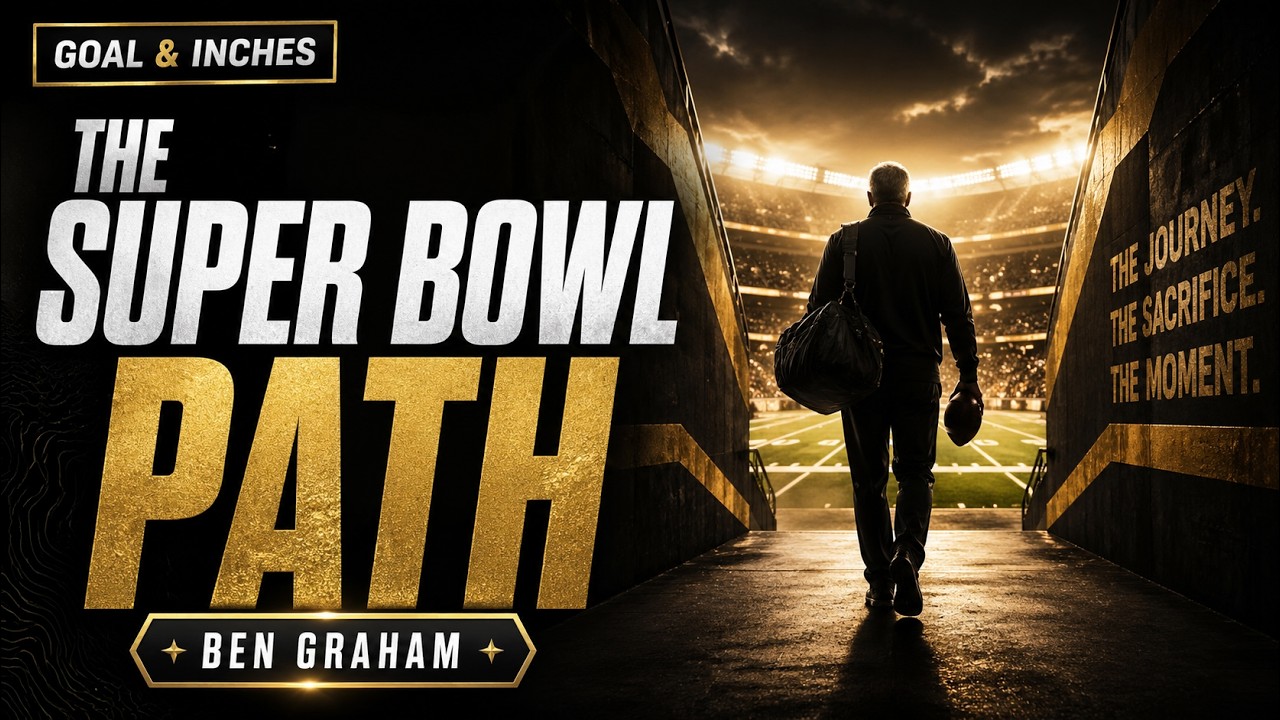
It’s not the view that people remember, it’s the journey to get to the pinnacle.
Ben Graham played in an AFL Grand Final with Geelong at 21 and, 14 years later, became the first Australian to play in a Super Bowl, punting for the Arizona Cardinals in Super Bowl XLIII. In Part 2 of his conversation, Ben goes behind those moments: playing the biggest game of his life with a groin injury, a halftime locker room in turmoil, Larry Fitzgerald’s second-half clinic, and why the journey mattered more to him than the result.
Ben was also the first Australian to captain an American professional sports team, voted captain by his teammates at both the New York Jets and the Cardinals. He explains what earning that respect took, why Herm Edwards treated players “fair, but not equal”, how a special teams oversight led to his first blocked punt, and how the Steelers and Cardinals prepared for the Super Bowl in completely different ways.
He also weighs in on drafting for need versus best player available, systems versus talent, and the teammates who defined elite for him: Larry Fitzgerald’s professionalism, Adrian Wilson’s “number two” mindset and Calvin Johnson’s respect for those who came before him.
Key Moments
0:55 – From an AFL Grand Final to Super Bowl XLIII
3:25 – Injured before the biggest game of his life
5:13 – Inside the Cardinals locker room at halftime
6:07 – Larry Fitzgerald turns the Super Bowl
7:40 – Becoming the first Australian captain in US pro sport
14:28 – The special teams oversight that led to a blocked punt
16:55 – Systems versus talent in the NFL
21:11 – “Fair, but not equal” inside an NFL locker room
What This Conversation Teaches About Pressure
Do your job, whatever the stage. Carrying a groin injury into Super Bowl XLIII, Ben leaned on everything his career had taught him and focused on his role when his number was called.
Respect is earned from your peers. NFL captains are elected by their teammates. Being voted captain at the Jets and the Cardinals was a recognition of who he was and how he did his job.
Train like you’re number two. Adrian Wilson wore number two at practice to remind himself he wasn’t yet number one, and worked to be the strongest and smartest player on the field.
Think beyond yourself. Larry Fitzgerald held out for a contract that set a standard for future receivers. Years later, Calvin Johnson credited him for the deal he signed.
Resilience is built in the hard winters. Cut three times in 2008, Ben kept punting in a cold New Jersey winter, waiting for the call that led to a Super Bowl.
Read the full transcript
Pressure does not just arrive on Super Bowl Sunday. It builds through every camp, every meeting, every punt, every locker room, and every moment where teammates decide whether they can trust you. For Ben Graham, that pressure led from an AFL grand final with Geelong to Super Bowl XLIII with the Arizona Cardinals. In part two, we will look at the path behind the moment. Captaincy, leadership, coaching, systems, talent, and what elite football reveals when there is nowhere to hide. This is the Super Bowl path. This is Goal & Inches.
In 1995, you played in an AFL grand final with Geelong going down to Carlton. Then in 2009, you appeared in Super Bowl XLIII with the Arizona Cardinals. Unfortunately, going down 27-23 to the Pittsburgh Steelers, the two biggest stages in two different sports. Take us back to the locker room after those two finales. What does a loss on those stages teach you about pressure, preparation, and the emotional cost of elite competition? The AFL Grand Final, I was 21, and it was the end of an era despite being Gary's first year as coach. It was the end of that Ablett, Brownless, Stoneham, Hocking, Couch, the older generation that got him through the 89, 92, 94. I just thought that we were such a great football team that we were going to be playing in grand finals forever and a day. So the memory from that game despite, you know, on paper it looks like Stephen Kernahan kicked five goals on me. A couple of them were out of the ruck. I felt like I performed quite well as a young man on the biggest stage, but records will also show that Carlton lost two games that year and were far too good for us in the grand final. So my memory was next year. There's going to be next year. I played every game that year, including the grand final. Gary, he had a core group of young players that we knew were going to be part of the next generation. So I sort of spent the next couple of years and in 97 we finished second on the ladder but Adelaide hosted a final, that's the Leigh Colbert mark game. We felt like we were the best team in it. So I always felt like we were going to get another opportunity but at that point didn't know that I wouldn't get another opportunity.
But playing in the NFL, it felt like that every regular season game was a final. And a playoff in the NFL is like a grand final. So when I got to the Super Bowl after that crazy year of 2008 where I started on Sesame Street, back in my fourth year at the Jets, ringing the Wall Street bell, getting cut three times and then end up playing in that Super Bowl. It was about and I haven't really told this story a lot, but I actually injured myself in the NFC Championship game with my second last punt of the game. So, I was under an injury cloud for those two weeks leading up to the Super Bowl. And I never really understood why there was two weeks leading up to the Super Bowl, although the Pro Bowl was traditionally in that weekend off. But now I know because you need a week to prepare for the game in your home facility, in your own bed, learning the playbook because when you get to the Super Bowl city, there are distractions galore. Tickets, family, friends, media day. It's a circus.
But all I could really do was lean on my career, the pressures that I'd been under at certain stages throughout my career as a young man playing in a grand final to being a captain of an AFL club to the pressure of, you know, winning a best and fairest and then trying to be recruited to other clubs but deciding to stay and then making the decision at the end of 2004 to embark on this NFL journey, to draw on all of that. But again, your role in a team, regardless of how big the game is, is to do your job. So, it was the pressure you feel. And I had some trouble sleeping that week because I wasn't 100%. I was dealing with a groin injury. But it was about embracing the moment when your number's called. And I feel like I handled it pretty well. I didn't have my best day of punting, but it didn't hurt us at all. It was a really interesting game. And they'll call it top three Super Bowls of all time based on how it played out.
Leading into halftime, we were driving and Kurt Warner threw an interception to James Harrison. James Harrison then ran it 100 yards back for a touchdown. It's essentially a 14-point swing. So the halftime at Raymond James Stadium, the locker room, we're in the away locker room, was about as small as this studio. You couldn't swing a cat in it. There were chairs flying. There were people yelling like it was a really, someone had to take control. No one did. So I just left. I just went back out onto the field. And Bruce Springsteen was the halftime entertainment. So I had a great halftime. I just watched him perform from front row seats. It was kind of cool. But in the second half, we did compose ourselves. We came back and Larry Fitzgerald turned on an absolute clinic. But we were driving and we stalled. I punted the ball, it was downed inside the 2-yard line and the Steelers conceded a safety. So, we got the two points and we got the ball back and then we drove down and scored to take the lead in a Super Bowl and the rest is history because Ben Roethlisberger put on his Superman cape and found Santonio Holmes in the back of the end zone.
They win, but I don't care, Andrew. And people often, you know, cheekily will say, "But you didn't win." So, but you got to understand the journey that I'd been on, what I'd had to deal with that particular year. The fact that I was the first Australian to play in a Super Bowl, the journey was as much my story as actually winning it. So when Jordan Mailata won it two years ago and Michael Dickson last year I could not be prouder for them because I understand the challenges and the journey that they've been on. So when someone says the analogy around Mount Everest, it's not the view that people remember, it's the journey to get to the pinnacle. And that's I think important to me regardless of the result.
Ben, you became the first Australian ever to captain an American professional sporting team. No one had done it before you. What does that mean to you? And what did it take to earn that respect in a locker room where you were the foreign punter? The way captains operate in the two sports are really quite different and the way they're appointed is quite different. So, I feel like personally I've had to do it two different ways. And the fact that, you know, people can criticize the role of a captain on an NFL team because some teams have six, two for each phase of the game. And a quarterback, if a quarterback isn't captain, then there's something wrong. So you'll see these kids drafted, they'll be the starting quarterback. They'll just get a C on their chest and you wonder what leadership qualities do they have. You know they've got them because they've been quarterback for a college before, but what influence can they exert on that football team when there are so many veterans and savvy guys within a locker room?
But I did it for the Jets and the Cardinals. So I was captain for both teams and I drew on my experience as a captain at Geelong. But the difference being in the NFL you are appointed by your peers. So they vote for you. Now I know in the AFL some teams will go down that track. Now, when I was appointed captain, it was a club decision. In the NFL, it was a player-driven decision. So, to have that respect from your peers based on who you are as a person and your ability to do your job in your position was unbelievable. And I don't take that for granted. And you know, if I go back to the States and catch up with ex-teammates, you feel like a captain amongst men with the relationships and the memories that you build at that time. They mean a lot to me.
Iron sharpens iron is common coach speak in the NFL. The intent meaning that competition sharpens you. That facing the best every day is what creates elite performance. Looking back across 12 AFL seasons and eight NFL seasons, what was the moment that sharpened you the most? Oh, that's a good question. What moment sharpened me the most? It's probably more prevalent in the NFL. In the AFL, my career spanned an era of change, but it always felt like I was just ahead of the change. So, I didn't have to, you know, I started when there was 53 on the roster. I had the luxury of spending a couple of years in the reserves. You know, I'd played eight games in my first three years. I definitely had to work on things. There was no doubt about that. The NFL was just a complete different ball game. So, you really had to stay in check with your own thoughts. Back in the AFL you didn't have to think that much. You just played. You just played. We didn't have the scrutiny that they do now. Young players with social media and the number of people in the game covering the game. In the NFL, it was really about how you approach every day knowing that when you drive into work you could lose your job. So it really became a mental, I'll say struggle, but it was a challenge. It was a daily challenge.
Let's take a couple of questions on NFL football doctrine and ideology. The NFL draft is one of the greatest debates in sport. Do you take the best player available or do you fill a need? Well, Andrew, that depends on who you are, how you've built your roster previously, what holes you actually do have, who you've traded in, out, free agency. It's a great product though, the draft. But again, like any draft, it'll remain to be seen how we judge them, how they work out. Take Fernando Mendoza as an example. Everyone would like to think that he will be the savior for the Raiders because they've been so bad for so long. They're in a tough division, but it's not just him. It's the pieces they put around him that they'll be judged on. I always keep a close eye on the Jets. I think they had a pretty good draft. They surprised a few with David Bailey. But I hope he turns out well for them. Taking a tight end, 13th overall, was an interesting pick. But they're coming from a long way back. The Arizona Cardinals, again, there's your best player available analogy with Jeremiah Love, running back, but then they're widely criticized because they take a running back with their third pick. You can't win. Someone's going to criticize you, but the proof will be in the pudding.
Do the smartest organizations draft the best pure football player or do they draft for traits and trust coaching to shape the rest? Yeah, that's a great question. So, I'm a big believer, doesn't matter what sport, you need the recruiting team or list management or pro personnel, whatever you want to call them. They need to be aligned with your development team that actually once you do get them into your building can develop them to be the best version of themselves. Then you need the game plan. You need the coaching to be able to get the best out of your players within a certain scheme. You could have the best roster with the worst development. You're not going to get the best out of your coaching. So, you need to be aligned in all of those things.
And now, I've seen NFL rosters get built differently. A lot of money spent on offense or defense or both and none on special teams. And I've been privy to this because there was a moment where you get to know your special teams and generally they're backups in another position but they've played special teams before in college or in the NFL and I had full trust in my protection. One of the guys got released and he was replaced by a linebacker from another team and he was my right guard on punt protection. Had never played special teams before. He had been a starting linebacker all his life. He had no idea what to do. He was supposed to block in. He blocked out. Guy came up the middle. Blocked punt. My first blocked punt was because he had no idea what he was doing. So, if you're a club that invests in offense and defense and doesn't take care of your special teams, there's flaws. There's going to be holes in your game. You're up to chance when it comes to that big kick, field goal to win a game, critical punt for field position. But some teams overspend in their special teams, too. So, you got to find that balance.
Injuries are a big part of the game, obviously. So you need depth at every position outside of the kicker and the punter where you can only afford, because of the numbers game, to have one of each on your roster. But I think the best window if all those things aligned is when you have a quarterback on their rookie deal. So it might be one to four years before they take up the fifth year option where they are spending the money elsewhere to bolster their roster and they're getting their quarterback. So think of Drake Maye at the Patriots. I mean there are so many teams that have a quarterback. This is where the Rams success is really interesting because they've got a lot of veterans. So their strength is in their depth, in their role players that are able to understand the game plan and play their role for the most part. But it's a fascinating case study when you look at the teams and how they're built.
Ben, you've seen different locker rooms, different standards and different structures up close. In your experience, are systems ultimately greater than talent or does talent still set the ceiling no matter how good the system is in the NFL? Yeah. Interesting because I've seen both work really well. I mean, you can go back to the old age analogies of, you know, you'd rather a team of champions or a champion team or somewhere in between depending on the circumstances. But in the NFL, there's no doubt talent is critical. And that was a bit of a change in philosophy from the AFL where character and talent was really important. They just for the most part don't really care too much about the character as long as you have talent. But if you've got flaws in your game plan or your system, and this is why we see coaches get fired when they're trying to implement something, but they don't have the players to execute what they're trying to implement or a system that has got flaws in it, and the players end up essentially lunatics running the asylum. So, I would say that you've got to find that level of trust where both can work at the times they're required within a game because there are sometimes you just want to let your stars take over.
And I use Josh Allen at the Buffalo Bills as an example, a quarterback for the Buffalo Bills. He is one of the best quarterbacks in the league. And the Buffalo Bills were at their very best when he had the keys. He could do whatever he wanted. He could throw it to wherever. He could run it whenever. But it was deemed because they never won a Super Bowl then he needs to start to invest in the system. So they created a system where he was a role player at quarterback and became more of a game manager and they went south. So it was evident that they're actually at their very best when he is at his best which is playing a lot on instinct. Now, yes, you have your game plan. You have your plays drawn up. You read your defenses. You call what you need to. They still haven't won a Super Bowl. They're a very good football team. They fired Sean McDermott after nine years, but that's an example of talent that has outlasted the system. Now, it's whether a new system can capitalize on the talent that they have to get across that next hurdle for the Bills.
People say coaching is the great differentiator, that the gap between a good roster and a championship roster is the man drawing on the whiteboard. Across four NFL franchises and 22 years of professional sport, who was the coach that genuinely changed the way you saw the game? And what specifically did they do that others didn't? Well, in the AFL, my coach for the first three years was Malcolm Blight. Malcolm Blight, one of the most eccentric coaches ever existed. And I think that's why the players at Geelong at the time were endeared to him. He didn't necessarily influence my career because I'd only played eight games under him other than we used to just go out on a Thursday night before training and kick torps to each other. Gary came in and instilled the confidence in a young team, but the game plan was very simple. Mark Thompson came in and taught us a whole new way to play and how to see football and he was instrumental to the success of Geelong from 2007 and beyond, including the 2011 Premiership when Chris Scott was in charge. In the NFL, a little different structure. You have more to do with your special teams coach, but the head coach is really important.
But I'll never forget sitting in my first team meeting at the New York Jets after the final 53 roster had been announced and Herm Edwards was the coach and he said something that left me scratching my head, put it that way. He said, "I'm going to treat everybody fair, but I'm not going to treat everybody equal." And he went on with his speech and I sat there and I thought, "Hang on, that doesn't sound right. I've been brought up to treat everybody equal. Why isn't he treating everybody equal? I mean, fair, I get, but equal. Like, is he favoring people? Are there other ulterior motives here? Like, what's going on?" But then you realize in the NFL that they're trying to create equity, but when it comes to a team and a roster, they don't treat everybody equal. If you're on a larger contract, you will get looked after more than someone that's on a lesser contract. If you're a quarterback, you get looked after better than if you're a backup lineman. It became evident that statement was true and correct.
He only lasted one year and Eric Mangini, who I'm friends with today, he was a coach under Bill Belichick for many years and he tried to install a Patriots way analogy at the Jets and I know he did at the Browns as well. That didn't work because Bill Belichick had built it and it's not something that is transferable. You've got to start to create your own energy and your own environment that you can engage the players with. I can't really speak of the Saints. I only played for them for one game, but the experience at the Cardinals under Ken Whisenhunt was I did see the difference in philosophies particularly leading into the Super Bowl. Mike Tomlin at the Steelers, Ken Whisenhunt at the Cardinals, who was an ex-Steeler. The approach that both teams had leading into that Super Bowl were completely different. Steelers had been there before. Their mantra was embrace it, get out, hit the town, do what you want to do, don't be afraid of it. Yet, we were very much stay in your hotel, don't be distracted, just get in your books, study hard. It was a real difference and I'm not saying because the Steelers won that was the right approach, but it was interesting that two teams took a completely different approach.
And then I mean we haven't really talked about the final two years in my career with the Detroit Lions. They were fun. It was difficult because it was after the lockout, the family had moved back to Australia. I spent two seasons in Detroit, but it was playing for a team like Detroit, a city like Detroit that hadn't won a lot in any sport for a long time. To have success with Detroit was a lot of fun and the coaches embraced it. So, it was a time when I first really saw a team truly embrace a city for who they are and how they're built. And I love that. Matthew Stafford was the quarterback at the time. He was only in his third and fourth seasons. And to see him still playing, reigning MVP of the NFL and leading the Rams to a Super Bowl after the trade from the Lions. And to see him out here in Australia at the MCG in September still strutting his stuff, it'll be great to catch up with him.
Every player has a short list. The teammates who made them realize what elite actually looks like up close. Who are two or three players you played alongside in either the AFL or the NFL who genuinely took your breath away and what separated them from everyone else? I'll start with the Arizona Cardinals. So the New York Jets, we weren't a great team. We made the playoffs in 2006, but a lot of great people. But not to the level of Larry Fitzgerald and the professionalism required to get the very best out of yourself. Larry Fitzgerald was someone that if he was running a route for a quarterback in practice, he would finish the play. Every single play. You know, people naturally will take shortcuts. They'll do what they're asked, but then they won't do much more. He always did more. He was the most prepared and professional footballer that I've known. So, natural talent, but he had to work hard to get there.
The second one at the Cardinals, safety by the name of Adrian Wilson. So he was a physical specimen and he was the definition of having a chip on your shoulder. He would wear number two. So during games he was 24, but at practice he would wear number two. And no one wears a different number than the actual number that they wear on a Sunday, but he wore number two. And I remember I asked him one day, I said, "Why do you wear number two?" He goes, "Yeah, but if I put two on my back, I know I'm not number one. So, I've got to work harder than the next guy so I can become number one." Like, it was just a mindset. So everything he did in the gym, he wanted to be the strongest safety. He wanted to be the smartest player on the field. So, he was your Caleb Downs of this draft. He's the safety. Normally, they're linebackers that captain the defense. He was the safety that just had everything under control, but he wanted to be the smartest, and he was one of the best athletes that I've seen.
But interestingly enough, working and playing with Larry Fitzgerald, he was going through a contract negotiation when I was at the Cardinals and he held out for a period like some players do. And I never really understood that because we were talking 90 95 million in total including guarantees which, the difference between 90 million and 95 million doesn't really seem a lot right, but I remember asking him one day. So yes he's an athlete and the hardest working player that I've ever played with but his view on the game was he held out to get a hundred million because he wanted to be a shepherd for the wide receivers of the future to ensure they get what they deserve when it was their time to sign a new contract. So, he was not just thinking about himself, he was thinking about the future of the guys in his position.
So, fast forward four years. I'm at the Lions and teammate Calvin Johnson, Megatron. We're in a cold tub and he just signed a new deal, a $132 million deal. And I said, "Congratulations. Well deserved. What? How did it all go down?" He said, "Well, I wouldn't have got that unless it was for Larry Fitzgerald." And he didn't know that I played with Larry Fitzgerald. But the acknowledgment of someone like Calvin Johnson at the top of his game signing a massive deal, he looks back and recognizes that people before him have created an environment for him to achieve a contract of that magnitude. And it does sound a lot of money, but it really boils down to the guaranteed portion of it. A lot of people say NFL stands for not for long. Injuries can cut careers short. So make it while you can. And that's two men anyway, Larry Fitzgerald and Calvin Johnson that would have made a lot of money throughout their NFL careers.
Some incredible names. They also say the NFL has a way of finding out exactly who you are. What were the one or two moments that tested you deeply and what did they reveal to you that perhaps you didn't know about yourself? Well, as great as 2008 was with the events in New York and then finishing in a Super Bowl, I found out that I am a very resilient person because there were times when I wanted to throw it all in. And my wife recognized the same thing. She used to say every time she heard the blower start, a leaf blower, that was when she thought that I needed help because I'm only doing it because I am struggling to come to terms with the fact that I've got my family overseas, but I haven't got a job and I've got no avenue to get back in until someone calls me to say, "Hey, we want to work you out." But in the depths of winter, New Jersey, it's cold, it's wet, the balls are heavy, but just the resilience to be able to get up every day and punt, work on my craft, contact my agent, go and blow the leaves, and do it all again the next day. I think I found that part at that period about myself, that I knew I was resilient. You have to be when you're in professional sports and you travel across the world playing another sport. But it was that year that I thought no, this is a real strength of mine.
Your professional career is a testament to talent and reinvention. If you had to distill everything, the AFL career, the NFL career, the grand final, the Super Bowl, the captaincy, and the media career into one piece of wisdom for someone starting over, what would it be? Well, if I'm talking to kids, it would be have fun. If I'm talking to adults, believe in yourself and trust in your ability. And your ability might be sporting, it might be business, it might be entrepreneurial, it might be love, but believe in yourself. Understand what makes you tick, how you're built, and trust in your ability to execute it. There's levels of execution when it comes to what success looks like, but it's very simple. There's no magic here. People are successful because they are hardworking. They are skilled in their field. There's a little bit of luck involved in it, too. But none of it happens if you don't believe in yourself and trust in your own ability. Ben, thank you. Yours is an incredible journey that continues to inspire today. Thank you for joining Goal & Inches. Thanks for having me, Andrew.
Ben Graham's career is often described through the milestones. Geelong captain, NFL punter, first Australian to play in a Super Bowl, first Australian to captain an American professional sports team. But the deepest story is the path behind those milestones. The losses that stay with you, the locker rooms where respect has to be earned, the coaches and the teammates who sharpen you, the systems that hold and the talent that separates. And the moments that reveal exactly who you are. That is the real Super Bowl path. Not just the game, not just the lights, not just the final score, everything that had to be built before the moment arrived. This has been Goal & Inches, the NFL pressure test. Subscribe for more conversations on football, leadership, and performance under pressure.
More Pressure Tests
Episodes