
All the work that is unseen is what prepares for the work that is seen.
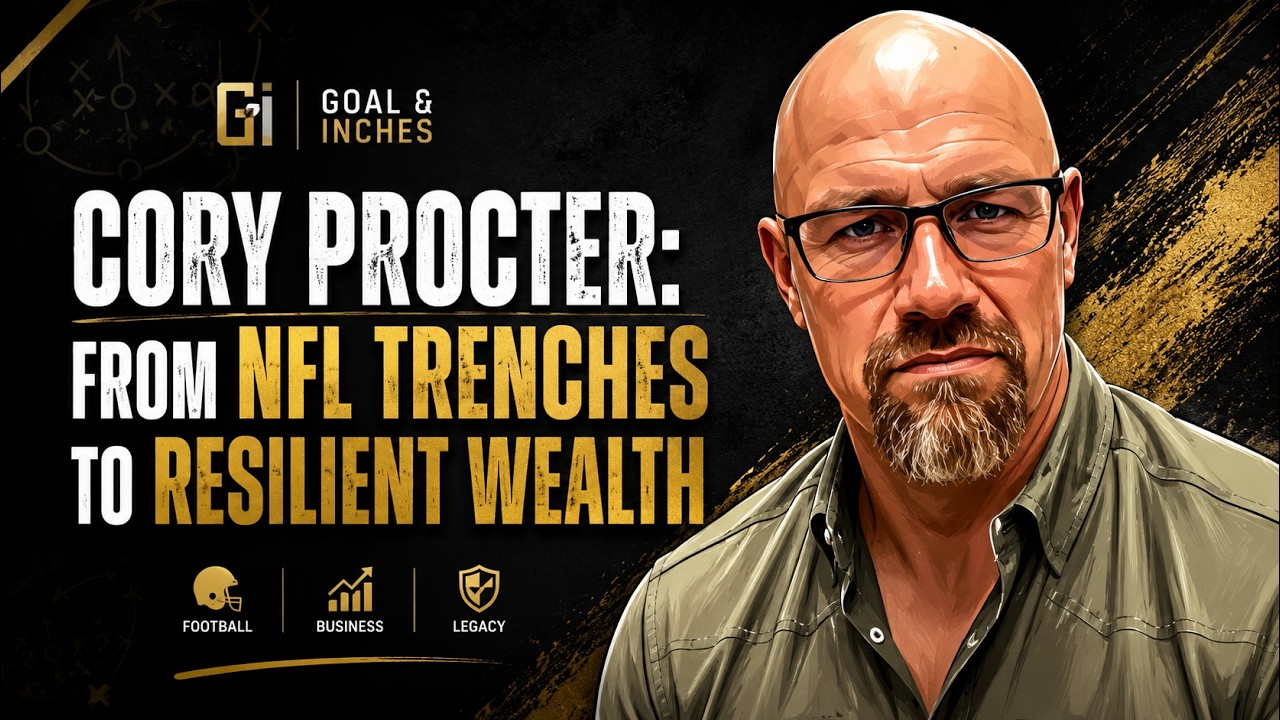
Cory Procter played 54 NFL games as an offensive lineman, 44 of them with the Dallas Cowboys, and also spent time in the Detroit Lions and Miami Dolphins locker rooms. Undrafted out of the University of Montana, he made his career at a position where success is invisible and failure is obvious, by knowing the playbook, rarely making a mental error and being able to play center and both guard spots.
Cory goes inside the offensive line: how five linemen learn to move as one, why one missed assignment can wreck a play, what it means to play with your “feet in cement” and how to get out of your own head. He shares what Bill Parcells’ blunt standards taught him about coachability, what it was like to protect Tony Romo, and how great position rooms correct mistakes without turning on each other.
He also talks openly about identity after football, the faith that reshaped his purpose, and how the same principles of protection, risk and accountability now drive his work in business and wealth management.
Key Moments
1:56 – Living with accountability when success is invisible
3:40 – How five linemen learn to move as one
8:02 – Playing with your “feet in cement”, and how to break free
11:26 – Preparing without overthinking: why time away from football matters
20:21 – Cory’s first start for the Dallas Cowboys
22:08 – Bill Parcells, standards and blunt truth
34:45 – Correcting mistakes without turning on each other
48:18 – From protecting quarterbacks to protecting wealth
51:01 – A “burn the ships” mindset: Cory’s Goal & Inches moment
What This Conversation Teaches About Pressure
Do your job on every snap. Offensive linemen are expected to execute 90 per cent of the time or more. Cory stayed in the league by knowing the playbook and never giving coaches a reason to see him as a liability.
Trust is built before Sunday. Five linemen move as one because of thousands of hours together in the weight room, meeting rooms and practice long before kickoff.
Get out of your own head. Overthinking leaves your feet stuck in cement. Simplify the plan, protect time away from the game, and play like you did as a kid.
Value clear, blunt feedback. Under Bill Parcells you always knew where you stood. Being coachable, taking the coaching and applying it straight away, earned Cory trust in football and beyond.
Be a brother first. Coaches correct; teammates pick each other up. Unless it’s an effort problem, the job of the room is to get a struggling player back on track.
Read the full transcript
All the work that is unseen is what prepares for the work that is seen. Today on Goal & Inches, I'm joined by Cory Procter, NFL offensive lineman and now founder of Pro Capital. Cory played 54 games in the NFL, 44 of which were with the Dallas Cowboys, whilst he also experienced the locker rooms of the Detroit Lions and Miami Dolphins. This conversation starts in one of the most unforgiving places in football, the offensive line. It is a position where success is often invisible but failure is obvious. If the run breaks open, people follow the ball. If the pocket collapses, everyone sees it. Cory takes us inside that world. How five linemen learn to move as one. How trust is built long before Sunday and how one missed assignment can change the entire play. We also talk about Tony Romo, Bill Parcells, earning credibility as an undrafted player and what it means to operate inside a room where standards are direct, blunt, and non-negotiable. But this is also a conversation about life after football. Cory speaks openly about career transition, identity, purpose, and how the same lessons of protection, risk, and accountability now shape his work in business and wealth management.
Cory Procter, thank you for joining Goal & Inches. Come on, happy to be here. Excellent. Cory, you played a position where success is often invisible, but failure can be obvious. Watching a game live, if a running back finds a hole through the trenches, people's eyes follow the run, not necessarily seeing how the gap was created. The O line is usually noticed when the pocket collapses or a flag comes out. How did you learn to live inside that kind of accountability? Shoot. Well, I mean, how do you got to be thrown in the water if you're going to learn how to swim. So, you got to be in it to learn how to be a part of it, right? I guess but you know as you're in that kind of environment and there's good and bad teams and poisonous and amazing teams and but like but I had been around enough good teams or enough good sports in my life that O line position it becomes an expectation right like you want and I wouldn't even call it like excellence is an expectation but do your job is an expectation. And because you screw up, one big screw-up and the entire world knows about it. And as much as that sucks, you know, you have to make a living doing your job all the time.
And that was something we used to get graded. I remember getting graded in the O line room. You know, guys would have a 60% 60 to 70% and we're getting our butts chewed on not executing our job, which we'd always laugh because, you know, if you're what if you're batting you're batting 20% in MLB, you're making Hall of Fame, something like that. But you know, we'd be kicked to the curb if we had that kind of percentage in our job as an O lineman. Really you're supposed to be operating at 90 plus% executing your job in every game and that's when you got the attaboy that's when you got a good game and it was basically if we didn't execute our job or at least get our block taken care of you know we're a liability at that point.
So within that context then how does the O line operate as a unit, how does five linemen move as one and where does that trust actually come from in doing your job off season. I mean, it's trust comes from a lot of work ahead of the game. And where a lot of people, they kind of they lose sight of this is, you know, I used to get asked the question, how does it feel working one day a week on Sundays? Right? And you're like, well, that's a pretty short-sighted question when you get asked that. And because it's the premise that you only do one work a week, one day work a week and there is no work that goes into the previous when all the work that is unseen is what prepares for the work that is seen. And so all of our off seasons in the weight room, all of the off seasons that in or in OTAs or in college spring ball or any of the even in high school, you know, other sports seasons, I wrestled in high school. So, it was relationships I made even in the mat room when we were doing that. But all that coming into two-a-days during fall camp and all the work that goes into that to practice the week of the game. There is so much study, so much film, so much field work, so much weight room work, so much that goes in to a 60-minute game that your molded relationship and trust and feel for each other all is developed before you ever get to the game time. And that's how you develop the trust and the one working as a one unit, five guys working as one that you that allows you to do anything during the game is all that work ahead of time because it what it has to start out looking at like a mess before it ever looks like something good.
So let's ask that question the other way because we do see the work the training camp footage playbook installs and can imagine the volume of reps. Why can it go awry for one player? And what does that teach you about role clarity? Shoot. Role clarity. That's a that's a good question. I mean, like people can miss a block that happens, but sometimes a missed assignment looks really clear out in the field. Oh yeah. Yeah. Missed assignment is a bad deal. You get an you get a mental error. That's not a good deal. I mean, that's that's part of the reason for all the reps is like I got to condition my body, my ears, and my eyes and my mind to be able to hear a call while things are moving in front of me and still execute the steps to get to my position. And so, that's where guys really become a liability because if you're making mental errors or you have a missed block, not even that you got beat, but you have a missed block or missed assignment, that can blow up the whole play. And now that's an opportunity lost or set back, you know, potentially a on a first and 10 now we lose a couple yards, second and 12, second and 15 potentially that now we have so much more to go get back that we put ourselves in a deeper hole. So, you know, those are bad places to be.
This is also why in the NFL when pay is on the line and jobs are on the line, you know, a guy might get a job. This is why you see a lot of amazing athletes get cut from the NFL because to be blunt, they may not pick it up fast enough or they're not willing to put the effort in to actually learn the playbook. And this is why guys like me who are really, if you want to call it, more subpar athletically, physically speaking, where, you know, I ran five a five flat 40 the best out of my even coming out of college. I only benched 225 15 times. So I was never any explosive offensive lineman from a number standpoint where anybody was excited to draft because I went undrafted. But what kept me around in the league was that I knew my playbook. I rarely made a mental error. I rarely made I rarely was a liability to the team. I might have gotten beat plenty, right? But I was always at least going to have a great effort on my block that I could organize an offensive line to get everybody on the same page. And that was really what kept me around long term and a lot of other guys in the league was because they weren't allowing themselves to become a liability and get cut within the week.
You've talked before about playing with your feet in cement. What creates that state in a player. Once it starts happening in a game, how does a player get out of it before the whole performance unravels? Man, that's a tough one. I've been stuck in there before and it sucks. It's, you know, when you're playing your feet in cement, what that means is you're stuck in your head a lot of times. And so instead of going out and playing the game like you should be playing a game, you're thinking too much about the position, you're thinking about your other player, you're thinking about too many things at once. So because of that, your body freezes and it is not able to move fluidly or fluently or in a natural state. And so you become super rigid in that case. And I mean it sounds weird, but you know, this is like shaking somebody's hand, but if you're if I'm nervous to shake your hand or I think how I'm going to how are you going to feel when I shake your hand? Am I my palm sweaty? Am I looking a different way? Or am I looking all kind of awkward? You're going to feel that energy when I shake your hand. The same thing happens with the play is if you're not acting natural, you're going to act very unnatural and play your feet are going to end up stuck in cement to where a guy can beat you and it's merely a mind problem.
So to get out of that, man, I it's really hard to share exactly how you get out of that, but you know, aside from like the Ted Lasso be a goldfish thing, but you know, the thing that I think about, one of the best talks I ever got was from Tony Sparano, one of my late coaches. He was offensive coordinator with the Cowboys at the time. He came and in our offensive team meeting, he would just talk about, "Man, I wish you guys would just come to the ball field and play like you did when you were kids. Come with your buddies to the ball field and just play." Like, just come and play. Just show up and play and let everything else out of your head. And it's stuff like that where like I'm not thinking about my paycheck. I'm not thinking about supporting my family. I'm not thinking about like if you're going to beat me or not or any of these types of other complexities in the defense or whatever we have, but go play ball. It's a game. And if you're able to release your mind enough to almost just say screw it and let the weight off and say I'm just going to go play some ball, man. I'm going to go play with my buddies and that's it.
And I've had to do that at times. I did that. I had a poor game with against the New York Giants in New York and then when they came back to Texas Stadium when we were still there had a great game. Ended up getting a game ball for it. But that's something that I remember thinking about going into the week. I was so stressed out about having some bad reps or bad games that I was like, you know what? I don't care anymore. I don't care about getting screamed at. I don't care about looking good for anybody. I'm going to go play ball the best way that I know how to play ball. And I ended up getting a game ball and having a great game because of it. And it was merely cuz I'm like, you know what? I'm going to relax and have a ton of fun playing the game that I grew up playing.
So that's an example of on game day, you've had a big week. What about can those nerves sit in or come into play earlier in the week? And where is that line between doing enough preparation to trust yourself but not doing so much that you tighten up? Man, I kind of tell everybody simplify everything. I mean like the more we can simplify things that you know the game plan the playbook at the beginning of season starts out so complex so thick and you know when it actually comes to game one and even game 10 and 15 and 18 now, right? It condenses way down and it's super small by that point because you've gotten bread and butter plays. You know what you're good at and what you're not. So you cut out what you're not good at. But I mean I go do you have your same rhythm of the week you work typically. You know Monday's review day, Tuesday is off day, Wednesday, Thursday, Friday are work or Wednesday, Thursday is main work days. Friday is you know third and long nickel plays or might be short yardage goal line that day. I can't remember. It's been so long. But like keep your natural rhythm of the week, but don't stress so much. Like get out and go do stuff away from football.
And when you're caught up, this kind of the same at work. I could sit in my office all day lamenting about what I need to do to push this business forward. And if that's all I do and I'm just chasing it like crazy, it's going to run away from me. And instead, I got to go sit with my family. I got to go sit by the fire. I got to go get with some buddies and BS and let loose a little bit and eventually what ends up coming to mind is great ideas for the business and it's really it's a clarity place. You let the weight off of you so now you're just playing the game again. And that's that's what I would encourage during the week is like section off those times, get your work in while you're there and then leave. And you got to be able to go do other things and clear your mind in those other areas because otherwise your mind just gets clouded and bogged down with that stress of wanting to perform so well that it takes you to the cement your feet in cement place and that's that's not a place that you want to be.
And is that harder to do as a youngster coming into the NFL when you're a vet, you've got family, you've got other interests. Is it easier to get away or it's really about the person just having the discipline to make sure that you get that downtime? It's both, but it depends on the guys. So, like, you know, I remember talking with Ndamukong Suh about this. He's right. He's a big D-tackle, famous D-tackle who's done phenomenally well. And I remember him telling me, he goes, "Man, when I got to when I went to a new team, I told coach, he goes, "My deal is, coach, I will bust my butt all week long and I'm going to kill it in the game for you. Don't bother me. When we're done Friday with practice, we're it's a half day Friday. When we're done Friday, don't bother me till the game." And you know, you always have like a meeting on Saturday, you know, walkthrough or something like he was like, "But when we're off, don't bother me at all. Don't I that's my time where I can get away. I might work on my business. I work on something else to get my mind off it. I need that recharge time to be able to make sure I show up at the game ready to roll." And that's and I thought that was so great because he was clear in that boundary with his coach where he's like don't sit here and try to over coach me so much and get my mind all worked up where now I'm not playing my best ball which is what you hired me to do.
Now this is tough because you know to me who was like a bubble guy I was always concerned with what you thought of me as a coach and to make sure that it was always on point at least from me not to get cut right. And so, you know, that's a little tougher. But I would even encourage those guys then because often times a lot of times I bring this up even in youth sports. You know, we get so many we get so many parents that want to over concentrate their kid in one sport and never play any other sports. And I always bring up this stat in Alabama. They did a stat. You are four times more likely to get a scholarship to the University of Alabama if you're a multi-sport athlete versus a single sport. Well, the same thing applies to your game preparation during the week. When am I most my most athletic overall physically was when I played multiple sports and had multiple domains that my body was working in. The same thing when my mind applies to the game. In order to be best prepared for the game, I need to be doing multiple things in order for my mind to get clear itself fully of each category. Now, I'm not saying that, you know, we go do 10 different things all week long, but you got to have some sort of escape to clear your mind away from football for a minute for when to be fully charged up when you can come revisit it again. And then we're ready to roll. And so that's that's a different approach than what I've seen a lot of guys in the past, including me at points where I'm so engulfed into the game. I'm so concerned about what my coach thinks about me that's all I think about and focus on and think about is a game. And ultimately, like I've overthought myself into my feet in cement again. And now I'm having a poor game. And now I'm in this downward spiral. And that's a killer place to be. So, we got to get out of it.
What did the NFL teach you about confidence that talent alone never could? So, you're leaving high school and college and feeling really at the top of your athletic prowess and then you enter the big leagues. Man, there is always somebody bigger, faster, stronger than you. That is 100% the case. You know, I was an all-state athlete in high school, ended up becoming an all-American athlete at in college at University of Montana, Go Grizz. And you know, when I got to the NFL, there's guys that were way bigger than me, way stronger than me. But I also started seeing different flavors because this is kind of like seeing guys come off the bus where they look amazing coming off the bus, but then you realize some guys aren't as great athlete as you think they are. And so there was lots of times where, you know, I would impress coaches during offseason and that's how I would get a shot in training camp was because they would I would be able to show my athleticism in the offseason during conditioning or OTAs or something like that and they would give me a shot in training camp. And so in training camp, that's where I could show I can hold up a little bit. And now rookie year, there was an adjustment for me. I needed that time on the practice squad in Detroit to adjust to the speed and understand that this is just the same game at just a notch above a little bit bigger level and that's it.
But I'll tell you one thing that helped my confidence being in the NFL was I knew one thing. I was I played scared lots of times and there were plenty of times where I'd walk up to that line of scrimmage and I'd be like, "Holy cow, this dude is a whole lot bigger in person than he was on film." And I remember having a distinct thought against the Washington Redskins when we playing in Texas Stadium. I'm like, I better punch him as hard as I can or it's going to be a long day. And so I did. And maybe I lost a little technique doing it, but I punched him as hard as I could. As soon as I laid hands on the guy, realized that I could hang with him. And so in that, I built my own confidence up in that action. And I'll give it to you like this. We one of our great coaches, one of our coaches, he passed away, but he was our special teams coach with the Cowboys at the time, and he used to tell our gunners or our edge rushers on field goal block, which was always like a corner or DB or something. And sometimes they would take plays off because the statistical probability of them getting to the block was short. And so, but he'd always tell him this. He goes, "I can't guarantee you if you're I can't guarantee if you go hard, you're going to get it, but I can guarantee you won't if you don't." And so my only thing I applied to those roles is, man, I better punch this dude and go as hard as I can. And I would realize and surprise myself a lot of times that I can hang with some of these guys. And because of that, my confidence would grow in that I can play this game. I'm meant to be here in this time. And so that gave me enough confidence to go start a bunch of games and make a lot more money in the NFL with the Cowboys and other teams.
Take us into that week before your first Cowboys start, one of the world's biggest brands. What was that private pressure like? First start was against Carolina Panthers. I started at center for Andre Gurode and obviously it's a ton of pressure, right? You're like first guy I got to do something and everybody puts it on you in the facility. So it was a lot for me. So I needed in the initial and coaches know this that you got to get in to get your butterflies out. So it's kind of like the first several rounds of a boxing match. The best boxing usually happens several rounds in or late rounds into the match because now they're tired enough where the jitters are all out, the butterflies are all out. Same thing in the game. You know, all the butterflies were there in the very beginning, but when we finally got into the game, our offense really got going and I can't remember his name, but they had this big D-tackle who was like 390 lbs. And so I had to go against this guy who was a beast. And I'm I'm 305 310 playing against this guy, you know, almost got 100 lbs on me. And I got to run through this and play against this guy. He was a good player. So, and we had enough plays that it wore me down enough that I could stop concentrating on the jitters or whatever was happening in my mind. And I was tired enough where I had to focus on catching my breath to now allow me to play the game. And if you played anybody who's anybody who's like played in like Flagstaff, Arizona or a place that's high elevation and they're worried about catching their breath, you forget about focusing on the opponent so much and you're just like, I'm just trying to survive right now sometimes. And surprisingly enough, I've had some of my best games in those situations.
What did playing for Bill Parcells teach you about standards? He has a reputation for bluntness, pressure, and clarity. What did his environment demand that was different from anything that you'd experienced before? I love that guy, man. It's if that's my language, it's direct and blunt. And we don't have any time to waste on niceties. And I'm like, you know, I like, you know, having a little bit of surface talk for sure, right? How's the weather type stuff, but here's we're living a short life and I don't have time to screw around. I'm I'm here for my family, my business, my faith. Those are the things that are important to me. And if it doesn't serve those three, then I'm gonna leave. And so this is where I like the guys that are all signal like the Elon Musk's or even the Bezos of the world. It's like we got to quickly cut out the crap. And that's what that's what Parcells was. And so you always knew where you stood with them. And those are the people the most real. I just made a LinkedIn post about this, but those are the people I wanted to be. I want it so bad for you to tell me the truth because that's the quickest way for me to get better and the quickest way for our relationship to get better. And honestly, if you're truthful with me and we realize that we're not a fit in working together, let's move on. We're not serving each other any good at all if we're not truthful with each other and real.
And so, but what he taught me in that was, you know, he had certain rules that I really love. Like I even remember in the red zone, he had a rules. No exotic snap counts, no jumping off sides, no exotic plays. And those were basics because we're in the red zone in a position to score. So do what you do best. Don't try to church it up and screw around and dig yourself into a deeper hole. So I appreciate that about him. But what I loved about him was essentially the standard that was set. Get your stuff done. And what looks like a really hard exterior or maybe some people even think looks like a jerk on the outside really isn't that. It's no time for garbage. I don't have time for wasting time in my life. And so I've had people that even come into my business that they think that I'm a jerk. And I'm like, I don't have time to screw around with you right now if you're not going to work.
And so that's what Bill liked about me and the mutual respect that we had and I really appreciate what he shared was, you know, my one of my favorite stories from him was I came into the weight room in Oxnard, California, and he was he used to call me Grizz from Montana. He goes, "You're doing pretty good, Grizz, right? You're moving back and forth between left guard, right guard. That's not easy." He goes, "You're doing pretty good. You're a pretty smart guy, too. You're no freaking genius." which you're pretty smart and he could never give you it he was always a backhanded compliment, right? But I mean what I loved about that was you knew exactly where he was and he was clear in his communication. And so if you're not clear in your communication exactly what you want, one side is going to muck it up somehow. I have to be clear to you and if it's for you, if you're not receiving it clearly, that's on you. But if I'm if I'm communicating clearly and there's some sort of disconnect, we're not going to really work out. And so ultimately I'm a guy that is he could say that to I need more than that Grizz or he would coach me up a little bit and I would fix my problem and I would execute a better rep the next time. And because of that, I was coachable. He liked me. And now that's been the same thing from every mentor coach even past football that I've had in my life is I would just take their coaching and go apply it to whatever I was doing. And because I was willing to run, you tell me to coach me to run through a wall, like I'll run through the wall. There's I don't mince words or actions at all, just go do what you tell me to do. And because of that, I've been able to gain great favor with people in my life merely because I was coachable and willing to listen and get the success that would came from it.
Fascinating. What about from the perspective of the rest of the O line at the Cowboys? What did that teach you about earning credibility? You mentioned being an undrafted free agent. What do the veteran offensive lineman respect? Well, they like the guys that are workers. Anybody who's anybody who like you like individuals, right? So, if you're a great weight room guy, which Bill Parcells is a big weight room guy, so he required you to hit like 40 workouts in a offseason. And so, if you didn't show up, you didn't really have time together. If I don't have time to hang with you, then we're not really developing a relationship at all. You're not seeing me work and I'm not seeing you work. So, you know, there's lost opportunity in that. And so, one, it's born in the weight room and on the practice field. Then, when you put the pads on and you see you can actually do some things and you can move and can run and you can make blocks and you can get back up and you're tough. All those things that football brings to the table or sports generally brings to the table. You start gaining more respect.
And the I'll tell you one very cool thing is my last couple years with the Cowboys, you know, they're always trying to replace you. They always want to find somebody better, cheaper, all that stuff. And I remember when they were trying to replace me and they had several guys coming in at center guard position trying to do that. We were doing one-on-ones and they had brought a new guy in and Stephen Bowen was one of our D-linemen at the time with the Cowboys and we were doing one-on-ones and Steve ran over this guy and I'm sitting in back. I'd already done my rep and I'm sitting in back and Bowen ran over this guy in one-on-ones and he as he's running by me, he just said, "That one's for you, Proc. Let's get that trash out of here." and legit it was one of the coolest things because all that was a stamp on his and my relationship or a mutual respect that has been grown over the off seasons and seasons together of battle and that's we both had fought so many times and Jay Ratliff was one of these guys where he was like you know we fought each other on in the during the week and he was like man I hate you during the week but I love you on Sundays and it was like why is that because as much as I hate fighting with you and we're butting heads all the time and we don't, you know, agree because we're both trying to beat each other. That's the kind of guy I want on my team when it comes time to win. So that when you talk about earning respect, if you're not getting the work done and willing to fight and show that and fight it out with each other, might as well just walk away.
Let's look at the relationship between the QB and the O line. You protected Tony Romo. What did you see up close in terms of command, communication, toughness, even improvisation? How was that trust with the O line developed? It's reps. I mean, hey, it's it's cool. The good thing about Tony was he became a lot better passer, even more so as he aged, but he was a great improv early, right? That's what got him exciting. That's got him a Pro Bowl. And then, he made big plays also, which was awesome, but he was his improv was awesome. So that it made the game exciting, not just for the fan, but it made it exciting for the whole line, too. So it was like if listen, if you can duck out of a bad play that I caused or I created, then God bless you. Thank you so much. So that's what he helped create. So because of that, you know, he would give friendly jabs. Quarterbacks can give friendly jabs to O line and be like, you owe me one and now we can get on to the next play. So, you know, he was he's a great guy. I appreciate him. I haven't talked to him in a long time, but you know, he was something that people don't know about him before he got a starting role. You know, he came from he was undrafted guy from I think it was Eastern Illinois, one of the Illinois teams. He was the first guy to give me his phone number when I got to Dallas. And he was just because we're both 1-AA football guys and he was like, "Hey man, any anything you need, let's go hang out." And so that sticks with you. It's like those guys that are willing to connect with you to be like, "Let's whatever we're doing, let's go hang out. We're we're cut from the same cloth."
When protection breaks down, what's usually misunderstood by the fans? Oh, fans don't know what the heck they're talking about. Majority of time they have no idea what's going on. Heck, there's so many times the announcers don't know what they're talking about. I remember watching Jon Gruden when he was announcing. I remember him watching and sharing how the guard missed the block. And I'm watching this play and I know exactly what the pass scheme and the blocking scheme is versus the defense and the dog that's getting run on the defense. This is a strong dog that was getting run. It's a left guard's guy was looping out. The left tackle is just floating out to nobody and completely leaves when this is a tackle's guy and he blames it on the guard. And so I say that because even announcers don't always know what the heck's going on. They're just talking heads most of the time. So, you know, when it comes to the fans, they for sure most of the time don't know what's going on. They're fans of the game, which I appreciate. Some of them know what's happening because they may maybe learned up on the football field, but largely if you haven't been in the film room forever and have studied this thing forever, you're going to have a real misplaced judgment of where people are winning and losing and or whose fault is what when a play goes wrong. And it always cracks me up cuz I don't necessarily like hanging out with the people who want to act like an expert in an area they have no authority in, you know.
Without going into names, at the NFL level where everyone knows football, what's the difference between a coach who makes linemen better and a coach who might make talented players play a little smaller? I would I tell you what, I hated the coaches that were just screamers. Like, don't stop screaming at me. You know, they you know, I get it. Some guys are more intense than others, and that's great. But if you're going to be an intense coach, your players, you better be good at your drills, at your own technique. But you also better know, understand that you better care about your players for them to give you everything they have. And I've played for the coaches that were just screamers and they didn't care about you. And because of that, I didn't care about them. And it's a really bad place to be when you mutually don't care about each other. No, we're not going to win in that situation. It's a bad deal. And so there's a there's a two-sided portion there that I would challenge a coach and a player to be the leader in that situation if they're struggling with somebody to approach them and try to have a man-to-man talk about what's going on and how we can win together. Right? Because if you're my coach, I have to be on your team before you're going to be on my team because you can easily have me cut if you really wanted to. And then the other side is that coach, if all you're doing is screaming and you're not a real example of a man who's in shape who can handle another man, which is what the offensive line and defensive line is all about is manhandling these other giant dudes, and if you're not an example of that, chances are you're not going to be a really great leader for it. So that's that's that's what I share with coaches is don't be the jerk that is not an example of somebody you want to be.
So that's the relationship between player and coach and you mentioned the pressure franchise is always looking to get better and cheaper. So from an O line unit perspective if a player misses a call or loses a block and the whole unit pays for it. How did great rooms correct mistakes without turning on each other? So, I actually got this from one of my college coaches. We used to have I screamed it. We had this was in Montana one time. Our O-line coach and I remember this senior year. So I'm a leader in the team right now and leader on the O line and our second team was jump kept jumping off sides during training camp and I was screaming at him for whatever reason and I remember he pulled me aside after a walkthrough we had that evening and he just told me he was like hey let the coaches get on the guys, let the coaches jump on them, you're the brother, you're the player, right, you pick them up. And that stood with me. That was, you know, that was 2004. That stood with me for 22 years now. And that made a moment to me was when, you know, if your guys are screwing up, make sure you're a brother to especially if your teammates, make sure you're a brother to them and pick them up. Let's go. Let's go. Let's get back to work. Come on. Next rep, next play, anything. Because I need my I need encouragement to get my head out of the sand. Just like you do at times. And especially guys, we can go to real poor aggressive places where we need to get picked up out of that really fast.
And so, you know, for players, we know we got to be accountable to each other. Now, if there's an effort problem, that's when you got to get on each other hard. Like, that's when I'm going to yell at you if you're not giving your best effort. Where if it's a totally different deal where if you're giving your great effort but you're still screwing up. Maybe you're getting beat physically or something other thing, that's when I got to come pick you back up. I'm like, let's go. Let's go. Cuz it's not an effort problem. It's a it's a different problem other than that. And we just refocus and come back to the game. So, you know, keep from imploding. I would just say remember that you are a brother to each other first. And aside from the only exception of an effort problem, if everybody's given great effort, then there's no screaming that needs to be had. There's all there is picking each other up. So if you have that, that contributes to a whole different positive vibe that everybody can feed off of. And you know, some guys go in the hole and they don't want to hear anything and that sucks. But collectively, we got to go pick guys up.
Fantastic. That sounds like good advice in any industry. Cory, what's the hardest challenge in offensive line play that outsiders do not understand? Hardest challenge outsiders, man. That's a that's a that's a tough one right there. I mean, there's probably a whole lot they don't understand. I mean, the complexities of multiple defensive schemes that you got to be prepared for and not just schemes, but movements and looks and play calls and everybody's got to be on the same page, especially for a center to orchestrate the whole thing. All that prep goes in ahead of time and everybody's got to be sharp on there. But I don't I don't know why this comes to my mind when you ask this, but I had the picture of postgame when people wanted to meet after the game, everybody wanted to shake your hand all hard like everybody like we post, you know, after out of the stadium, you always met a bunch of new people and so every one of them would come up and shake your hand as hard as they could and prove that they were like equally or more strong than you are than a Cowboys offensive lineman, right? And I'm like, dude, what are you trying to prove right now? I've been punching guys for the last three hours straight basically and my hands hurt. I just took off my gloves and all my tape and my hands are all raw from punching guys in the helmet and pads and you want to sit here and act how strong you are. I'm like how about that? Let's just shake hands normally. And if that's anything that people don't understand about that whole line is we get physically beat up during the game. I'm like, "Stop trying to prove yourself to me afterwards when you weren't just spending three hours. You're drinking for the last three hours." I was battling for the last three hours. So, let's not try to prove yourself to me like that. Let's Let's just be real.
Cory, I'm really interested in, I guess, the specialist versus generalist development. You mentioned it's very valuable to play multiple sports at college and you played center left and right guard. The attraction of versatility is obvious from a roster perspective. But from the players perspective, how do you realize your potential when you're preparing for multiple roles? Well, it's a it's a tough deal because I mean, you got to get a chance to start, right? So, at the beginning, you got to be a bit of a generalist. So, if especially if you're like me who is an undrafted guy who's bottom of the roster trying to make the team, I got to be able to do multiple things and so that's just a requirement from most backup positions. But at some point you get a shot. And so whether it's a left guard going down like Kyle Kosier did in order for me to get a shot to start with the Cowboys, you know, that opens up a spot where I can come in and potentially fill a role, you know, or it's a Dak Prescott who came in and replaced the Tony Romo when Tony got hurt and Dak was playing really good and now it's Dak's team. Well, he filled a role that all of a sudden he was able to take care of, right? And that's often times how it happens is even if I'm preparing from three different positions or multiple positions, you know, a spot opens up somewhere from somebody getting hurt or playing poorly or whatever it is. And if I go fill that spot and do well with it, a lot of times I'm going to end up owning that spot. And that's how I specialize.
When your body's the asset and suddenly it can't do what it used to do. What did that career ending injury reveal that football had hidden? Oh, go ahead. I know. I know you mentioned that it wasn't instantaneous like you were when the injury first happened, you certainly thought you were going to make it back. So, this would have happened over a longer period of time, but yeah. What realizations became apparent that maybe you hadn't foreshadowed? Well, you don't realize exactly how much of your soul you poured into an area, a certain area of life like football until you can't have it anymore. And so, you know, like many people, you know, I wanted to make Pro Bowl. I wanted to win a Super Bowl. I wanted to be a full-time star. I started a lot of games. I wasn't a full-time starter. And so, you know, I wanted all those things just like any guy does when it comes in the league, but I didn't get them. And so, you know, missing those goals that you wanted to go after and not attaining the things you wanted to attain, essentially having somebody else tell you that we don't need you anymore is a pretty hard pill to swallow. And I'll tell you in that is for every guy is a ton of soul-searching. And you just kind of reach a wall of like what the heck do I got to do? What is what's the point? And so, you know, unfortunately for a lot of guys, it can lead to a poor place and end in a poor place. But in those situations, what it started revealing was the relationships that I had in my life, who was around me, who actually gave a damn about me, and football was not necessarily a part of that, but also how tough was I mentally now in a place where I had no one to fight but myself.
And that's probably the biggest reveal for me was you know football was such a great like many guys like their job is this is the thing I can go chase right this is the thing that's concrete and you know when somebody gets fired or you get let go or a major life transition happens like there's major soul transition in that process too and for me I had to go find my purpose all over again now. What I found was my faith. And because of my faith, I get I can get in right standing with God and essentially reconcile a bunch of the trash in my own past that I hadn't reconciled yet. And so for me, like the order that it took was essentially salvation. I realized I needed God in my life and I had to give my life to him. Reconciliation. So he had to clean up all the trash and I had to realize all the trash that I had brought to my life. Then once I had salvation, reconciliation, then it released vision into my life for what he was calling me into. And so that's when I became a rabid consumer where I was a good student before, but I became an insane consumer where I wanted to read every book I could get my hands on. I want to listen to every message, every TED talk, every testimony, every story and every interest. All of a sudden, my life became started lighting up with interest in other areas. And because of that, because I became a rabid consumer, I became an overflowing cup of information. And so all of a sudden, speaking engagements came in and all opportunities started showing up. And it's because that's when I lit up. I started getting bits of vision released into my life where I could start taking more steps after more steps into the next thing. It was still confusing and I wasn't sure where I was going, but enough was getting released where I could start seeing light in the end of the tunnel and see an opportunity. And that's what lights a guy up.
And guys, if anybody need vision in their life, the scripture talks about without vision, my people will perish. So for me, you know, all of a sudden I started realizing in my scripture and my faith walk the deeper context and what it meant to be a husband to my wife and what it meant to be a father to my children and the representations of those things and the effects that it has not just in this life but in eternity. And then the job ultimately like my business that I started was a mission born from my faith or born from context of my faith. My nephew passed away from cancer and in that God used to reconcile me and I was so ticked off. But all of it's a longer story for another day. But all of this led to everything that I do right now. So you know where some people feel like I can be intense at times which absolutely I can be. Reality is I'm convicted and I'm convicted. And this is what I talk about in not wasting time is we don't have time to waste. If I got to get a message out there that God is you need to get right with God and get in alignment with him in order to release some explosions into your life that you need and get out to a vessel that is bigger than you. And so only in that does your mind start wrapping around what's bigger. Right? Especially guys, if you're trying to make more money, like you know, when I came out of college, I got an $8,000 signing bonus to the Detroit Lions. I was like, I'm rich. 8,000 bucks. I'm like, I'd never had that kind of money before, right? Well, you know what? What if your mind starts wrapping around 80,000 or 800,000 or 8 million all of a sudden and this is where you start elevating your life and really God can start expanding you to other new capabilities that you have available and in this grand ecosystem. It is the coolest thing ever when a guy starts realizing his vision and starts walking and acting it out because then you start seeing him excelling.
And I this is what I love because I tell guys that are coming out of football now. I said you need to get to church. You need to get in your relationship with God and start understanding asking the question where am I supposed to be? And you start understanding your craft. We might give some practicals in there that are really good like a strength finders test or something. But when you start understanding those practicals and where you're supposed to be, understand your natural gift set, your natural strengths, you start walking into a whole bigger ROI. And so all of a sudden, my rate of investment or my rate of return on my time, money, and effort is way bigger than I ever imagined it could be. And it is the coolest thing in the world. And that's something that I am very passionate about in my life cuz I've seen the fruit and I've seen the explosion and I want other guys to find that.
There's an interesting thread between your business and O line play for wealth management protection risk and possibly one missed assignment creating major loss. Do you see any connection there? Sure. I you know I what I like about our business it's a we can get on the whiteboard and draw out the play like I get somebody's life and I get my team knows it now. The first time my number two, McKenzie, ever saw me draw somebody's life up on the whiteboard she was like this is like some Rainman type stuff I don't know what this is right and but the more she's seen it the more she's understood it and the same with the rest of my teammates. But really, it's a big puzzle piece. And how fun is it? Everybody knows the high of like putting together a big puzzle, even if you don't do it today, but you did it as a kid. When you fix something, you feel better about it, right? When you execute a task that took a lot of effort to get done, you appreciate it. And so, so much is better a meal that you cooked than from somebody else. Like your hands went into that preparation. You're like, "This tastes good." And so the same thing when it comes to your work, it's like, man, we prepared a lot. But then you start taking the risks in your business to go after bigger things and you start realizing, you start getting some bigger things and you're like, "Holy cow, you just freaked yourself out and I never thought that I could, you know, score a $30 million deal. I never thought that I could score a hundred million deal." But then when you get a yes in those deals, all of a sudden you're forcing yourself to have to one go execute the job you're you said you were going to do, right? But you have to go learn new nuances within that level that you're now operating. And so that the stuff is the coolest thing to me because you know when you start talking with your first billionaire for the first time about doing business together, you're like this is in another stratosphere that I've never dealt with before. But this guy has totally different problems than these other people. And that's something that's pretty cool that I get to go learn about right now. And at every level I get to learn a new thing. And some people have similar nuances. And I have high probability problems that I'll go attack. But you know those are cool things that when you start challenging to go bigger and bigger you know shoot life meets you at your level of audacity. So like why not go and swing at the big thing and take a risk and if you don't get it so what? Let's go swing at another big thing. And it's that you'd be blown away at the big wins you could gain in your life if you would just go try.
You mentioned in your book there's a million kids playing high school football every year. So across all the franchises, 2240 players including the practice squads at any one time in a profession with an average tenure below four years. When you reflect upon your NFL career, was there a Goal & Inches moment that changed the arc of how you realized six seasons? There was never another route for me necessarily, you know, like I remember my head college coach at the time, Bobby Hauck, which you know, I love him. He's he's a great guy. But he had shared one time, basically shared me that stat. He was like, "Most guys don't make it." And how I receive that was like, "Oh, so you don't think I'm going to make it, right?" It was like, "It's not how he intended. He was just trying to be real with me." And but I took it like that. And so, you know, my mindset was never in another direction, which a lot of guys are like that. But because of that, I've always had a bit of a burn the ships type attitude. And the same thing in my marriage. What are we doing together if we're not going to be together and like fight out and work out this problem? Like I've seen so many guys their marriages failed because they were fighters on the field, but they weren't willing to fight in their own home for their marriage. And it was the wildest thing to me to see that stuff. And so to me having kind of that burn the ships attitude was that was like I had that with football and because of that you know I was willing to go talk to my coach. I was willing to go talk to him to see what I needed to do to get things done. I was willing to go bust my butt and do all the things more than other people.
And that's a big thing that I realized was even as I got outside of football, I realized the bar is way lower in the world than it should be. And I'm like, holy cow, with all these people that are lazy or have a false sense of what hard work is. And some people's level of work is literally their hard work is I remember having this when I was a kid. You know, you thought you did 10 push-ups, you're like, "Ah, that's good for the day." and you knock it off. I'm like, meanwhile, the guy over here is doing a thousand push-ups, you know, and killing it a day or several hundred in a day, whatever. His workout is completely different from yours. So, his sense of hard work is completely different from yours. Well, that guy's going to go get a whole lot more done. Typically, if I can apply that same volume in the right focus in the right area, whatever facet of my life, I'm going to have more out of it and I'm going to have more success because my level of work is way greater than this other guy who's only doing the 10. And so that's that's what I saw even in the league and out that propelled me past was my own capacity for work and my speed at which I got it done was so much greater and faster than everybody else. And because of that, it allowed a guy who was necessarily a subpar athlete but had a massive capacity for work and speed do a whole lot more than other guys who were way better than me.
What a fascinating journey. Cory Procter, thank you so much. Congratulations on a tremendous NFL career and now all that you're doing with Pro Capital. Thanks for joining Goal & Inches. Appreciate it, Andrew. Thank you. A big thank you to Cory Procter for joining Goal & Inches. What stood out to me in this conversation was the thread running all the way through it. Protection. In football, protection means the five linemen doing their job with clarity, trust, and accountability. In business and life after football, it means understanding risk, protecting what matters, and building something that can hold under pressure. Cory's story is a reminder that elite performance is not just about talent. It is about preparation, standards, coachability, resilience, and the willingness to keep building when one chapter closes. If you found value in this conversation, please like the video, subscribe to Goal & Inches, and share it with someone who cares about leadership, preparation, and decision-making under pressure. Thanks for watching. I'm Andrew Johnson, and this is Goal & Inches.
More Pressure Tests
Episodes