
It’s not about how heavy he can squat or how fast he can run if he can’t do it on Sundays.
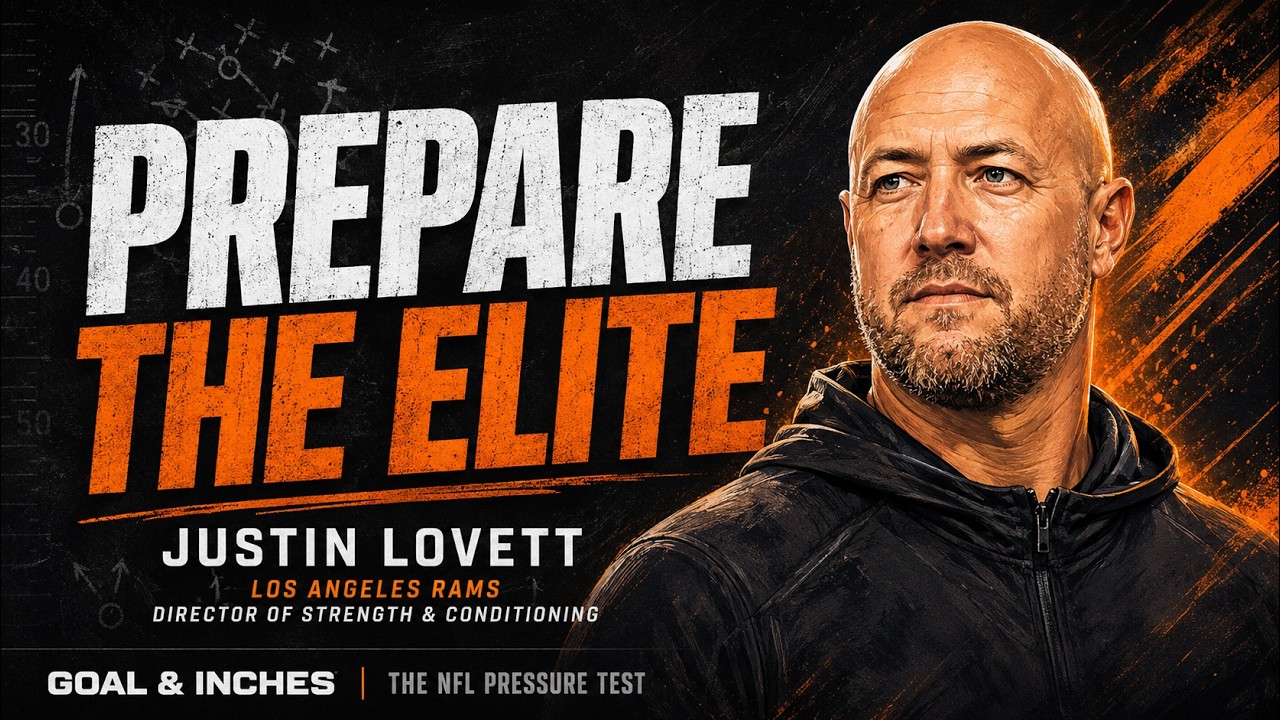
In the NFL, the real scorecard isn’t how much a player can lift. It’s whether he can play on Sunday. Justin Lovett, director of strength and conditioning for the Los Angeles Rams and part of the staff that won Super Bowl LVI, takes us inside the performance system behind one of the league’s elite organisations.
Justin explains why player availability is the truest measure of his work, how strength and conditioning aligns with coaching, sports medicine, nutrition and performance science, and why the Rams use data and AI without “chasing ghosts”. He walks through the NFL calendar from locker cleanout to the playoffs, how positional blueprints and individual “buckets” shape each player’s programme, what changes when college players become professionals, and how return-to-play decisions shift between the regular season and the postseason.
He also shares how the Rams approach long-haul travel ahead of the NFL’s first regular-season game in Melbourne, and what he saw up close in Aaron Donald’s preparation before his decisive moments in Super Bowl LVI.
Key Moments
2:16 – Inside the NFL year for a strength and conditioning director
7:52 – What outsiders misunderstand about NFL strength and conditioning
10:49 – Why player availability is the real scorecard
13:50 – “It’s never about you”: building a player-first performance staff
25:37 – Data, AI and why the Rams “don’t chase ghosts”
31:31 – Blueprints and buckets: individualising player development
40:55 – What changes when college players become professionals
44:43 – Managing risk and return-to-play decisions
What This Conversation Teaches About Pressure
Availability is the scorecard. Every team can be compared on whether its players are fit to play. Strength and speed only count if they show up on game day.
Hire for character, not ego. The Rams look for staff with empathy and passion who keep the focus on the players. Anyone who talks mostly about themselves doesn’t fit.
Break down the silos. Training days can’t be planned without coaching, sports medicine, performance science and nutrition aligned on what each day is meant to achieve.
Don’t chase ghosts. Data and AI help spot problems sooner and validate decisions, but one reading is not a reason to overhaul a proven programme.
Consistency beats complexity. Rosters turn over quickly, so simple, well-taught routines and a steady weekly rhythm, at home or on the road, protect performance better than clever one-off ideas.
Read the full transcript
In the NFL, the real scorecard is not how much a player can lift in the weight room. It is whether he can play on Sunday. Whether the body holds up, whether the preparation survives contact, whether the systems behind the athlete are strong enough when fatigue, travel, pressure, and injury start to accumulate. This is the hidden side of elite football performance. We write, develop, implement, and facilitate strategies that we feel will allow our players more frequent access to their elite performance traits and attributes. A Super Bowl may be won on game day, but it is often shaped much earlier in the off season, in the weight room, in recovery, in travel planning, in nutrition, in the way an organization manages risk, readiness, and resilience across a long NFL season.
Today on Goal & Inches, I'm joined by Justin Lovett, director of strength and conditioning for the Los Angeles Rams. This conversation is not about gym numbers. It is about the performance system behind one of the NFL's elite organizations. We discuss why availability is one of the truest scorecards in professional football. How strength and conditioning connects with coaching, medical, nutrition, and performance science. Why the Rams do not simply chase data for its own sake. And how a team prepares bodies to withstand the pressure of an NFL season. We also go inside the demands of international travel, the challenge of the Rams upcoming trip to Melbourne, and what Justin saw up close in Aaron Donald's preparation before one of the defining moments of Super Bowl LVI. This is a conversation about standards, systems, and the work that has to hold long before Sunday arrives.
Justin Lovett, welcome to Goal & Inches. You got it. Pleasure to be here, Andrew. Excellent. Look, Justin, one of the theses of Goal & Inches is that a ring may be won on Super Bowl day, but it is often lost much earlier. From locker cleanout day onwards, what does the next 12 months look like for a director of strength and conditioning? Yeah, that is a unique challenge in the sense that once they clean out their lockers, we go through what's called a dead period. So, we're unable to contact, excuse me, we're able to contact with our players and provide virtual frameworks for their performance programming, be it in the weight room and or on the field, but we are unable to meet with them and coach them on site due to the collective bargaining agreement that we abide by as an organization. And its league-wide mandates restrict our access to our players. So that's a unique challenge from cleanout till April.
Once we get into April, we're we're running OTAs and or organized team activities. And those activities include three phases. Phase one where your players interact with the strength staff and in weightlifting and on the field. Phase two is where coaches are taking the field with your players. So our role is limited to weight room activities and you know return to play settings. And then phase three is more amplified or competitive team activities with coaches. So really our runway from when we see players to onboard them to football activities is two weeks of lifting and running by ourselves. And once the off season, eight or nine weeks depending on which you know what your team philosophy is and new coaches have two more weeks in addition to that they can access. After your offseason program, you have another dead period. And your dead period would be four to five weeks and put you into July.
Late July is when our team reports to training camp. And training camp is, you know, offsite and usually in a college or away from your facility in some cases. Some organizations will build out your training camp at their home base and provide fan access to lifts, you know, practices, meetings. I mean, that's what all your players are doing. Your fans can be a part of, you know, the on-field portion, but and watch. But training camp is usually three weeks. And in that time, you're you're participating in preseason preparation and preseason games where your younger players get a chance to develop and get cracks at making the team some kind of way. And your veteran players are either playing to refine their skills and crafts or they're being rested in order to prepare for the regular season. The regular season would take place from September through January and then the playoffs would start January and take you through February and you know it's a long season so there's 17 regular season games and up to three or four playoff games including the world championship and then that would bring us full circle back to the end of February, our dead period where we started.
When people talk about winning in the NFL, they usually start with scheme or talent. From your seat, how much of winning is really built through standards and preparation long before Sunday arrives? It really presents itself in their process. Everybody at this level, for the most part, has a discernable talent that got you to this point, whether it's speed, size, or technical ability. And usually it's a combination of all of those. What we find separates players from one another is their professional process and not just film study or the willingness to improve tactically, but it's how much time and effort they dedicate to their nutritional habits, to their sleep habits, to their recovery habits. And it's not easy to fall in love with things that will make you bigger and stronger. But it is very difficult to fall in love with some of the time that it takes to help your body and your tissues turn over to allow you to perform at an even higher level for the next practice.
So I would say that it comes down of course there's you know scheme and talent and you know strategy involved with you know putting your players in their best situations and allowing those players to really accelerate. But it's the hidden secret is the process the frameworks that surround your everyday habits. The consistency of which you attack that process can really be a differentiator. If your average career lifespan in the NFL is two and a half to three years you know what separates players from being able to last longer or shorter than that I would say it's dedication to your professional process and how you take care of your body.
Well what do outsiders most misunderstand about the job of a strength and conditioning leader inside an NFL organization. I think that most would look at your statistics and chalk up your team's ability to run the ball or stop the ball as something of unique importance to strength conditioning. You know, initially the power and strength. When you think strength conditioning, you're thinking of can your guys move other people? Can are your players resilient? Can your players run all day and be repeatable and fresh and ready in the fourth quarter? I'd say that's initially what most and I did too when I gravitated towards this field. That's what you think of strength conditioning. But what's misunderstood is the really critical importance of collaboration and alignment throughout an organization or a program from your tactical onboarding through your coaching staff. Does that align with your field, your tissue onboarding that you experience from the strength conditioning world of max velocity days, shapes and exposures of change direction, deceleration, accelerative efforts and do those metrics ramp themselves?
The other piece is nutritionally. Are you timing your menus and your post-recovery or pre-activity supplementation? Is it centered around your high stress days? And are your strategies modified through low stress days? What about everything that surrounds your players within sports medicine? It's access to specific recovery modalities. And when you choose to access specific recovery modalities over others, is it a volume? Is it an intensity modality that is chosen to help you recover? So, it's really to me most outsiders think that maybe it's five sets of five with heavy weight on a player's back. And in reality, it's it is that is a critical piece of when you chase strength and when you chase max velocity and sustained speed outputs. But it all does not exist in a silo. You must have specific alignment and collaboration across your whole performance department. And within that performance department, if you are not tied in with your tactical build-outs and your coaches aren't viewing their tactical development through a performance lens, I think that is what's often misunderstood from my seat.
You've described the NFL as a pure environment because work is ultimately audited by player availability and readiness. How does that reality influence the way that you make decisions? Yeah, I think that it in a professional sense, if you lose man games due to injury, that comes at a cap salary cap cost, which puts you at a competitive disadvantage against your competitors or a cash value that is lost that your organization has to account for to replace an injured player, to fly out other players to try out in an effort to replace the injured player. And that you have to factor in the player's cost that his contractual cost that he's owed that and then he's not able to take the field. So when we're saying a pure environment, we write, develop, implement, and facilitate strategies that we feel will allow our players more frequent access to their elite performance traits and attributes.
And if that's the case, there's going to be pinch points in your weekly schedule and your monthly schedule, depending on travel, depending on style of play that you would encounter from week to week. That's going to cause you and your performance team to make audibles. Maybe it's in exposures on the field. Maybe it's, you know, it could be a compounding effect from previous games with snaps played that puts your player at a position that he is at elevated risk of a soft tissue injury. Or maybe you're experiencing fatigue or you're seeing fatigue throughout his metrics where he's tested on the field or he's he's in the weight room. And so the ability to make audibles is the most key and critical thought process that you have. That player has to be available to play at his potential. And if he's not, then I don't know what we're what we're doing this for, right? It's not about how heavy he can squat or how fast he can run if he can't do it on Sundays.
So everything really comes back to is the are you helping the player prepare, develop, and be available. And if you know you are, then that's why it's pure is because we all have the same scorecard. We all can look at player availability at the end of the day and compare 32 teams against each other. Whereas if you were to break it down to say how many fast guys do you have? How many strong guys do you have? You know, you could have many fast guys and many strong guys, but if they're not available, then it's not truly a comparison that we find redeeming.
Just diving a little bit deeper there. So, I've heard you say it's never about you. In a league full of status and I guess money, how do you actually build a high performance environment where the work stays bigger than the individual? Well, we know that the players drive everything. It's a player-driven league. Our coaching staff and our support staff are really working in unison to help our players play better, shine, be resilient, and become available. So from a performance standpoint, we make sure that we have a competitive process when we hire or onboard new coaches or new support to our staff that have abilities and attributes that can unlock certain modalities or strategies in return to play, strength conditioning or field performance that we might find valuable. I would say how do we make it work initially is we don't hire narcissists. We don't hire people that are about themselves or have a secret agenda. We really try to search for people that are great people first of all that have empathy. They have passion about this industry. And I'd say that it's as simple as that. If you find that your candidate or somebody on your staff is using a bunch of "I" language or it's about them or what they did, that really goes against everything that our head coach in our organization is about.
So, usually those candidates don't make it onto our staff in a full-time capacity because it's it's about the players. That we are a bunch of, to quote Mike Tomlin, who is a longtime coach in this league. It's we're just replaceable, nameless, gray faces. And I could care less if a player knows my full name. I'd rather that player know that when they come into our room that they're going to get good care, that they're going to feel like we're invested in their success, and they feel like we can individualize programming to fit them. And it's it's a relationship that allows us to keep building and keep individualizing programming as they progress throughout their career and have different needs or different strengths and weaknesses that they want to address.
Noting your comments earlier about the blockout periods. So, in a long NFL season, how much of your role is preparing bodies, and how much is helping build the standards and habits that players can take off site themselves and allow a team to hold up when pressure, fatigue, and injuries start accumulating? Yeah, the professional process developing strategies is year round. So it starts whenever we see and we're we're aiming to educate and be transparent with our strategies so that it makes sense to the athlete. Why we would deploy certain strategies and education as to the intent is critical for buy-in. So that doesn't stop when they leave the building during dead periods, but that continues through virtual build-outs and frameworks of those exact principles in a format that can help them facilitate their own lifts and runs away from our facility. And it requires constant communication because again with alignment through sports medicine, they might have treatment plans available to them and they'll need resources back in their hometown of who to find and who would the Rams personnel trust to help facilitate their return to play or their rehab.
With our dieticians. They've they've built in their own processes about calorie tracking and meal planning. And with that, when they leave our facility, the next step would be to help them keep their strategies or find a personal chef that they can hire or send supplements to them and check in and make sure that we are in it together. It isn't just send a 10-page pack home and we'll see in four months. There's constant check-in, constant communication, and our aim is to keep a conversation going so that they view us as assets and resources that can help them on their journey versus maybe somebody that's lording over them or requiring work or evidence of work or there's a threat of them coming back to us out of shape. So, there's going to be a test and consequences. All that certainly exists to, you know, various levels across the NFL, but for us, we're not really interested in that. We're interested in fostering a relationship, a professional and helping them build a professional framework so that when we are not available to work with them that they feel that they have a strong connection and a strong strategy that they can rely on that is proven that they're engaged with and that they can continue until we see them again.
You mentioned the importance of alignment earlier and alignment's important across all industries, but it's one of those things that's very hard to measure. From your vantage point, what does strong cross-functional alignment look like between coaching, medical, nutrition, rehab, and performance, particularly when a season starts to test everybody? Yeah, I would say you have to rely on your, you know, on your strong commitment to collaboration and breaking down silos. So, what we can't do in the strength and conditioning world is write our high days and low days, our upper body emphasis days, our lower body emphasis days, or our mobility or recovery days. We cannot write those days and install those days on the calendar without communicating effectively with tactical to understand their tactical buildup, their tactical plan of how they would like to prepare players for preseason and regular season games. In addition with your sports medicine and your performance science, what is the audit? How do you track and what are your thresholds that you need to hit to feel and to you know gain evidence that your tissue is adequately being onboarded and ramped in an effective way.
So you must align with your performance science, your sports medicine to make sure that your recovery modalities and your treatment exposures match with your level of demand. So if it's high days, what's going on between the high days as far as recovery or before and after your high days, what do your individual correctives, what do your post-practice activities look like with sports medicine? What do those activities look like? And are they strategically aligned with the goal of ramping up, you know, or allowing your players to peak if it's in season. So, and the same thing goes for nutritionally, pre post supplementation, what do your menus look like on those high stress days? Are there more carbs? Are there more options to provide players with more fuel? Because it is a longer day. It's a big day in a weight room. It's a big day on the field. And what do your menu items look like in between where you might have to deal with more inflammation from the body? So, do you have strategies that address inflammation with supplementation or menu choices? So, that's what it looks like when you're talking in a holistic alignment and collaboration across multiple departments throughout the season.
When a season gets hard, short turnaround time, injuries, external noise, emotional swings, what keeps a performance system from drifting? Frameworks and processes should not be something that are easily reversed. If you have the courage of your convictions to install a process that you believe in, if it's matching stressors, if it's you believe in max strength development or whatever the case is, as our performance vice president would say and our head coach would also say, stress plus rest equals growth. If we don't stress our athletes, then why would we need to rest our athletes? And if we don't do either of those things, where's the growth going to occur throughout the year? So, I think relying on your processes and understanding that there will be turbulence along the way. You may have a tight back from a pull or a squat. Maybe you have a puffy knee from a collision with a helmet on Saturday that's going to interfere with your development in the weight room from a single leg standpoint on Wednesday of the following week. So, you know, you have to have versatility and adaptability to continue to chase gains to continue to facilitate your programming without being painted in a corner or unable to help your athletes when unique situations have arrived. And really it takes a lot of practice-based evidence and evidence-based practice to develop your processes and frameworks as something that your performance department can lean on as this is the way we do it.
And football is a collision sport. So just because you maybe have two groins, a back, a hamstring, and a pec across your roster in training camp, all those injuries are multifactorial. How many of them are non-contact? How many of them are result of contact with another player or maybe hitting the ground? Were any of them as a result of chasing too much weight in the weight room? So really once you slice and dice how those injuries have occurred, you understand that it is multifactorial and it's very difficult to pinpoint why somebody has a hamstring issue for the second time unless you understand that you know his previous injury history may have something to do with it. What shapes he makes during max velocity efforts look like. Is he a puller? Does he keep his heel tight? Is he sequencing properly? Is he stacked underneath the bar or as he moves? Or is he compensating because he has maybe an issue with one leg being hot or tight from a collision or overuse and then the other leg has to carry the burden. So, it's and you would really only find that out through test diagnostics. And so leaning into what's underneath the hood, what you see subjectively, and you know, other strategies that are versatile and applicable on an individual basis can certainly help.
Just diving a little bit deeper there, obviously data underpins your performance science and in the world AI is big on everyone's lips. Is technology a source of competitive advantage within NFL teams or the big technology companies are who they are and the competitive advantage comes from the interpretation and execution? Yeah, that's a that's a really good question in the sense that every team is chasing metrics, but I do think that one of our strengths is that we don't chase ghosts. Just because we see something under the hood doesn't mean we have a hard swerve of programming to accommodate. We do believe that we've built out programming on the field and in a weight room that is designed to address asymmetries or muscle sequencing. And we are conscious that we don't want to build strength or speed on top of dysfunction. However, you do have to live in a world where it's not as if you would rewire a player to suit your needs. That player got here and he has a certain speed and explosiveness with said mechanics that he has. All you're trying to do is make efforts to allow that player to become more efficient in his movements and his efforts in order to make those pathways more frequently to his elite attributes.
So I do think there is a role for AI, which can pull your metrics and provide narratives if used carefully and allow you to strategically target more quickly active interventions as opposed to chasing ghosts or making interventions without an ability to audit the successful outcomes of those interventions. So I think if used appropriately you know AI will be critical and makes your decision time or your intervention time much faster. Your window is much smaller so you don't have to chase four or five different apps or you know testing measures and then interpret them blind. You can provide metrics, compare metrics to historical data and AI will help those narratives or suggested interventions illuminate out from the rest. And it's up to your performance department to make strategic decisions that they see fit based off of what they see objectively, subjectively, and through AI. And often times if you have a clean crew, if you have an elite performance science department, you have an engaged sports medicine department as well as strength conditioning and nutrition. Those AI initiatives are often used as validation of the strategies that you were going to employ in the first place.
That's fascinating. Taking the 1% is down to half a percent or lower. In season. When do you first start to see the pressure show up physically? Is it fatigue and decision-making as an indicator, the recovery discipline? Anything else less obvious? Yeah, we like to provide players with wellness screens as a way to allow them to communicate. So, globally, we're looking for subjective soreness. Objectively we're we're trying to understand what our jumps and if our Nordics or our force frames are providing information that could illuminate that we have global fatigue or even individual fatigue. Maybe our GPS numbers on specific players were having problems with autoregulation, so we don't see hard accelerations or max velocities out of players over the course of practice like we had the previous three weeks. And so all of those metrics that are quickly analyzed can help your performance team develop strategies to, you know, to influence their tactical build-outs from week to week. So that's where the alignment from performance goes with tactical cuz if we're seeing all those elements show up and we do see fatigue and maybe you know usually at this level we're not seeing a recovery fall off or we're not seeing buy-in fall off. It's usually an inability to perform at their standards or level that becomes an issue.
And that then it's necessary for our performance department to try to intervene and not protect necessarily, but provide a different strategy or an alternate strategy for that player to rebound and continue. And maybe that's a tactical influence where he's restricted during practice to certain periods where it might be a closed box or just a change direction situation or it's, you know, they're for the first half of practice and then they'll continue conditioning the second half of practice in an unloaded fashion. So I do think that we would see fatigue show up diagnostically on the field and within your weight room and sports performance science initiatives. We would see that show up and in a way that we would actively try to intervene.
Individualization aspects that you've talked about are clearly critical. If we look at the broader group, where must the standard be non-negotiable and where does the program then need to flex around the individual athlete? What's the balance? Yeah, great insight. I think within your programming, what we would try to do or advocate, you'd want to have positional blueprints, whether it be an offensive lineman or a defensive lineman. Those guys have different traits and attributes that allow them to play those specific positions. Maybe it's more eccentric control and eccentric exposures for your offensive lineman versus very concentric and instead of receiving force, it's propulsion and exerting force on others if you're a defensive lineman. And the same can be said with your defensive backs and wide receivers where defensive backs have to break and cut from backwards or laterally going forwards to break on a ball and close distance. Your receivers can find strategies to create distance and create separation. And with that being said, your blueprint programs of strength conditioning in the weight room and on the field should reflect patterns and movements and exercise choices that cater to those specific movements and positions.
With that being said, the individualization comes with your ability to bucket. So, take for example, you have an offensive line that has a 24 year old rookie that is fresh. He may have less miles on his odometer than others. On the same offensive line, you have a 37-year-old 11 or 12 year veteran that has joint or, you know, preservation qualities to his program. Whereas the rookie might just follow the blueprint. That rookie might follow the blueprint with the exception of this rookie doesn't have as much power as he needs. He has enough strength, but he can't apply that strength quickly. So, he would be in a power bucket where the veteran has a lot of twitch, but he struggles to train heavy because he has joint preservation initiatives, range of motion considerations that you have to deal with. There's a variety of different buckets that you can put your athletes in. Whether it's this athlete needs more armor because it is a collision sport. He doesn't need more girth around lower body per se, but he needs more impact girth in his shoulders and back so when he hits the ground that we don't have any collision related issues.
So those buckets could be endless. You need a player to lean out. Well, how do you lean a player out? Do you run him more or do you, if you do that, are you bleeding away his muscle mass and taking away his superpower, or do you attack that from a nutritional standpoint and then unloaded cardio, providing more exposures to let him gradually slim down while at the same time helping him to keep his legs fresh for games and practices if you're making that sort of transition in season. So buckets can be joint preservation, could be individual based according to strengths and weaknesses of what they need comparative to others or what they feel comfortable in a training environment. How much comfort they feel within a training environment. Some athletes avoid Olympic movements. Some athletes came up through elite collegiate programs that are dominant in Olympic movements. So we have a mixed method approach that provides blueprint position-specific programming up to eight different positions: quarterbacks, your specialists, your running backs, tight ends versus your linebackers, your edge players, your interior defensive linemen, your offensive linemen.
So you have blueprints, but within each blueprint you could bucket towards strength, power, armor, joint preservation, catered individually. So that's where the individualization comes across is cuz when you talk bucket to bucket, you should have primary drivers of lower body strength, primary drivers of total body power that transcend all your blueprints. It's just you're toggling intensity and volume and alternative modalities in auxiliary or maybe even a primary driver format that are similar across the nature of your positional buckets. So it is it's layered. I would say ultimately you have big rocks that you need to accomplish along your positional buckets. But then also you have individual characteristics that you need to address with those undulations and variations across your strength conditioning system.
That's really incredible. So many moving parts. You have said previously that you never really run it back. Every roster is different. Every season's different and you have to meet the players where they are. And given the variety of blueprints, how do you build a stable performance system or is there always ongoing tweaking or is there a period during the year with the new rookies coming in that you feel comfortable the blueprints are in place, everyone knows what they're doing and you can see it through the year or does that sort of more happen mid-season after you've seen performance on field? Yeah, every roster is different. Like I said, and I would say an example that I could use is in 2021, we were an older team, so there was a lot more joint preservation. There was a wider spectrum of players that were bucketed based on asymmetry, that were bucketed based on power and strength. If you fast forward to 2023, our roster consisted in the offseason of 40 rookies. So, a lot of those rookies did not need buckets. They just needed exposure to what our program is. And in that regard, we were able to lean a little bit more on Olympic movements because our roster was so young. And we would modify other players into a different modality if the Olympic movement didn't fit.
And so I would say that it is a challenge but in the same sense you know the versatility in which you can apply your strategies is a game changer and you can really create uniqueness from year to year so that your programming stays fresh. And again, just because whatever we're doing works for the 2026 group by no means is going to work in 2027 because our 2026 players who do come back, they're likely going to have different needs and different attributes that either ascending and they can take their focus somewhere else or maybe they've just turned 32 and they need to address something that's always been in their toolbox since the day they got here as a rookie, but yet now at 32, it becomes more of a challenge for them to train in the same capacity. So, it allows us to program with fresh eyes each year. And I would say that we do have pillars, if you will, of what we think lower body strength, upper body strength development looks like, as well as a wide range of modalities that we would use across our roster to help create pathways towards more power. And which modalities that we choose is highly dependent on our roster and how they transcend the game and from season to season.
So, yeah, it's a new year every year and we want to attack our offseason preparation with fresh eyes and really start from scratch. And that's not any dissimilar than what an offensive coordinator or a defensive coordinator within our organization would be asked to do. They're asked to deconstruct, start over, and reteach the basics. How do you reteach the basics better? How do you facilitate cleaner and more efficient understanding of your offensive and defensive and special teams concepts? So, you're really trying to refine your programming in the offseason. And we feel like we can do that the best if we have fresh eyes and really lose the bias from whatever previous experience that we've had year-to-year.
If we were just to focus on the rookies for a moment. So you've worked at major college programs and in the NFL. Some of the college players look enormous on television but still the transformation from year one to year two in the NFL can be striking. What actually changes in those physical development modalities once a player enters the league? Yeah. The first is that they're a professional. Their whole job is to develop their asset and their asset is their bodies and their minds. So tactically they are immersed in film study and from a physical standpoint they're experiencing new ways to recover, new ways to train and a very selected exposure regimen of when to train and how to train. So if I'm going to clear that up, it means that there's no classes that interfere. There's less social life cuz these guys are more mature. There is some element of that, but in a college environment, a lot of times your exposures are fundamentally different. I'm not going to knock all colleges and say there's activity without achievement but there are less considerations toward player readiness in the sense that they're lifting five days a week, they're taking the field four days a week. In a professional environment there are strategic and cerebral instances where you would want to deploy high-intensity strength conditioning, high intensity tactical work and there's really no emphasis here of activity without achievement.
If it's going to help you develop, if you have proper time to turn over before the next practice, then we will use it. If we don't think that, you know, 6:00 p.m. meetings and 5:30 yoga stretch and, you know, water aerobics at 4:30 are really going to help move the needle, then there's not a situation where we would prescribe any of those activities for our players. Whereas in college, sometimes you end up throwing so much at your players that you're really not sure what's substantive. And that's that speaks to the differences between university or scholastic environments and professional environments is that we feel like with our rosters age and the horsepower of our staff and the resources that we have, we can really lean into what works and trim the fat as to what might be white noise but doesn't really move the needle. So I would say to close that, if you can audit your programming and you can gauge if it was a successful outcome or not, we're going to use it. And if you cannot, you don't know if cold tubs after practice, if you don't know that, you know, the sauna before practice, if you don't know that, you know, maybe slushies on hot days, if you can't audit some of those things, we're going to provide exposures to those things, but we're not going to mandate it. So that would streamline the experience from the player to find out what works for them and lean on professionals within the building to come up with the right individual strategy to take them forward.
I love it. If player availability is one of the real scorecards for your work, how do you think about risk? And every year we see maybe players and coaches at least reported through the media not on the same page in terms of return timelines or things like that. How do you manage those moments? We're pretty fortunate with our administration and how they look at selecting players in the sense that they do consider previous risk of injury. And we know that's part of our equation. If we take a player that has considerable injury history or a lack of injury before, we know that and we can lean into strategies that surround each of those players. So, it starts there from a talent selection standpoint. When it comes to competitively chasing gains or strategies throughout the regular season, I would say that for the most part, any team would have a more conservative approach in season as opposed to postseason. So, you know, if you can mitigate somebody's risk of injury by modifying their workload within a given week and playing that player on Sunday and coming up with a plan to support injury mitigation through tactical exposures, then I think you would see more of that in the postseason as opposed to in season. You may not play a player who's at risk in season depending on if you are in the playoff race or not.
I just think that there's more of a team concept in the regular season. We have practice squad players that are flexed up and can be available if they are going to tactically help our versatility and help our depth. Because when a player gets injured or a player gets modified in his workload, other players within the position room will feel and assume those reps. The reps aren't just gone. They have to be taken by somebody. So, there's a strong consideration of how those ripple effects will adjust your roster rotations. And I do believe that you see more conservative strategies in the regular season depending on how much of the postseason depends on the upcoming game. Now, postseason, it's really, you know, you're riding the lightning is what we would say. Your performance team, your vice president of performance is making a call and it's with the best intent for the player and best intent for the team, but it may be a shift to a more aggressive notch up on the continuum of, you know, discretion. So, it does change in my viewpoint and it does change the player's mindset as well. They're more willing to take a beat and have more patience throughout the process in a regular season, but not so much when you're talking a championship level game. And they'll do anything that they can to be out there. And it's our job in that sense to protect them from themselves so they don't put themselves in a bad spot, tactically for our team or professionally going forward with their asset, with their bodies.
So the heavy work's done pre-season. During the season it's about managing their stress, recovery and adaptation and being ready for the championship games. During the regular season, is there ever a time when you need to lift it up again? Yeah, I think there's multiple peaks within a season every two to three or three to four weeks depending on your schedule, your exposures to high-intensity work. If you have a really stiff travel schedule that limits your exposure. For example, last year we played in London, but before we played in London, we played in Baltimore and stayed out on the east coast of the United States in Baltimore the week before we left to London to make that trip shorter. And our challenge was to provide the same number of exposures and regulated workloads as we would if we were home in Los Angeles. So, I do think that there are many pathways to peak and at least elicit a fresh, stout readiness of your roster in a regulated manner. So, you can't peak every week, but you do strategically pick times within your calendar that you want to peak. And to keep it simple, we work backwards. We want a peak in February. But there are many peaks throughout the regular season and the playoffs where you're providing opportunities to lift heavier or rip the bar faster and you're being more aggressive in your load prescriptions and being more aggressive in your modalities. And that's part of the periodization and undulation that you would have throughout the NFL regular season and postseason calendar.
You talked about the travel schedule and obviously all Australians are very excited that week one is in Melbourne, but from a performance perspective that obviously creates unique challenges and that the long haul is bigger than done before. Time zones really significant and then the need to recover quickly for week two. How do you think about that challenge from a performance standpoint? What can be planned for? What has to stay flexible? And where can a game a month later be compromised by decisions made around that week? Yeah, that's the big challenge that I think a lot of NFL teams are dealing with right now since our schedule just came out. Speaking for us, we would like to have our work be done before we get on a plane. So that means our work week, everything is completed film-wise and you know lift or practice-wise before we get on a plane and that allows us to leave a little bit later. We like to leave later and we like to be consistent when we land at any host city so that it feels closer to our circadian rhythm. When we land at 6:30 p.m., for example, we're going to have dinner and then we're going to have a team meeting and then we're going to bed. We'll wake up at whatever time that is the next day and depending on when our kickoff time is and we will try to keep that similar. It's not perfect but we try to stay in similar rhythm throughout our home games, our night games, our day games, away games.
We try to have the work done before we leave first of all and then we try to be consistent with how our players would experience flights, recovery, meetings, and meal times. And that way, some trips are longer than others, some trips are more taxing than others. But if your next week is similar to the previous week, then you do have to get back on track and fall into a regular weekly rhythm going into the next game. And so that's the strategies that we take and most teams would take. And you know, if it's not handled right, you alluded to it, you can have a travel scenario that would affect next week or two weeks later because you haven't recovered or maybe there wasn't the best strategies during your bye week that would put your players in a situation where they didn't feel optimized in terms of their tissue quality or their state of readiness. So, it's the butterfly effect. And so, to avoid the potential challenges that come with dinners and breakfast and lunch offered at different times and curfews and flight schedules being offered at different times where you can never really calibrate, we like to keep everything consistent. And so, yes, some trips are more challenging than others, but at that time of the year, it's about resilience. So hopefully your programming up to that point has helped your players be physically and mentally resilient to withstand those acute spikes of travel or you know high-speed exposures in games.
Can I take you back to Super Bowl LVI and Aaron Donald closing the game in the final moments? Everyone remembers the play. From your vantage point, what are the habits and standards and physical qualities that make a player capable of producing a decisive moment that late on that stage under that level of stress? That moment was particularly special leading up to it. Aaron Donald as far as his DNA is a monster in how he trains and how he pushes his body. And I don't mean that just in an absolute weight sense. I think it's a mentality that he's spoken of often that started in his dad's weight room in his basement in Pittsburgh and he's made himself into somebody that, part of his process was to physically exhaust himself from a strength and power standpoint and volume each and every exposure that he got to the weight room in season. Even from an unloaded cardio perspective, this guy would really push himself beyond limits that most of us thought were sane or even safe. And so what I learned really quickly is how do we stay in a relationship with Aaron to where, you know, we don't exactly feel comfortable with how hard he goes all the time and how much he does all the time, but how do we help influence those activities in a way that can provide a successful outcome that don't create inflammation in shoulders and elbows. So it's really just wanting to be a part of his process that you know maybe he would consider certain movements over others or application of high stress and intense workouts on certain days over others.
And I'd say the professionalism, the consistency and the mindset of the monster mindset or what they would call dog work, the D-A-W-G dog work mindset that he had. And that was different. I've never seen anybody like him from a physical standpoint and really never seen anyone like him from a mental standpoint. The year before, you know, after we exited the playoffs early the year before Super Bowl LVI, he was out there two weeks lifting and running. I believe it was after checkout, so he started on the week that we got back. It was like the Monday. Part of it was anger, part of it was frustration, but I'll never forget those two weeks. He pushed himself harder than ever. And so that was just his nature. And so to put himself in that position, that was a lot of work. That was a lot of sacrifice. And really I think we knew it. As soon as somebody pushed him and shoved him on the sideline, we were talking to ourselves like that could be a problem for them. And just because Aaron was on the field an absolute superhero, it was like you would see in the movies. You don't mess with that guy and if you did then there's going to be problems and it still gives me chills to think about it because we saw it on the side and there's some extra pushing and shoving and then right after that the game changed. And so that's probably one of the most magical things I've ever seen on the football field is what he did in the NFC Championship versus the 49ers and especially what he did in Super Bowl LVI against the Cincinnati Bengals. Unbelievable. Just amazing.
A lot of people assume elite performance is about cutting edge complexity, but you keep coming back to the basics, cadence, rhythm, organization. Where have you learned that winning is protected more by the boring details than by the flashy ideas? Well, it comes along with the nature of roster turnover. Within 3 years of us winning Super Bowl LVI, there was probably five players on that team that were still here. And so any complex or highly invasive activities must have been retaught so that you have premium quality when you deploy those activities and those strategies. And so it really comes down to consistency, doing what you say, saying what you do, being a consummate professional every day in the sense that you have an opportunity to either push your body or help your body recover. And there is no in between. So there's no standing still. There's moving forward or there's taking a step back. And so if it comes down to those simple things, if you are providing a consistent level of urgency, you try to be consistent in your rhythm and how you structure tactical preparation and weight room activities. That will carry far greater of a yield than a highly specialized or complex one-off periodization strategy that you maybe haven't vetted for long-term success. We'd rather have long-term consistent growth in professionalism, in frameworks surrounding recovery and selected and undulated periodization strategies than we would extremely high highs and low lows based on, you know, a moving target if you will.
Justin, thank you so much for joining us. The Rams are an elite organization and I've got no doubt that in the postseason they'll be right in the mix for another ring. Best wishes for the upcoming season and thanks for joining Goal & Inches. Thank you for having me. Looking forward to our trip to Melbourne. My thanks to Justin Lovett for joining Goal & Inches. What stands out from that conversation is how much of elite performance is built away from the spotlight. The public sees the game. The organization has to manage the season. Availability, recovery, travel, nutrition, data, judgment, trust, alignment. None of it is glamorous in isolation. But together, those are the systems that allow players to perform when the stakes rise. And that is one of the central ideas behind this show. Pressure does not just arrive on a Sunday. It reveals what has been built long before. If this conversation gave you a different view on how elite NFL organizations prepare, subscribe to Goal & Inches. More conversations are coming on the decisions, systems, and standards behind performance at the highest level. I'm Andrew Johnson. This is Goal & Inches, the NFL pressure test.
More Pressure Tests
Episodes