
That’s where you learn about yourself: in high-pressure moments, high-stress situations.
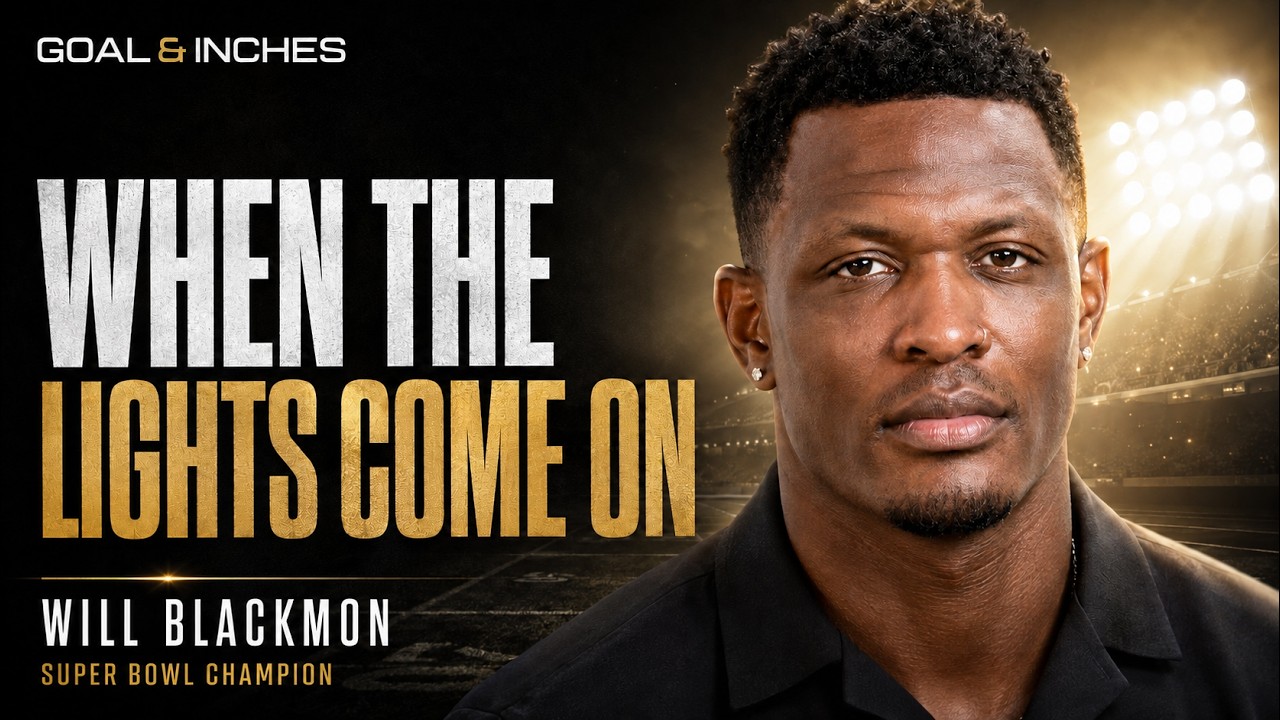
Will Blackmon spent a decade in the NFL, playing more than 100 games, including five in the playoffs, as a cornerback, safety and return specialist with the Green Bay Packers, New York Giants, Jacksonville Jaguars and Washington. Drafted by Green Bay in 2006, he shared a locker room with Brett Favre, Aaron Rodgers and Charles Woodson, and returned two punts for touchdowns against Minnesota in 2008.
His career included a serious knee injury, position changes, a season out of football and the ultimate triumph: winning Super Bowl XLVI with the Giants. Will takes us inside the punt he had to field in the Super Bowl just before Eli Manning’s famous throw to Mario Manningham, how a 7-7 Giants team locked in to win it all, and how he fought his way back into the league after a year away to play four more seasons.
He also shares what Charles Woodson taught him about preparation, what separates an elite coach, and what transfers from the gridiron to the boardroom in his business career today.
Key Moments
2:17 – Where Will felt the most pressure in his career
4:28 – The Super Bowl XLVI punt he had to catch before Eli Manning’s throw to Mario Manningham
11:58 – Brett Favre, Aaron Rodgers and Charles Woodson: what set the greats apart
16:24 – Two punt-return touchdowns against Minnesota, and the “first 10 yards” rule
19:00 – Coming back from an ACL reconstruction
22:58 – How the 7-7 Giants locked in and turned their season around
29:24 – A season out of the NFL, and how he fought his way back
32:24 – The fumble return that gave Jacksonville its first win of 2013
What This Conversation Teaches About Pressure
Stay on task. On the biggest stage, Will’s job was simply to catch the punt. Pressure moments are won by doing your job, not by trying to be the hero.
Take the first 10 yards. Forcing a big return led to bad decisions. Being decisive and banking the sure gain is what opened up the touchdowns.
Be a student of the game. Learning to study opponents the way Charles Woodson did slowed the game down, and the versatility to play corner, nickel, dime, safety and return extended his career.
Never be a victim. Out of the league after winning a Super Bowl, he called clubs himself, signed to keep playing and earned his way back.
Play for each other. When everyone is on the same page, pressure shrinks. The Giants’ playoff run came after players, coaches and front office decided to lock in together.
Read the full transcript
I've returned thousands of punts and kicks in my life and there was one I had to return in the Super Bowl. I just had to do my job. Just catch the ball. That football was in the air for about three hours. Okay. And it's funny cuz I'm I'm big on, you know, positive self-talk. You know, say great things to yourself, be and I literally told myself, I was like, if you drop this football, you cannot go back to New York City. I said you are not allowed and thank goodness I kept caught that football and held on to it. That's where you learn about yourself are in high pressure moments high stress situations.
Will Blackmon spent a decade in the NFL playing more than 100 games, including five playoff games. A substantial career in a league where longevity is never guaranteed. Drafted by the Green Bay Packers in 2006, he played cornerback, safety, and return specialist, sharing locker rooms with some of the greatest players of his generation. His career included serious injury, position changes, being released, a season completely out of the NFL, and the ultimate triumph, winning Super Bowl XLVI with the New York Giants. He then fought his way back into the league and played another four seasons. Today, we explore what that journey taught him about pressure, preparation, resilience, and performing when the margin for error disappears. This is Will Blackmon on Goal & Inches.
Will Blackmon, thank you for joining Goal & Inches. No, I'm so glad to be here. Appreciate that. I love talking football anywhere on Earth and clearly this is the case. Fantastic. Well, this whole show is called about defining pressure. So, why don't we start there? Your career was incredible in that it included multiple position changes. You had serious injury, though. There were releases and a season out of football and a Super Bowl run. Of all those moments, when did you personally experience the greatest pressure? And what did that moment demand from you that you weren't certain you possessed? During those times, what was the greatest amount of pressure? Oh man. I mean I you almost get conditioned where you kind of like thrive in the pressure moments. Just from myself growing up being a huge football fanatic. That's I was first and foremost a diehard football fan before I played the game of American football. And just seeing, you know, guys with the game-winning touchdowns and crucial situations making the game-changing plays like you always try to rehearse it on your own as a kid, but then to be in those moments, it's it's pretty cool.
I mean the biggest thing is your preparation as a person, as a team, as an organization to really rep out those moments and situations. But sometimes that's not enough, right? To be in the Super Bowl. Number one just seems impossible, right? And you're the only game on and people can say like, "Oh, it's just another game." No, it's not. And now once the game gets going and you're playing, yes, you know, you it's still first, second, third down, fourth down, still punt, special teams, all that stuff. But before the game, there are a lot of people on the sidelines. A lot of people. You know, I think I saw some celebrities on the sideline. Like you see everything and just even leading up to the game that during that whole week there's so much you're responsible for media-wise but once the game gets going you're fine but I will say that I've returned thousands of punts and kicks in my life and there was one I had to return in the Super Bowl and it was right before Eli threw that pass to Mario Manningham and I just had to do my job just catch the ball I didn't have to do a special return or nothing, just catch the ball.
And tell Andrew, that football was in the air for about three hours. Okay. And it's funny cuz I'm I'm big on, you know, positive self-talk, you know, say great things to yourself, be and I literally told myself, I was like, if you drop this football, you cannot go back to New York City. I said you are not allowed. And thank goodness I kept caught that football and held on to it. But you know that's where that's where you learn about yourself are in high pressure moments high stress situations you know where can you just stay on task. That's the hard thing is to just stay on task no matter what's going on. You know whether it's the first play of the game or the last play of the game. Like how do I stay on task? So that's really what it comes down with pressure moments.
Why don't we go back to the beginning and your time at Boston College? You established yourself as an outstanding cornerback and returner before moving primarily to the wide receiver position and you led the team with 51 receptions and 763 yards. What did succeeding on both sides of the ball reveal about your ability that you might not have discovered if you'd remained in that one position? Yeah, I think it just playing on both sides of the football. I think just reminded me that like I was a complete football player. It didn't matter what I did, where I was needed, I was able to step up and do my part, you know? I mean, growing up, that's when you played outside, you did everything, right? There was no like I'm only playing this side. We played everything. And it was the same thing in when I played youth tackle. It was the same thing when I played high school football.
When I was getting recruited out of high school, I just I was just telling a buddy of mine, I got recruited as a running back, I got recruited as a receiver, I got recruited as a defensive back. So, different team different schools like me for a specific role. So, ultimately, they call that if you see if you look at a recruiting website next to the name, you'll see a and that's just athlete. We're just going to recruit this kid as an athlete and we'll find what fits best for him. Ultimately when I end at Boston College, end up being a defensive back and return specialist. I always wanted the football in my hands and yeah, my senior year I was asked to switch to receiver. I reluctantly said yes and then it ended up working out. So I think just overall being a complete football player and it helped me because you know playing offense in high school and defense I learned you know what both sides are looking for and then playing defense and then going to offense I knew what the defensive backs were trying to do to me and I also understood the coverages better because I just came from that side of the football and I'll say too it didn't hurt having Matt Ryan throw me the football so that was pretty good.
So that's big decisions though when you're being recruited to go to college. How do you how did you land on which one was going to give you the opportunity that you wanted most? Gosh, you know what? One, you did a lot of listening. You know, you because everyone's getting recruited and multiple guys getting recruited in your position and all these schools are fighting to get the best players they can get. So, for me, it's just a it was just a matter of who was the most genuine, who really had a true plan for me. I would say there were a good handful of schools that I really liked and that I felt that they were being genuine, but there was something just there was something special about going to Boston College. They were my first offer and they recruited me very hard the first day and very hard to the very end. So, for me it was cool to feel like that. Yeah. And it just to me it just made sense. And also they played against top competition at the time. Before the ACC, the conference was called the Big East and you had the University of Miami, Virginia Tech, Pittsburgh, West Virginia, you there's a lot of talented schools in that division. So that's ultimately what it came down to.
And so in that sort of environment, you mentioned Matt Ryan and there was a ton of other future NFL stars at Boston College. What did competing with that level of talent every day demand from you? And when did you first know that you belonged in that same professional conversation? You've seen at college or in the pros? At college. Yeah. I just always well I played early. They had me play early. I was a 17 year old freshman. Really threw me out there. And at the end of the day, it just came down to football. And that's something I just I knew how to do well. I didn't really think of I didn't really think of professionals until there was a magazine that came out I think after my sophomore year called Sporting News and I was on the cover and I was like oh shoot like this might be legit you know if they looking at me like a potential prospect like maybe this is the real deal you know so I kind of thought about that after my junior year and also too you know it helps too when you're playing against competition like guys who are getting scouted and you're going against them and you're having success, you're like, "Okay, you know, if I'm having success against a potential draft prospect, then you know, for sure like I must be on the list eventually."
So at college earned all conference honors at cornerback and returner going into the NFL then a decade into your NFL career you moved to safety and produced one of your strongest seasons. What enabled you to perform at such a high level in different roles? You know I think for me it was I always had an high I had always had a very high IQ for football. That's because I played it so much. I played multiple positions. But the biggest thing I learned in the NFL is that you really had to be a student of the game, especially if you wanted to play a long time because if you became a student, you knew what to do, you were healthy, my coaches trusted you more. So, I was always in a situation like the more you can do. You know, when I was in college, I played corner, receiver, returner. When I got to the professional level, I was just a cornerback. But then, you know, I really wanted to get in the field. So, I learned how to study and learn how to play nickel and then I learned how to play dime. Then I learned how to play safety. So that I ended up being very versatile and when it came down to making the team, when my name came up on the table, they're like, well, he could play multiple positions, so that's value for our team. And that's where that's kind of where it was. And I'm glad you said that. I thought I had a pretty like productive year in Washington my senior year. I go I sit back and look. I'm like actually I didn't do I didn't do too bad. Yeah, I got really comfortable and I was so excited to play safety again the next year, but obviously that didn't happen.
So let's just go back to being drafted. You went to Green Bay and that locker room had Brett Favre, Aaron Rodgers, Charles Woodson when nearly everyone in an NFL building is talented. What precisely separated those players and which of those behaviors did you deliberately incorporate into your own preparation? Yeah, it's crazy, right? You walk into a locker room and you go from college and you got like four Hall of Famers just sitting there in your locker room, which is pretty wild. I think what separated them from everybody else, I think they were just fearless. They had a different edge, a different vibe about them. And when the lights came on, they showed up. That's all that mattered. When the lights came on, they performed. You know, you can be the, especially in professional sports, you can be the hardest worker. You can be the first one in the building. You can be the last one out. You can work as hard as anybody else. You can eat all the healthy things. You can do everything you can to give yourself the best chance to perform. But at the end of the day, you still have to perform. And these guys day in and day out, you know, they went out there and performed. They just had this edge, this swagger, this mindset about them to the point where like if you look at them, you're like, "Okay, I have I think we have a good chance by looking at them." And I think that's that's what really separated them.
So, you were drafted the year after Aaron Rodgers, and he obviously had to spend several years behind Brett Favre. While you were fighting to establish your own role, what did you observe in the way that Rodgers prepared for an opportunity with no guaranteed arrival date? Yeah, I mean I think he was just efficient, you know, he changed his throwing motion. He used to be high up here, then he came more like traditional and also from able to throw from the hip. But I think just him being behind Favre and knowing that there was even though he was a backup and he was learning things, there was still competition. I think coach Mike McCarthy is a good quarterback developer, a good quarterback coach. And I think that was the thing. He just really got to sit back there and honestly I think that was the best thing for him is like there was no pressure on him. I knew he had an edge because he thought he should have been drafted higher in his draft, end up getting drafted later. But I think everything worked out for him. He, you know, came from Cal, had to wait a while in the first round, goes to a place where he doesn't have to immediately step in and be the guy, get to develop, get to train, get to learn, you know, learn behind a Hall of Famer. How many get to say that they did that whether he took a lot of things or not. So, just to watch him be consistent. And then when Favre got traded and we kind of felt like Aaron's ready, we knew he was just seeing him every day in practice. We a lot of times we would go into games and the other team's backup was not better than I mean other team starter was not better than our backup. It was Aaron Rodgers. So that was just like it was a dream to have those two as your quarterbacks.
Of all the elite players you competed alongside, who directly raised your own standard and what did that player see or demand from you that changed the way you approached your career? I would say it was Charles Woodson. Because I was a fan of him growing up and then to watch him every day, the way he prepared, the way he practiced. Sometimes he didn't even practice, but the way he prepared and watched film and studied and the way he was able to put himself in position to make plays. That was the biggest impact on me because everybody in the NFL is good. Everybody's good. Everybody has they everyone has some elite level of ability that helped him get into the NFL to begin with. But it does come down to situations and he was able to really study breakdown opponents and put himself in position to make plays. And the first like four years of my career, I didn't really know how to study. I was just trying to play and react. And that's not good enough because teams are scheming against you. Even though I had success at returning, that was obviously a little bit different. But then once I really learned how to prepare and study my opponent and really break down what's happening, my mind slow down. I was able to see things faster. I was able to make more plays and essentially able to extend my career. So I think just watching him and learning from him how he prepared that was the biggest blessing for me in my career.
Can we just on that punt returning is a little bit different. Just explore that a little bit further. So in 2008 you returned punts of 76 and 65 yards for touchdowns in two different games against Minnesota which tied Green Bay's franchise record three punt return touchdowns in those split-second moments. How did you read what was developing and know when to commit? Yeah. Well, I learned it was this is funny. So, the first punt return against the Vikings was Monday Night Football. And at the time, my wife was my girlfriend. She's never seen me play. So, you know, sure, do I want to try to do something special? I'll try, but you know, nothing's guaranteed. So, I was really trying to force I was really trying to force and score a touchdown, and I was making terrible decisions. And they were like, "What's wrong with this kid?" Like, "What is he doing?" You know? So, remember I go to the sideline and former Packer player Robert Brooks comes up to me and he says, "Once you feel the once you catch the punt," he said, "Just get the first 10 yards cuz two things. One, it's essentially a first down, right? You're moving forward. You're getting good field position. Two, if you're averaging 10 yards a return, you're probably going to be top in the NFL in terms of the leaders. So, he said, "And after that, you know, see what happens."
So, I catched the punt, get a little bit of yards, catch the next one, and I was like, "All right, I'm just not going to think about anything. I'm just going to get put my foot in the ground and get 10 yards." So, I go get 10 yards, and then it's 20, and then it's 30. And then I'm like, "Oh my gosh, like I'm gone." So that was the thing I learned was when you catch the punt, you got to be decisive and, you know, get immediately get the first 10 yards cuz that's a 10 yard return is a an extremely positive return. And then if you happen to get more, that's great, but don't go backwards. Don't, you know, make good decisions back there. So that was the thing for me was just to get the first 10 yards was the biggest thing I remember returning punts. Do you think that's a mindset that all punt returners have or is that something that I think they're told to get vertical, get north, but not really understanding why. Just okay, let me just get run forward. Well, yeah, but I had a goal and they think I had a Goal & Inches. That's what I had. Very nice.
If we go back to your ACL injury and the reconstruction, it wasn't properly repaired and that put your career in, you know, I guess genuine jeopardy. But the Giants supported the corrective surgery that allowed you to return. What decisions did you have to make medically, professionally, psychologically to prevent that setback from defining the end of your career? Man, that is I don't know. I felt like I got this far that this can't be the end. And I was very fortunate that I got to be around some very smart, supportive people to help me bounce back and recover. And that was the thing I just I always felt like somebody has been I always tell myself somebody has been in a worse situation than me and overcame it. You know, like someone has some Yeah, I had an ACL, someone maybe had two ACLs, maybe someone had an ACL, a tear, a break, and they came back. So that was the thing for me, but I was relentless in terms of finding a way to make sure that I can get back to how I am. And so to have the Giants pay for my reconstructive surgery, to meet Gavin MacMillan, at Sports Science Lab, who is I think is an absolute wizard in terms of his training and style, all these doctors all over the country that I went to go see like on my team to help me. I think that was the thing. And then also too, the biggest thing too is my supportive like wife and family. Like they were she was never like why us? She was never negative. She was always positive, always looking forward to the next opportunity. I was the one like being a baby about it, but you know, I had a I have a strong household. So, that was a big thing, too. So, I had a lot of support. That was big. Otherwise, I don't know where I'd be.
Let's have a look at the Green Bay to Giants transition in 2007. You were part of a 13-3 Packers team whose season ended at Lambeau against the Giants. It was the NFC Championship game. And four years later you were their 9-7 Giants as they entered the playoffs as underdogs and went on to win the Super Bowl. Looking back, had you learned anything about handling pressure by 2011 that you did not yet understand in Green Bay? No, I felt like I went to war with Green Bay in those four years. So, we had a team that was ready to go. I think pressure is fun. Pressure is fun. That's That's where you That's where you really learn about yourself. You really do. You know, it's it's no fun when it's when it's always easy. You know, you're always winning easily. Like, I like challenges. I like when it's a little bit difficult. I like when I have to, you know, go through another level. But that's the beauty of it being a team sport. You know, when everyone's on the same page and when everyone starts playing for each other, it really helps minimize the pressure. You know, when you start playing for yourself, you start doing individual things. You're not when you're not focused on the team anymore, then yeah, you put pressure on yourself. But when I got people who believe like me, who think like me, who work like me, who train like me, who want to win like me, it kind of it becomes so chill. When we went to the playoffs for the Giants, we just felt good every game. We did. I don't think we I don't think we felt stressed out one time. Maybe when we played the 49ers cuz it went to overtime, but we felt good going into that game. So that's it. I think you just, you know, when you look at it like that, like pressure, that's exciting. That's the fun part because now you really get to find out who you are and that's cool.
So that's fascinating. Let's just go back to that Super Bowl run though. The Giants fell to 7-7 after losing at home to Washington and Tom Coughlin's future was being openly questioned. You'd fought through surgery to get back into that locker room. What did you see and what responsibility did you feel as the team faced the possibility that its season was slipping away? I think what happened was is I think the coordinator, Perry Fewell, our defensive captains, we all decided to get on the same page. I think sometimes maybe we had too much in the play call sheet. Maybe some guys were trying to do their own thing. And I think it came down to like look, let's find a way to link up and get together. Like that's important. And that was the biggest thing. We really came together as a team. And that sounds so cliche and boring, but that's really what happened. Our leaders and our captains, our veterans, our younger guys, we all just we all had decided to lock in like, "Hey, man, like we have such a good thing here. Like, let's let's get it together and get this going, you know?" and that's what it was. We just finally just got the same page, not just the players, but the coaches, the front office. We all just like locked in was like, "Hey, let's get these games and let's go to the playoffs and win a division." That's what happened.
So you had that mindset and then you open the postseason by beating Atlanta 24-2 and didn't concede an offensive point. Was there a moment during that game that you sensed you've moved from mindset and this team was becoming more dangerous than that 9-7 record suggested? Yeah, I mean after that dominant win, I mean I thought once we got to the playoffs like it was a fair game. Like it didn't matter what your record was. Like let's go. You know, we had a home game to start which was great. And I just felt like with how our team was designed, we had a really tough offensive line. We had a really tough defensive line. We had a really tough We had a really smart linebacking crew and a really gifted secondary. Our running backs were absolutely physical and dominant. You know, we had really tough receivers. And we had Eli who I think is the toughest quarterback ever. Just he just is so locked in. So I think our team was just built for battle. That's just what it was. So that was the thing that was cool. I never looked to the left or the right and was like, "Oh man, I don't know what we're going to get." I knew every guy was going to bring it. Our coach was disciplined. Our coach Coughlin was tough. He was on it. And we just had a team that was built for what we went through.
So fascinating though. Then you then returned to Lambeau. You mentioned you went to war with Green Bay and now you're facing a 15-1 Packers team that had beaten you earlier in that season. Did your four years in Green Bay change the way you prepared for that game? And if so, how? No, it didn't because it wasn't about Green Bay, Andrew. It was just like another game. Let's go. We're going to Lambeau. It's cold. They beat us last time at our stadium. Let's go there and get a win. And we went in there and did that. So, we were just on a mission. It didn't really matter who was there. We didn't even look at the opponent like that. We respect everybody, but our I think just based on how the veterans were going, we were just ready to go and we had such a phenomenal defensive line that just made it tough for everybody.
So earlier you mentioned maybe the only time you felt that pressure was the NFC Championship game and that was against San Francisco in that home stadium. You returned three punts and made two fair catches that night while San Francisco had two fumbles in the game that ultimately changed the direction of the game. From a returner's perspective, what happens to your decision-making when every kick could end the season? Yeah, you just be smart. You know, again, the biggest thing is don't try to be the hero. Like, being a hero is just doing your job. Especially when you have a very productive offense like Eli and Victor Cruz, they were so locked in that day. And it just comes out as just literally, it sounds so silly, sound boring, but just do your job. That's all we ask. And if other things happen beyond that, cool. So, especially, yeah, it's more glaring when he's messing up a lot. And so, I'm like, let me make sure I do my job and don't look like that cuz, you know, that did cost him the game. So, yeah, it's a constant reminder that it's an honor that they trust me to be the guy back there fielding those punts and kicks. So that's what if they feel comfortable putting me back there on this phenomenal team, then that's an honor to have.
So you've overcome adversity as a team and you've made the Super Bowl and you're playing Tom Brady, the New England Patriots. You enter the game as an underdog. How do you personally process that underdog status? And what did the Giants do during Super Bowl week that allowed you to carry the magnitude of the occasion without being consumed by it? Well, I'm sure we were the underdog, but I think because the 2007 team beat the Patriots, they felt good. They knew exactly what they had to do. It was the same. It was the same. They had a little They had a couple more talented people, but it was kind of like we know this team. We just played them not too long ago. We feel good about it. And so, we were just we were ready to go. You know, the night before, Coach Coughlin gave us a speech about just how much he really loved us. It wasn't so much about the Patriots. Was more so about us, the sacrifices, the things we did to be there for the team and he really just poured his heart out to us. And for us after hearing that it was like okay, we're like not going to lose tomorrow. So we went into the Super Bowl Sunday just feeling good. We felt confident. We felt loose. We didn't feel nervous. We didn't It was just like let's go win this game. That's what happened.
You mentioned earlier that you took a punt just before that final drive and you're now on the sidelines. From your position on the Giant sideline, what did you observe in Eli and the team that showed you they were prepared for that moment rather than simply hoping to survive it? I think just knowing just get the ball back to Eli, man. Like at the end of the day, that's it. You're going to hear this common theme is literally just it was just do your job. Just, you know, don't do any extra. Make sure you have good feet, see the ball, catch it, and make sure they get it back. And that was the biggest thing.
So, after reaching the pinnacle and winning a Super Bowl, you spend the following season out of the NFL. Did you ever think your playing career was over? Take us through that journey that brought you back in 2013. Yeah, it was tough that year. I was out. You think after winning a Super Bowl like okay I'm going to be a hot commodity on the market you know somebody will want to pick me up and that hap that was not the case so I ended up taking the initiatives in my own hand and started calling clubs myself and was like hey you know I'm trying to get an opportunity you know nothing worked out eventually I got through to the Seattle Seahawks because the general manager there was John Schneider was a scout on the Packers when I was there so it was around November I believe he agreed to have me come work out for the team to put me on the short list and so they worked me out. The Raiders also worked me out. Nothing happened, but at least now the league knew that I was available. I end up signing an arena contract or indoor football contract and cuz I just wanted to play. And I never end up going to play for them because when I had to report to that team, the Seahawks called me and signed me after the season. So, that's how I ended. I never went to Arizona to play for the Rattlers. I went straight to Seattle.
So, again, that's just my whole mindset is I'm never a victim, right? I'm never a victim if I'm if I don't like the way something is like to go do something about it. I don't think anything's ever fair and I'm like that's fine because I like to compete. I like to work. I like to find out and figure and solve problems. So, especially when it has to do with me and my career, you know, it's different. Like, I'm trying to help my kids or help somebody else, other players. But when it came down to me, I know what I want. I know what I need to do. I know what I need to handle. I know like I am in complete control. And so, that's the thing is I just never I never felt sorry for myself. Yeah. I would I can I will be down and upset. That's normal. That's that's human, you know. But there will be times where I snap out of it. It's like, "All right, let's go. Let's go make something happen." and keep fighting, keep finding ways, keep, you know, looking for resources. You know, I've done every type of treatment, anything you can think of to try to get myself feeling better. And just having that mindset of like, I can still do this. I'm still young. I still have a whole career ahead of me. I just kept naturally just fighting to do that and I think that helped me.
So talking about that fighting mindset in 2013 with the Jaguars still searching for their first win. You sacked Ryan Fitzpatrick, forced and recovered the fumble and then returned it 21 yards for a touchdown that sealed the victory. After a season out of the NFL and a roster cut, what did that moment mean to you? Oh, that was huge because I went to when I went to the Jacksonville Jaguars. It was a new it was a new head coach Gus Bradley, new GM, new uniform, new owner, new everything. And when you're trying to when you're trying to establish a team identity, you rotate a lot. So, you don't really have consistent starters every week. So, I was like, sometimes I was playing, sometimes I'm not. Sometimes I was on, sometimes I wasn't. So that game it was a lot of substitutions and I was kind of wasn't happy the way things were going but I just kept a positive mindset and then I remember I get the game towards the end and I they run that play and I go and you know make a crazy play like that. Well it felt great because it was a tough season. We were 0 and eight at the time right so that was our first win of the season. It was Gus Bradley's first win. I have that football over here somewhere. There it is. It's over there. In it's in a case right now. And yeah, it was great. It was phenomenal. Such a good feeling and I'm glad that the at that time the city of Jacksonville got to witness that. So that was a big deal.
Across your career, you played under Mike McCarthy, Tom Coughlin, Pete Carroll, Gus Bradley, and Jay Gruden. And you got to observe Sean McVay before he became a head coach. Having been coached through championships, injuries, position changes, and losing seasons, what separates an elite coach from someone who's simply knowledgeable about football? I think an elite coach, he is able to uplift everybody in the organization. An elite coach, everybody matters. He's able to get the best out of everybody. And it's genuine. That's truly what it is. You know, being with coach Coughlin when he started to open up more and reveal who he is as a person other than this hard, tough coach, that helped him. McCarthy is big on family that helped him. And another coach, he's all about everyone else. It's not about him and he's big on keeping in a healthy positive environment and holding each other accountable that helped him. Yeah, I just think those qualities are big. If you can impact someone else's life, if you can uplift those around you, that's what leaders do. Leaders are able to whatever way it is. It could be the It can be your multi-million dollar quarterback. It can be the grounds keeper. You matter because if I can get the best out of everyone, it's going to help us.
And looking back across your career, it doesn't necessarily need to be a head coach, but was there one coach that materially improved you the most? I would say when I was with the Seattle Seahawks, Kris Richard, he was the secondary coach. He was like the architect of the Legion of Boom, but he was really big on just I learned so much football from him. And just life and I think he was very instrumental in my career for that. And that was the biggest thing. I think he was the most impactful. I learned a lot from a lot of people, a lot of coaches, but I think he was really impactful in terms of what helped me have a very successful last five years of my career.
Last question, Will, if I may. I want to take a look from your business career perspective. Now, so during your football playing career, you were required to prepare for uncertainty, make decisions at speed, accept changing roles, and repeatedly prove your value. What specifically transfers from the gridiron to the boardroom? Is there one operating practice that an executive team could adopt on Monday, and explain how that should measurably improve them as a result? Yeah, I think the difference is if something goes wrong, you can't just tackle them, right? You can't do that now in business. But I think just kind of the things I just talked about as a head coach is understanding how to add value for everyone else. And you know, I think I did a pretty good job of developing relationships and networking and what have you. And then yeah, you're going to have a lot of nos and not you know, versus people saying yes where things going to work out. So I think it's important to prepare in terms of doing your homework and understanding what's going on. But be a student you know I did not I don't have a business background so I had to be a student from here on out I went to a lot of seminars a lot of clinics a lot of met a lot of mentors a lot of workshops a lot of networking events and then I had to take a leap of faith and leap of faith and just go you know don't don't be afraid and that's kind of because those are things I took from football I think me going through my experiences of having to work extremely hard to get back on the field. I was able to use that or I still use it today in business.
Will Blackmon, congratulations on a magnificent career and your portfolio approach to business today. Thank you for joining Goal & Inches. Thank you so much, Andrew. I really appreciate it. Thank you. Will Blackmon's career is a reminder that performing under pressure is rarely about doing something extraordinary. It is about preparation, adaptability, staying on task, and when circumstances move against you, taking responsibility for what you can control. From fielding a punt in a Super Bowl to fighting his way back into the NFL after a season out of the game, that principle remains remarkably consistent. Do your job, keep moving forward, and be ready when the opportunity arrives. If you found value in this conversation, subscribe to Goal & Inches for more conversations with people who have performed when the margin for error is at its smallest. Thanks for watching.
More Pressure Tests
Episodes